
Transients and Damping — How Audio Performance Is Measured
Why frequency response alone cannot explain speed, control, dynamics, imaging, resolution, or musical realism.
Audio reproduction is often reduced to frequency response: how evenly a component reproduces bass, midrange, and treble. That measurement is fundamental, but it describes primarily steady-state amplitude. Music is not steady state. It is a sequence of rapidly changing waveforms whose timing, intensity, harmonic structure, and spatial relationships must survive the recording and playback chain.
Two systems can measure similarly across the audible band and still sound substantially different because of transient behavior, damping, resonance, phase response, distortion, noise, dynamic compression, and interaction with the room. These attributes explain why one system sounds immediate and organized while another sounds blurred, slow, or mechanically reproduced.
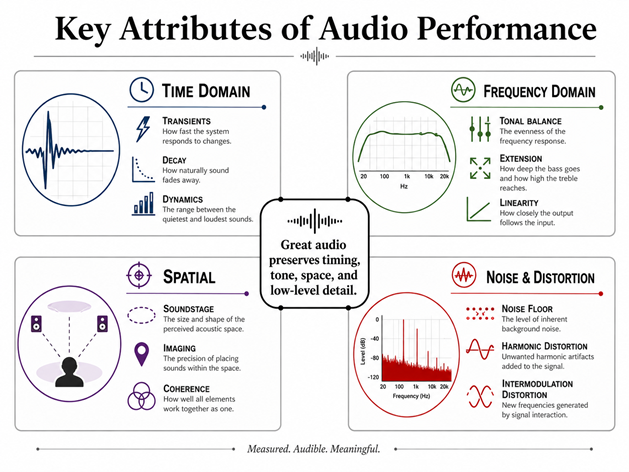
Figure 1. Audio quality is multidimensional: time, frequency, spatial behavior, and noise performance must be considered together.
Transient Response: Reproducing Change in Time
A transient is a short-duration event involving a rapid change in amplitude. Drum strikes, piano attacks, plucked strings, vocal consonants, and the opening bite of brass instruments are familiar examples. A sharp transient contains energy across a broad frequency range, so reproducing it accurately requires adequate bandwidth, low stored energy, and reasonably consistent phase behavior.
Transient performance is examined with impulse and step responses. An impulse response shows how a system reacts to a very brief stimulus; a step response shows its reaction to an abrupt level change. Rise time, overshoot, ringing, polarity, and settling time reveal whether the system follows the input or adds time-domain artifacts. Restricted bandwidth rounds the leading edge. A resonant driver, crossover, enclosure, transformer, or digital filter can overshoot and continue oscillating after the stimulus has ended.
Listening Link
Words such as fast, snappy, immediate, articulate, and incisive generally describe audible consequences of clean rise time and rapid settling — not simply elevated treble.
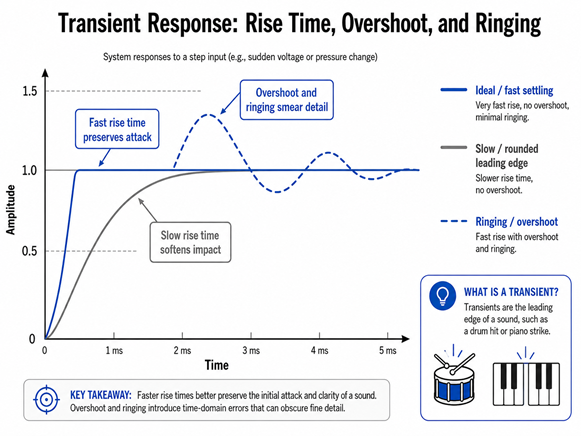
Figure 2. A fast but controlled response preserves attack. Slow rise time rounds the event; overshoot and ringing add energy that was not in the signal.
Damping, Driver Control, and Stored Energy
Damping is the control or dissipation of energy after a system has been excited. In a loudspeaker, the cone, suspension, voice coil, cabinet, port, crossover, amplifier, and room can all store and release energy. Ideally, the driver follows the electrical waveform and stops when the waveform stops. Mechanical inertia and resonance make that behavior imperfect.
Electrical damping is commonly expressed as amplifier damping factor, approximately the loudspeaker impedance divided by amplifier output impedance. A low output impedance permits greater electrical braking of the voice coil, especially near resonance. The published number is not the complete system value, however. Cable resistance, connectors, crossover inductors, and the speaker's frequency-dependent impedance reduce effective damping; therefore extremely high specifications often produce diminishing practical gains.
Mechanical and acoustical damping are equally important. Suspension losses, cone material, cabinet rigidity, enclosure volume, and port tuning influence how resonances decay. Parameters such as Qms, Qes, Qts, and the completed system Q describe portions of this behavior. A higher-Q bass alignment can emphasize output near resonance but may decay more slowly. A lower-Q alignment usually sounds tighter, although excessive damping can reduce perceived warmth or weight.
Key Distinction
Well-damped bass is not merely less bass. It preserves the separate attack, pitch, body, and termination of each note. Under-damped bass allows one event to persist into the next.
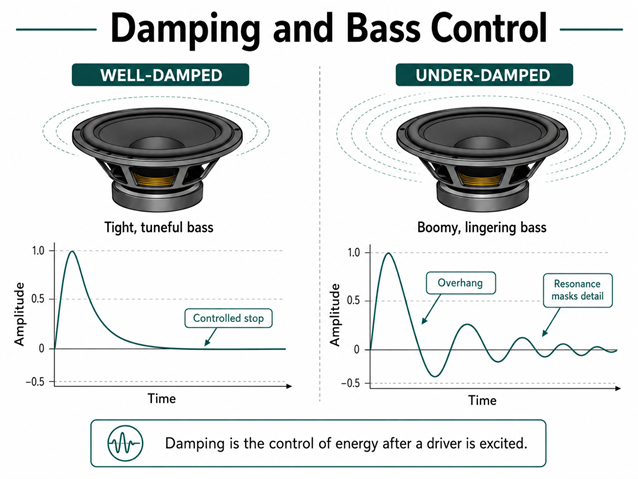
Figure 3. Damping determines how quickly energy settles. Lingering oscillation creates bass overhang, masks pitch information, and weakens rhythmic definition.
Decay, Resonance, and the Listening Room
Every instrument has a natural decay pattern, and the playback system should preserve that decay without adding unrelated ringing. Waterfall plots, cumulative spectral-decay graphs, and spectrograms reveal energy that remains after a test signal ends. A narrow resonance can appear modest on a conventional frequency-response plot yet remain audible because it decays slowly. Tweeter breakup, cabinet panels, ports, and crossover regions can each produce a recognizable coloration.
Below the room's transition region, the room is frequently the dominant source of overhang. Standing waves create modal peaks and nulls determined by room dimensions, loudspeaker placement, and listening position. A note aligned with a strong mode may continue far longer than neighboring frequencies. Frequency-dependent decay measurements are therefore more useful in a domestic room than a single full-range RT60 number. Placement, bass trapping, equalization, and multiple subwoofers can improve modal behavior. Apparent amplifier looseness may actually be room resonance.
Dynamics, Crest Factor, and Compression
Dynamic performance is the ability to reproduce level changes without compression, clipping, or noise masking. Macrodynamics describe large contrasts, such as a kick-drum impact or orchestral crescendo. Microdynamics describe smaller variations in phrasing, bow pressure, percussion texture, and instrumental emphasis. Crest factor — the difference between peak and average level — determines how much short-term voltage, current, excursion, and thermal capacity the system needs.
A system can play loudly while sounding dynamically flat. When amplifier voltage, current, power-supply capacity, or loudspeaker excursion is exceeded, peaks are compressed or clipped. Voice-coil heating causes thermal compression: resistance rises, sensitivity falls, and crossover behavior may shift. Dynamics concern contrast, not merely sound-pressure level.
Distortion, Linearity, and Resolution
Total harmonic distortion quantifies harmonics added by a nonlinear device. Intermodulation distortion describes unwanted products created when several frequencies interact. Low-order harmonics can be comparatively benign, while higher-order products and intermodulation components are often more objectionable because they create spectral content unrelated to the music. A single THD figure at one watt and one kilohertz cannot fully characterize a device; distortion spectra, multitone testing, compression measurements, and reactive-load tests are more revealing.
Resolution is the preservation of low-level information. It depends on linearity, low noise, transient accuracy, channel separation, and freedom from masking resonances. Boosted treble can create superficial detail, but real resolution exposes instrumental texture, ambience, and reverberant decay without forcing those details forward.
Phase, Group Delay, and Coherence
Frequency response describes amplitude versus frequency; phase response describes timing versus frequency. When frequency components arrive at different times, the waveform changes shape. Group delay expresses the delay affecting particular bands and is especially relevant around crossovers, bass-reflex tuning, low-frequency resonances, and digital filters.
Perfect phase linearity is not required for excellent reproduction, but severe phase rotation, poor acoustic-center alignment, or delayed bass energy can weaken transient coherence. Driver integration, matched directivity, crossover topology, and room reflections influence whether bass, midrange, and treble are perceived as one event or as separate sources.
Imaging, Noise Floor, and Transparency
Stereo imaging depends on channel matching, phase consistency, low crosstalk, speaker symmetry, and controlled early reflections. Small level or arrival-time differences can move an apparent source, so stable imaging reflects both equipment accuracy and careful setup. Soundstage describes perceived width, depth, height, and ambience; imaging describes the precision and stability of sources within that space.
Noise performance is described by signal-to-noise ratio, dynamic range, and sometimes SINAD, which combines noise and distortion. A low noise floor preserves quiet reverberation, spatial cues, and note endings. The familiar “black background” is not merely silence between notes; it increases contrast between musical information and residual noise, allowing images to appear more distinct and decays to remain audible longer.
Conclusion
No single measurement defines audio quality. Convincing reproduction occurs when energy begins at the correct instant, reaches the correct level, retains its harmonic and spatial structure, and decays without added resonance. That is the engineering foundation behind descriptions such as fast, controlled, transparent, dynamic, coherent, and lifelike.
Keep Reading
What Really Happens When You Change Moving-Coil Cartridge Loading?
What does phono cartridge loading actually change? A real-world comparison of 200Ω and 500Ω using a Benz Micro Wood SM moving-coil cartridge into a Conrad-Johnson ET6SE.
Mastering Matters More Than the Format
Why the same album can sound completely different across pressings — and why the mastering engineer may matter more than whether you're playing vinyl, CD, or streaming.
Why Dynamic Range Is the Most Important Audio Quality Metric in 2026
Discover why dynamic range has become the defining characteristic of great sound in 2026. Compression, mastering, streaming, and vinyl — examined through the lens of musical realism.
Vinyl Pressing Quality in 2026 — Warps and Plants to Avoid
Why are new records warped or noisy? Learn how vinyl pressing defects occur, which plants deliver strong quality control, and which deserve caution in 2026.