
Why Dynamic Range Is the Most Important Audio Quality Metric in 2026
In 2026, listeners are rediscovering what truly brings music to life. It's not louder. It's contrast.
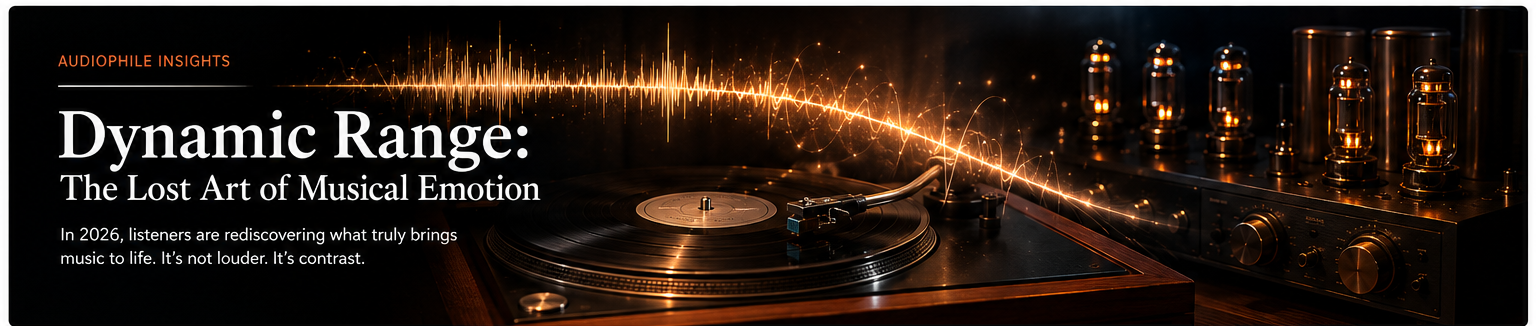
For decades, the recording industry chased a single objective: louder. Mastering engineers compressed dynamics, raised average levels, and sacrificed the very contrast that gives music its emotional weight. The result was a generation of recordings that measured well on paper but sounded flat, fatiguing, and lifeless on quality playback systems.
In 2026, that era is finally receding. Streaming normalization has eliminated the competitive advantage of hyper-compressed masters. Vinyl's resurgence has reintroduced listeners to analog mastering philosophies. And a growing community of audiophiles, musicians, and engineers are rediscovering what the human ear has always known: dynamic range is the foundation of musical realism.
1 — The Loudness War

For years, music became louder and louder. Compression reduced peaks, crushed dynamics, and stripped recordings of their natural emotional impact. The logic was simple: louder sounds better in casual comparison. Radio stations, CD players, and shuffled playlists rewarded the track that hit hardest at first listen.
But compression doesn't make music better. It only makes it louder — while removing the very contrast our brains crave. A whispered vocal followed by a full-band explosion creates emotional impact. When both are the same level, the explosion means nothing.
Compression doesn't reduce peaks — it removes emotional contrast.
2 — How Our Brains Hear Music
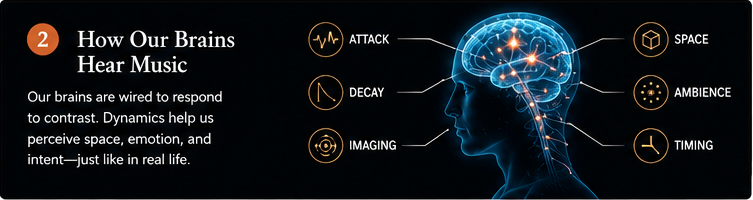
Our brains are wired to respond to contrast. Dynamics help us perceive space, emotion, and intent — just like in real life. When someone whispers, we lean in. When a door slams, we flinch. Music operates on the same neurological pathways.
Attack, decay, imaging, space, ambience, and timing — these are not luxury audiophile terms. They are fundamental aspects of how the human auditory system interprets sound as meaningful. A recording that preserves these qualities feels real. One that compresses them into uniformity feels synthetic, regardless of how expensive the equipment reproducing it.
3 — Streaming Has Changed Everything
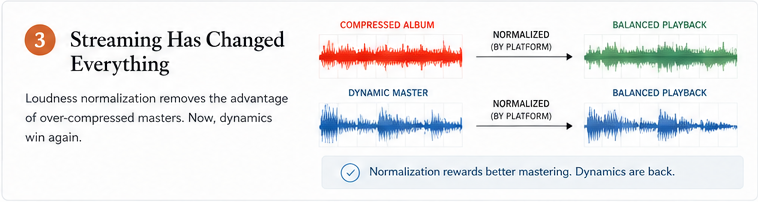
Loudness normalization has fundamentally altered the economics of mastering. Spotify, Apple Music, YouTube, and Tidal all normalize playback levels. A hyper-compressed master is turned down by the algorithm; a dynamic master is turned up. The result: both play at similar perceived loudness, but the dynamic master retains its contrast, depth, and emotional range.
The loudness war's competitive advantage has evaporated. In 2026, normalization rewards better mastering. Dynamics are back — for those willing to listen.
✓ Normalization rewards better mastering. Dynamics are back.
4 — Vinyl Isn't Magic. Mastering Is.
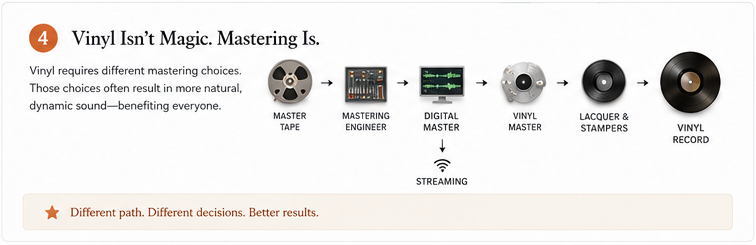
Vinyl requires different mastering choices. The physical limitations of the format — groove width, inner-groove distortion, cutting-head resonance — mean that a vinyl master cannot simply be the same file sent to streaming services. A dedicated vinyl mastering session often results in wider dynamic range, less limiting, and more careful low-frequency management.
Those choices often result in more natural, dynamic sound — benefiting everyone who listens to the vinyl pressing. But the format itself is not magic. The mastering decisions are what matter. A vinyl cut from a brick-walled digital master sounds no better than streaming the same file.
★ Different path. Different decisions. Better results.
5 — Micro vs. Macro Dynamics
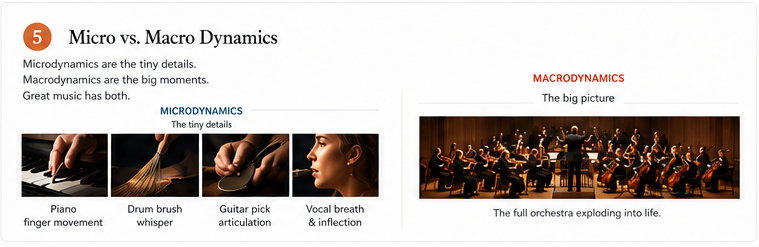
Microdynamics are the tiny details — piano finger movement, drum brush whisper, guitar pick articulation, vocal breath and inflection. These are the textures that separate a recording from a performance. They require low noise floors, clean transient response, and freedom from compression to remain audible.
Macrodynamics are the big moments — the full orchestra exploding into life, the kick drum that hits your chest, the chorus that lifts after a quiet verse. These require headroom, power supply capacity, and speaker excursion to deliver their full physical impact.
Great music has both. Great playback reveals both. And great mastering preserves both.
6 — What Compression Looks Like
Natural Snare Hit
Compressed Snare Hit
The visual makes it obvious. A natural transient has a sharp initial attack followed by a decaying tail that contains spatial information — the sound of the room, the resonance of the instrument. Compression squashes that peak and raises the tail, producing a uniformly loud event with no shape, no space, and no life.
7 — Audiophile Mastering vs. Commercial Mastering
Commercial Master
- Heavy EQ
- Multi-band compression
- Brick-wall limiting
- Clipping
- Normalization to max level
Goal: maximum loudness
Audiophile Master
- Original tape source
- Minimal EQ
- No clipping
- Wide dynamics preserved
- Dedicated vinyl cut
Goal: musical truth
8 — Your Stereo Is Telling the Truth
Bluetooth Speaker
Sounds OK. Compression is invisible because the speaker can't resolve detail anyway.
Mid-Fi System
Better detail. Dynamic differences begin to emerge. Good recordings sound noticeably different from bad ones.
Reference System
Reveals everything — good and bad. Compression becomes audible. Dynamic masters sound three-dimensional. Poor masters sound flat and lifeless.
A reference playback system does not make bad recordings sound good. It reveals the difference between recordings that preserve dynamics and recordings that destroyed them. The better the system, the more dynamic range matters.
9 — A Listening Exercise
Try This Tonight
▶ Put on your favorite album.
▶ Turn the volume down slightly.
▶ Close your eyes.
▶ Listen only to the silence between notes.
▶ Notice how realism appears.
Dynamic range is not what you hear during the loud parts. It's what you hear during the quiet ones.
The Verdict
Music Isn't About Loudness.
It's About Contrast.
Dynamic range is the space where emotion lives. Protect it. Seek it. Demand it.
Keep Reading
Mastering Matters More Than the Format
Why the same album can sound completely different across pressings — and why the mastering engineer may matter more than whether you're playing vinyl, CD, or streaming.
Aja Breathes; Gaucho Merely Has Excellent Manners
Why Steely Dan's 1977 masterpiece Aja remains sonically preferable to its immaculately upholstered successor Gaucho. Gaucho is perfection completed; Aja is perfection kept alive.
Why Do Different Vinyl Pressings Sound Different? Mastering, Matrix Numbers & Pressing Plants Explained
Two records can contain the same album and still sound conspicuously different. Learn why mastering, lacquer cutting, metalwork, and pressing plants all leave an audible fingerprint on vinyl.
Best Audiophile Vinyl Reissue Labels in 2026: Who Actually Makes the Best-Sounding Records?
We don't rank the packaging. We rank the records. A tier-based evaluation of Analogue Productions, Mobile Fidelity, Speakers Corner, Tone Poet, Impex, Intervention, and more — judged by mastering, pressing, and real-world listening.