
Best Audiophile Vinyl Reissue Labels in 2026: Who Actually Makes the Best-Sounding Records?
We don't rank the packaging. We rank the records. A tier-based evaluation of the labels competing for your audiophile dollar — judged by mastering, pressing, and real-world listening.
The Question Nobody Answers Honestly
You have read enough about vinyl to understand that weight doesn't determine fidelity, that first pressings aren't automatically superior, and that mastering matters more than the format. You understand that AAA provenance is not a guarantee of better sound.
So now the practical question: whose reissues should you actually buy?
The audiophile vinyl market in 2026 is crowded. Analogue Productions, Mobile Fidelity, Speakers Corner, Blue Note Tone Poet, Craft Recordings, Rhino High Fidelity, Intervention Records, Impex, and others are all competing for your shelf space and your money. Prices range from $30 to $150 per disc. The marketing promises are uniformly superlative.
This article cuts through the mythology. We evaluate each label using the criteria that actually determine how a record sounds — not the sticker on the shrinkwrap.
Best Audiophile Reissue Labels at a Glance
| Category | Our Pick | Tier |
|---|---|---|
| Best overall (reference) | Analogue Productions (QRP · Kevin Gray) | Tier 1 |
| Best for jazz | Music Matters & Blue Note Tone Poet | Tier 1 / 2 |
| Best entry point (value) | Blue Note Tone Poet (from ~$30) | Tier 2 |
| Best without paying $75+ | Speakers Corner (Pallas) | Tier 2 |
| Best for classic rock reissues | Intervention Records (Grundman / Gray) | Tier 2 |
| Research the title first | Mobile Fidelity, Rhino High Fidelity | Tier 3 |
The full tier-by-tier reasoning — source tapes, mastering engineers, pressing plants, and where each label stumbles — follows below.
How We Evaluate
Every label is assessed across five dimensions:
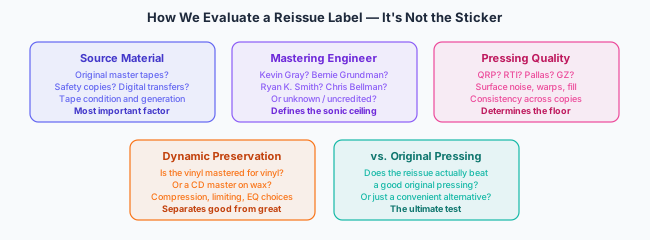
- Source material — Access to original master tapes is the foundation. Safety copies and digital transfers introduce generational loss or conversion artifacts.
- Mastering engineer — A named, experienced engineer (Kevin Gray, Bernie Grundman, Ryan K. Smith, Chris Bellman) operating a dedicated vinyl mastering chain is non-negotiable at this price tier.
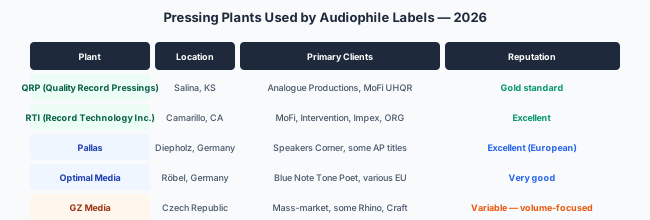
- Pressing plant and QC — Pressing quality varies enormously. QRP and RTI set the standard; GZ Media is volume-focused.
- Dynamic preservation — Is the vinyl mastered for vinyl? Or is a CD master being transferred to wax with no accommodation for the format?
- Does it beat the original? — The ultimate test. If a $50 reissue doesn't meaningfully outperform a $15 original, the premium is not justified.
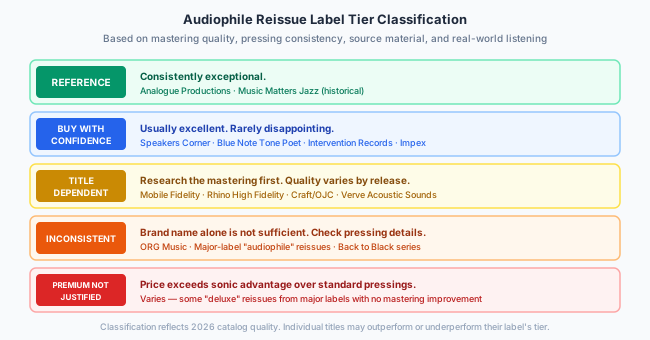
The Tier System
We do not pretend that every record from a given label sounds identical. Catalogs are deep. Engineers change. Source tapes vary in condition. But patterns emerge, and those patterns are what the tier system captures.
Tier 1: Reference — Analogue Productions / Acoustic Sounds
Founded: 1991 · Pressing plant: QRP (owned) · Primary engineer: Kevin Gray · Price range: $35–$125
Analogue Productions is the standard against which all other audiophile reissue programs are measured. Chad Kassem's operation controls the entire chain: mastering (Kevin Gray at Cohearent Audio), plating, and pressing (QRP, which Kassem owns). That vertical integration eliminates the communication gaps and quality-control failures that plague labels dependent on third-party plants.
The results are audible. AP's best titles — the jazz catalog (Coltrane, Miles, Bill Evans), the Classic Records acquisitions, the Acoustic Sounds Series — deliver reference-level dynamics, vanishingly low noise floors, and pressings that are flat, centered, and quiet. The 45 RPM editions exploit the format's inherent advantages with mastering that actually takes advantage of the increased groove velocity.
Why Reference tier: Consistently exceptional across hundreds of titles spanning decades. When AP misses, it's usually because the source tape was compromised — not because the mastering or pressing failed.
Best for: Jazz, classic rock, audiophile demonstration material.
Tier 1: Reference — Music Matters Jazz (Historical)
Active: 2007–2014 · Pressing plant: RTI · Primary engineer: Kevin Gray · Price range: $35–$50 (original retail; now $100–$300+ on secondary market)
Music Matters deserves inclusion as a historical reference point. Their Blue Note reissues — 33 RPM and 45 RPM editions mastered by Kevin Gray and pressed at RTI — remain among the finest jazz pressings ever produced. The program demonstrated that a focused, small-catalog approach with uncompromising standards could produce results superior to the original Blue Note pressings from the 1960s.
The label is no longer actively pressing new titles, but the catalog circulates on the secondary market and establishes the benchmark that current programs (Tone Poet, Classic Vinyl) are measured against.
Why Reference tier: Virtually no misses across the entire catalog. The gold standard for jazz reissues.
Tier 2: Buy with Confidence — Speakers Corner
Founded: 1993 · Pressing plant: Pallas (Germany) · Primary engineer: Various (Willem Makkee, others) · Price range: $35–$50
The German label Speakers Corner operates quietly and consistently. Their approach is almost anti-marketing: minimal packaging, no elaborate gatefold reproductions, no colored vinyl — just excellent mastering from original tapes pressed at Pallas, one of Europe's finest plants.
The catalog is enormous and eclectic: jazz, classical, rock, and folk spanning multiple decades. Pressings are reliably flat and quiet. The mastering philosophy tends toward transparency rather than enhancement — these records sound like well-maintained original tapes faithfully transferred to vinyl.
Why Buy with Confidence: Remarkable consistency across a very large catalog. Rarely disappointing. Excellent value relative to the American audiophile labels.
Best for: Jazz, classical, and buyers who want fidelity without paying $75+ per disc.
Tier 2: Buy with Confidence — Blue Note Tone Poet
Founded: 2019 · Pressing plant: Optimal Media (Germany) · Primary engineer: Kevin Gray · Price range: $30–$38
Joe Harley's Tone Poet series has rapidly become the default recommendation for anyone building a jazz vinyl collection in 2026. The formula is straightforward: all-analog mastering by Kevin Gray from original master tapes, pressed on 180g vinyl at Optimal Media, with Stoughton tip-on gatefold jackets reproducing the original artwork.
At $30–$38, these represent extraordinary value. The mastering is consistently excellent. The pressings are quiet and well-centered. The catalog has expanded well beyond the obvious Blue Note classics into deeper, more adventurous territory.
Why Buy with Confidence: Kevin Gray's mastering is reliable. Pressing quality from Optimal is strong. Price-to-performance ratio is the best in the audiophile market.
Best for: Jazz collectors at any level. The entry point for audiophile vinyl.
Tier 2: Buy with Confidence — Intervention Records
Founded: 2017 · Pressing plant: RTI · Primary engineer: Bernie Grundman, Kevin Gray · Price range: $35–$45
A smaller operation with a carefully curated catalog. Intervention's strength is selectivity — they don't release dozens of titles per year. Each release receives individual attention regarding source material, mastering, and pressing. The results have been consistently strong across their rock, pop, and R&B titles.
Why Buy with Confidence: Small catalog, high hit rate. When Intervention releases something, it's usually worth owning.
Tier 2: Buy with Confidence — Impex Records
Founded: 2007 · Pressing plant: RTI · Primary engineer: Bernie Grundman, Chris Bellman · Price range: $35–$50
Another focused operation with strong mastering credentials. Impex titles are typically mastered by either Bernie Grundman or Chris Bellman — two of the most respected names in vinyl mastering — and pressed at RTI. The catalog leans toward classic rock and pop from the 1970s and 1980s.
Why Buy with Confidence: Reliable mastering engineers, consistent pressing quality, and a track record of titles that genuinely outperform standard pressings.
Tier 3: Title Dependent — Mobile Fidelity Sound Lab
Founded: 1977 · Pressing plant: RTI (standard), QRP (UHQR/One-Step) · Primary engineer: Krieg Wunderlich, Rob LoVerde, Shawn R. Britton · Price range: $40–$150
Mobile Fidelity is the most recognized name in audiophile vinyl — and also the most complicated to evaluate in 2026. The label's history includes genuinely reference-quality work alongside titles that don't meaningfully outperform standard pressings.
The 2022 revelation that MoFi had been using DSD transfers rather than purely analog sources for many titles generated controversy. Our position, consistent with our AAA article, is that source methodology matters less than audible results. Some MoFi DSD-sourced titles sound exceptional. Others are merely good.
The UHQR/One-Step program at QRP produces technically superb pressings — extremely quiet, flat, and detailed. Whether the $100–$150 price is justified depends entirely on the specific title and mastering.
Why Title Dependent: The brand name alone is not sufficient. Research the specific mastering before purchasing. Some MoFi titles are genuine reference quality; others are competent but unremarkable.
Best for: Buyers willing to research individual releases rather than purchasing blind.
Tier 3: Title Dependent — Rhino High Fidelity
Founded: 2024 · Pressing plant: Varies · Primary engineer: Varies · Price range: $50–$80
Rhino's newer audiophile-focused sub-brand has generated significant discussion. The program is still establishing itself, and results have been mixed. Some titles have received praise for improved dynamics and reduced noise; others have been criticized for not meaningfully improving upon existing pressings at a substantially higher price point.
The inconsistency partly reflects Rhino's massive Warner catalog — the source tape quality and condition varies enormously across decades of recordings. When the source is strong and the mastering engineer makes good decisions, Rhino Hi-Fi can deliver. When the source is compromised, no amount of premium packaging compensates.
Why Title Dependent: Too new and too variable to earn blanket confidence. Individual titles need evaluation.
Tier 3: Title Dependent — Craft Recordings / OJC
Founded: 2017 (Craft as reissue imprint) · Pressing plant: Varies · Primary engineer: Varies · Price range: $25–$40
Craft Recordings manages the Concord/Fantasy/Prestige/Riverside catalog — an extraordinary jazz archive. The Original Jazz Classics (OJC) reissues have been reborn under the Craft banner with improved mastering on many titles. However, quality is not uniform across the program. Some titles use excellent all-analog mastering; others are less carefully handled.
Why Title Dependent: The catalog is deep and the quality varies. The best Craft titles compete with Tone Poet; the weakest are merely adequate.
Tier 3: Title Dependent — Verve Acoustic Sounds Series
Founded: 2021 · Pressing plant: Optimal Media · Primary engineer: Kevin Gray, Ryan K. Smith · Price range: $30–$40
UMG's Acoustic Sounds Series covers the Verve/Impulse!/Decca jazz catalog with mastering primarily from Kevin Gray and Ryan K. Smith. When Kevin Gray is at the lathe, results are typically excellent. When other engineers handle the mastering, quality can vary. The pressing quality from Optimal is generally good but occasionally inconsistent.
Why Title Dependent: Check the mastering engineer credit. Kevin Gray titles are near-Tier 2 quality. Others warrant more scrutiny.
Tier 4: Inconsistent — ORG Music
Pressing plant: RTI · Price range: $30–$45
ORG has produced some genuinely excellent reissues — their catalog includes titles mastered by Bernie Grundman and pressed at RTI that compete with any audiophile label. But the quality is not consistent enough across the catalog to recommend blind purchasing. Some titles appear to receive less mastering attention than others.
Why Inconsistent: When ORG is good, they're very good. But the floor is lower than Tier 2 labels, and you need to verify individual releases.
Tier 4: Inconsistent — Major-Label "Audiophile" Reissues
This category encompasses the various premium reissue programs from Universal, Sony, and Warner that don't fall under a dedicated audiophile sub-brand. The quality ranges from genuinely improved mastering to cynical repackaging of existing digital masters on heavy vinyl with a premium price tag.
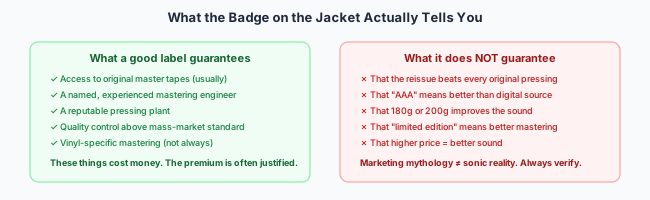
The 180-gram weight is not an indicator of mastering quality. Neither is "half-speed mastered" — a technique that can produce excellent results but also mediocre ones depending on execution.
Why Inconsistent: No consistent quality signal. Research required on every title. Some are excellent; many are not worth the premium.
Blue Note Classic Vinyl — A Note
Blue Note's Classic Vinyl series occupies interesting territory between Tier 2 and Tier 3. These are not Tone Poet releases — they use different mastering (often from digital sources) and different pressing plants. The price is lower ($25–$28), and the quality is correspondingly less consistent. Good value when the mastering works; disappointing when it doesn't.
Recommendation: Don't confuse Classic Vinyl with Tone Poet. They are different programs with different quality standards and different prices. The Tone Poet badge is the one that earns automatic confidence.
The Mastering Engineer Matters More Than the Label
If this article has a single thesis, it is this: the mastering engineer's name on the jacket is a more reliable indicator of quality than the label name.
A Kevin Gray cut for Tone Poet at $34 will almost certainly outperform an anonymous cut for a major-label "deluxe edition" at $45. A Bernie Grundman mastering for Intervention at $40 is a safer purchase than a brand-name reissue with no mastering credit visible.
Learn to read the dead wax. The initials in the runout groove tell you who actually cut the record. That information is worth more than any marketing copy on the jacket.
- Kevin Gray (KG) — Cohearent Audio. The most prolific audiophile mastering engineer working today. Responsible for AP, Tone Poet, Music Matters, and hundreds of other titles.
- Bernie Grundman (BG) — Bernie Grundman Mastering. Legendary engineer behind iconic original pressings and modern audiophile reissues for Impex, Intervention, and others.
- Chris Bellman (CB) — Bernie Grundman Mastering. Exceptional lacquer cutter with credits across multiple audiophile programs.
- Ryan K. Smith (RKS) — Sterling Sound. Prolific across Acoustic Sounds Series and Verve titles. Consistently strong results.
Price vs. Performance: Where the Value Actually Lives
The audiophile vinyl market in 2026 has a pricing problem. The gap between a $34 Tone Poet and a $125 UHQR is enormous — but the sonic gap is often modest. Both are mastered by world-class engineers. Both use quality pressing plants. The UHQR has a lower noise floor and marginally better detail retrieval, but the law of diminishing returns applies aggressively above $50.
Our value rankings:
- Best value in 2026: Blue Note Tone Poet ($30–$38). Kevin Gray mastering, Optimal pressing, tip-on jackets. Nearly impossible to beat at this price.
- Strong value: Speakers Corner ($35–$50). Pallas pressing, original tape sources, enormous catalog.
- Good value if you choose carefully: MoFi standard editions ($40–$50). RTI pressing, established mastering team.
- Diminishing returns: One-Step/UHQR ($100–$150). Technically superior but the incremental improvement over a $40 pressing is small relative to the price increase.
- Worst value: Major-label "deluxe" reissues ($35–$50) with no mastering improvement over standard pressings. You are paying for packaging, not sound.
How to Buy Smart
A decision framework for purchasing audiophile reissues:
- Step 1: Identify the mastering engineer. If it's Kevin Gray, Bernie Grundman, Chris Bellman, or Ryan K. Smith — proceed with confidence.
- Step 2: Identify the pressing plant. QRP, RTI, Pallas, or Optimal — proceed. GZ or unnamed — research further.
- Step 3: Check the source. Original master tapes? Or a digital transfer? Both can sound excellent, but know what you're buying.
- Step 4: Compare to the best available pressing. Sometimes a well-mastered original pressing at $15 outperforms a $50 reissue.
- Step 5: Read the dead wax after purchase. Verify what you actually received matches what was advertised.
Conclusion
The audiophile reissue market rewards informed buyers and punishes impulse purchases. A label name is a starting point — not a guarantee. A premium price is a signal of investment — not proof of superiority.
The labels in our Reference and Buy with Confidence tiers have earned their positions through years of consistent execution. They employ the best mastering engineers, use the best pressing plants, and maintain quality standards that justify their pricing. When they release a title, you can purchase with reasonable confidence that the record will sound excellent.
The labels in our Title Dependent tier are capable of reference-quality work but require research before purchasing. The brand name alone is insufficient.
And across all tiers, one principle holds:
The mastering engineer's initials in the dead wax tell you more about how a record will sound than any marketing copy ever written.
Learn to read them. Your collection will thank you.
Keep Reading
Why Do Different Vinyl Pressings Sound Different? Mastering, Matrix Numbers & Pressing Plants Explained
Two records can contain the same album and still sound conspicuously different. Learn why mastering, lacquer cutting, metalwork, and pressing plants all leave an audible fingerprint on vinyl.
Does 180-Gram Vinyl Sound Better? The Audiophile Myth Explained
Does 180-gram vinyl really sound better than standard vinyl? Learn what record weight actually changes — and why mastering, cutting and pressing quality matter far more.
Best Vinyl Pressing: How to Find the Best-Sounding Version of Any Album
Original pressing, remaster, reissue or audiophile edition? Learn how to use matrix numbers, mastering credits, pressing plants and Discogs to find the best-sounding vinyl pressing before you buy.
Mastering Matters More Than the Format
Why the same album can sound completely different across pressings — and why the mastering engineer may matter more than whether you're playing vinyl, CD, or streaming.