
Does 180-Gram Vinyl Actually Sound Better?
The sticker tells you how much the record weighs. The dead wax tells you considerably more about how it might sound.
No — not by virtue of weighing 180 grams.
A superbly mastered and pressed 120-gram record can easily outperform a mediocre 180-gram pressing. The weight of the vinyl has almost no relationship to the sound encoded in its grooves. What it has is a strong marketing association with quality — one built on correlation rather than causation, and one that the industry has been happy to exploit.
What "180 Gram" Actually Means
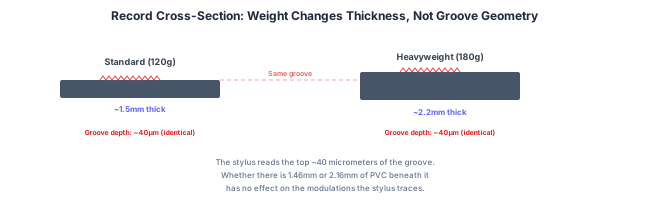
A standard 12-inch LP weighs between 120 and 140 grams. A "180 gram" record is approximately 30-50% heavier — translating to roughly 0.6-0.7mm of extra thickness. That is all it means. It does not mean the record was mastered from original analog tapes, that a specific engineer was involved, that the vinyl compound is virgin, or that the grooves are deeper or wider.
The stylus reads the top 40 micrometers of the groove wall. Whether there is 1.5mm or 2.2mm of PVC beneath that contact point has no effect on the modulations being traced.
Why 180g Became Associated With "Audiophile"
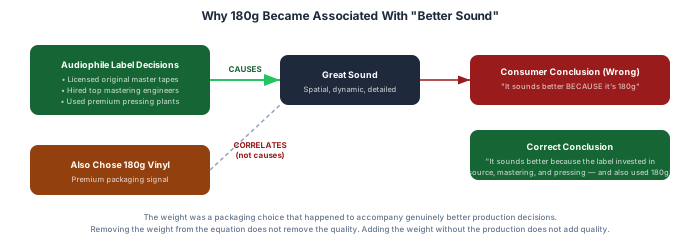
In the 1990s and 2000s, audiophile reissue labels — Mobile Fidelity, Analogue Productions, Classic Records — began using 180-gram vinyl as part of their premium packaging. These labels also licensed original master tapes, hired top mastering engineers, and pressed at premium plants. Their records sounded superb. Listeners noticed the weight and concluded: heavy record = great sound.
But the records sounded amazing because of the source, the mastering, the cutting, and the pressing — not because of the extra 40-60 grams of PVC. The weight was a packaging signal that accompanied genuine production investment. The industry then adopted the signal without the substance.
What Actually Determines How a Record Sounds
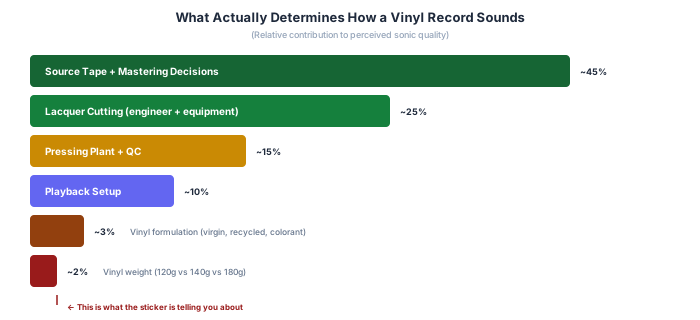
- Source material (~45%) — Original analog master tape, safety copy, or digital file? This determines the ceiling. See Mastering Matters More Than the Format.
- Lacquer cutting (~25%) — The engineer, the lathe, the speed, the monitoring decisions. See How to Read the Dead Wax.
- Pressing plant + QC (~15%) — Flatness, centering, surface noise. See Vinyl Pressing Quality in 2026.
- Playback setup (~10%) — VTF, VTA, azimuth, loading. See Turntable Setup — Precision Matters.
- Vinyl formulation (~3%) — Virgin vs. recycled compound, colorant additives.
- Vinyl weight (~2%) — 120g vs. 140g vs. 180g. Minimal to negligible.
Can Heavier Vinyl Provide Any Benefit?
In fairness: a thicker record is slightly more resistant to flexing during handling, may survive postal shipping marginally better, and can couple more firmly to the platter on some turntables. These are handling and mechanical benefits — none of them affect what the stylus reads from the groove. A proper record clamp achieves the coupling benefit regardless of disc mass.
Can 180g Actually Introduce Problems?
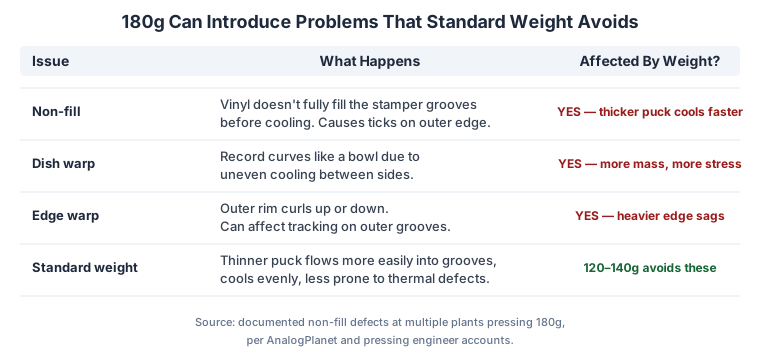
Yes. A heavier puck of vinyl presents specific manufacturing challenges. Non-fill — where the vinyl doesn't fully flow into the stamper grooves before cooling — is a documented issue at multiple plants on 180g runs. The thicker puck has more thermal mass at its center but cools faster at its edges. If the press cycle isn't precisely calibrated, outer grooves may not fill completely, producing ticks and distortion on the first tracks.
Dish warps and edge warps are also more common with heavier pressings due to greater thermal stress during cooling. A well-run plant calibrates for these variables, but the physics make 180g pressing more technically demanding than standard weight.
Real-World Examples: Standard Weight Beating 180g
- Pink Floyd — Wish You Were Here — The original 1975 UK pressing (~130g, cut at Abbey Road) has a spatial quality that several 180g reissues have failed to replicate. The difference is the mastering and tape condition — not the weight.
- Dire Straits — Brothers in Arms — The original Vertigo pressing (~120g) was mastered by Bob Ludwig from analog tape. Several 180g reissues were sourced from digital masters. The lightweight original sounds markedly more dimensional.
- Steely Dan — Aja — The original Bernie Grundman cut (~120g) remains competitive with or superior to several heavyweight reissues. Cut from the original tape by one of the best engineers alive.
- Fleetwood Mac — Rumours — The 2011 Pallas 180g pressing is excellent — but so is a clean original 1977 pressing (~130g). The 180g version wins because Pallas did the pressing and Kevin Gray cut the lacquer, not because it weighs more.
What to Look at Instead of the Sticker
When evaluating a vinyl purchase, ignore the weight and focus on who mastered it, what the source was, where it was pressed, and what owners report. For the complete evaluation framework, see How to Find the Best-Sounding Version of Any Album.
A 180g sticker tells you how much the record weighs. The dead wax tells you considerably more about how it might sound.
The Sonic Atlas Position
The archive contains records at every weight from 120g to 200g. Weight has never been a factor in purchasing or rating decisions. If a 180g pressing sounds magnificent — and many do — it is because the label invested in the production chain. The weight is a byproduct of that investment, not its cause. Buy the mastering. Buy the source. Buy the plant. The weight will take care of itself.
Keep Reading
Why Do Different Vinyl Pressings Sound Different? Mastering, Matrix Numbers & Pressing Plants Explained
Two records can contain the same album and still sound conspicuously different. Learn why mastering, lacquer cutting, metalwork, and pressing plants all leave an audible fingerprint on vinyl.
Best Audiophile Vinyl Reissue Labels in 2026: Who Actually Makes the Best-Sounding Records?
We don't rank the packaging. We rank the records. A tier-based evaluation of Analogue Productions, Mobile Fidelity, Speakers Corner, Tone Poet, Impex, Intervention, and more — judged by mastering, pressing, and real-world listening.
Best Vinyl Pressing: How to Find the Best-Sounding Version of Any Album
Original pressing, remaster, reissue or audiophile edition? Learn how to use matrix numbers, mastering credits, pressing plants and Discogs to find the best-sounding vinyl pressing before you buy.
Mastering Matters More Than the Format
Why the same album can sound completely different across pressings — and why the mastering engineer may matter more than whether you're playing vinyl, CD, or streaming.