
Best Vinyl Pressing: How to Find the Best-Sounding Version of Any Album
There are 37 versions of this album on Discogs. Which one should you actually buy? Here's how to answer that question before you spend a dollar.
Every serious record buyer eventually arrives at the same question. You want an album on vinyl. You open Discogs and find 14 pressings from 6 countries spanning 50 years. Some cost $12. One costs $400. The cover art looks identical on all of them. The track listing is the same. But they are not the same record. The grooves were cut by different people, from different sources, at different facilities, pressed at different plants, in different decades. One of them sounds magnificent. Several sound mediocre. One might sound worse than the CD.
This article is a systematic framework for determining which pressing will sound best — before you buy it. Not after. Not by trial and error across $500 of purchases. Before.
The Central Principle
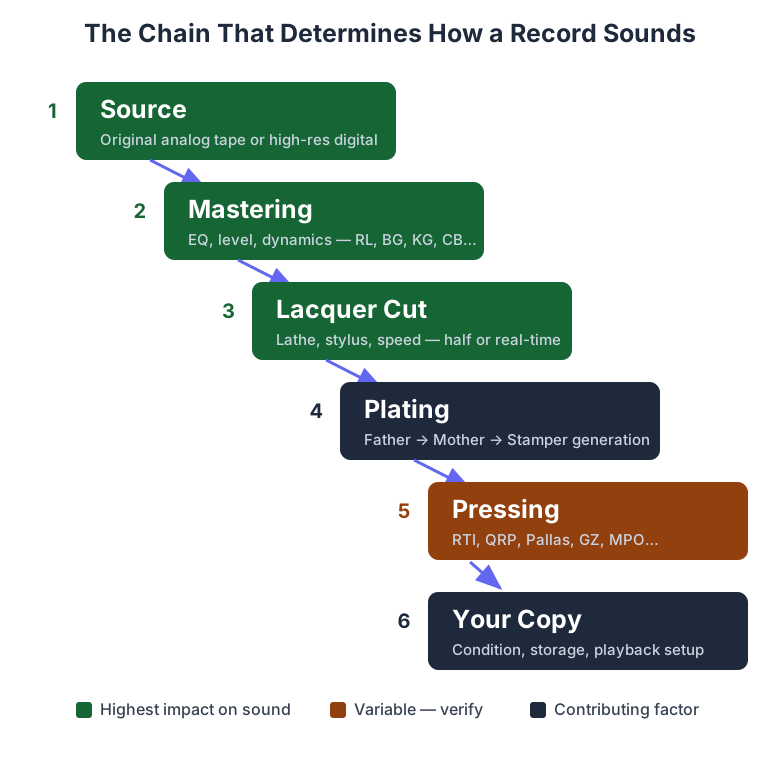
The first pressing is not necessarily the best pressing. A remaster can be better or worse. "180 gram" is a weight specification, not a sound quality guarantee. "Audiophile" is a marketing term, not a mastering standard. The only thing that determines how a record sounds is the chain of decisions and processes that produced it:
- What source was used (original analog master tape, safety copy, EQ'd copy, or digital file)
- Who mastered it and what decisions they made
- Who cut the lacquer and on what equipment
- Where it was pressed and under what quality control
Everything else — the year, the country, the label, the price, the gram weight, the word "remastered" on the sticker — is circumstantial evidence. Useful as a signal, but never conclusive on its own. For a deeper examination of how mastering, lacquer cuts, metalwork and manufacturing create audible differences, see Why Do Different Vinyl Pressings Sound Different?
Step 1: Identify the Exact Release
Before evaluating sonic quality, you need to know precisely which object you are looking at. On Discogs, every unique pressing gets its own release page. The identifying information:
- Catalog number — The label's internal identifier. Different numbers = different releases, even if the cover is identical.
- Country — A UK pressing and a US pressing of the same album are different objects with different lacquers, different plants, often different mastering.
- Year — A 1974 pressing and a 2014 pressing share nothing but the music.
- Matrix/runout information — The codes etched or stamped into the dead wax. This is the forensic fingerprint. Two copies with the same catalog number but different matrix codes may sound completely different.
Step 2: Find Out Who Mastered It
The mastering engineer is the single most important variable in how a vinyl record sounds. Their initials are often etched into the dead wax — a signature that tells you exactly whose ears made the final decisions about EQ, level, dynamics, and stereo image before the lacquer was cut.
Names to look for (and their typical dead-wax identifiers):
- Robert Ludwig (RL) — Sterling Sound, Masterdisk, Gateway. Known for dynamic, powerful cuts. His original Led Zeppelin II mastering is the most famous dead-wax story in vinyl collecting.
- Bernie Grundman (BG) — Bernie Grundman Mastering. Cut many of the definitive pressings of the 1970s and 1980s. His work on Steely Dan, Michael Jackson, and countless jazz titles is benchmark quality.
- Kevin Gray (KG) — Cohearent Audio. The most respected lacquer cutter working today in the audiophile reissue space. His all-analog cuts for Acoustic Sounds, Analogue Productions, and Craft Recordings are consistently excellent.
- Chris Bellman (CB) — Bernie Grundman Mastering. Another first-rate cutter whose work appears on many quality reissues.
- Stan Ricker — JVC Cutting Center, Mobile Fidelity. Pioneer of half-speed mastering. His MOFI cuts from the late 1970s and early 1980s remain definitive.
- Doug Sax / The Mastering Lab (TML) — Known for transparent, uncolored mastering. Cut many audiophile pressings for Sheffield Lab and others.
If you can identify who cut the lacquer, you have the single strongest predictor of sonic quality. A Kevin Gray all-analog cut will almost always outperform an unknown digital cut pressed at GZ Media, regardless of what the sticker says.
For a deeper dive into reading these markings, see How to Read the Dead Wax.
Step 3: Determine the Source
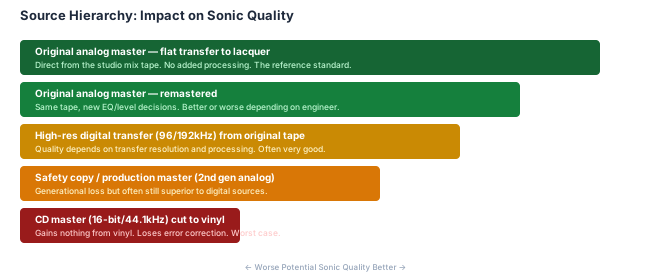
The source hierarchy, from best to worst in typical practice:
- Original analog master tape, flat transfer — The holy grail. The tape that was mixed in the studio, played back without additional processing, and cut directly to lacquer. This is what Mobile Fidelity, Analogue Productions, and similar labels aim for.
- Original analog master tape, remastered — Still the original tape, but with new EQ decisions applied. May be better or worse than the original cut depending on the mastering engineer's taste and intent.
- High-resolution digital transfer of the original tape — Common for modern reissues when the label won't ship the tape. Quality depends entirely on the transfer resolution, the equipment, and what processing was applied. A 192kHz/24-bit flat transfer can be excellent. A brickwall-limited 44.1kHz CD master cut to vinyl will not be.
- Safety copy or production master — A second-generation analog tape. Measurably worse than the original but often still very good.
- CD master cut to vinyl — The worst case for audiophile purposes. A 16-bit/44.1kHz source pressed onto vinyl gains nothing from the format and loses the error correction and silence that digital provides. Unfortunately, this is more common than labels admit.
How do you know which source was used? Sometimes the label states it ("mastered from the original analog tapes"). Sometimes the mastering engineer confirms it in interviews. Sometimes the dead wax tells you (an all-analog cut at a known facility from a known engineer implies analog source). And sometimes you simply cannot know — which is itself useful information when evaluating whether to pay a premium.
For more on why source matters more than format, see Mastering Matters More Than the Format.
Step 4: Identify the Pressing Plant
The pressing plant determines manufacturing quality: surface noise, flatness, centering, and consistency across the run. Quality varies dramatically between facilities.
- RTI (Record Technology Inc., Camarillo, CA) — The gold standard for US pressing. Consistently flat, quiet surfaces. Used by Analogue Productions, Mobile Fidelity, and most premium US labels.
- QRP (Quality Record Pressings, Salina, KS) — Owned by Analogue Productions founder Chad Kassem. Audiophile-grade quality control. Small-batch pressing.
- Pallas (Diepholz, Germany) — The European equivalent of RTI. Exceptional quality control. Used by many European audiophile labels.
- Optimal Media (Röbel, Germany) — Very good quality. Presses for many premium European labels.
- GZ Media (Loděnice, Czech Republic) — The world's largest pressing plant. Quality is inconsistent. Some runs are fine; others arrive warped or noisy. Volume production with less individual quality control than boutique plants.
- MPO (Averton, France) — Historically variable. Some excellent pressings; some problematic. Check specific releases rather than trusting the plant name alone.
For a full breakdown of current pressing quality, see Vinyl Pressing Quality in 2026.
Step 5: Ignore the Marketing
Several common claims on vinyl packaging tell you nothing about sound quality:
- "180 gram" — Heavier vinyl is slightly more resistant to warping during shipping and may sit more stably on a platter. It does not affect the sound in the groove. A well-pressed 120g record will outperform a poorly pressed 180g record every time.
- "Remastered" — This word means someone applied new processing to the audio. It does not tell you whether that processing improved or degraded the sound. Many remasters are brickwall-limited for loudness. Some are revelatory improvements over thin original cuts. The word alone is meaningless.
- "Audiophile pressing" — Not a regulated term. Any label can apply it. Evaluate the mastering credits and pressing plant, not the sticker.
- "Virgin vinyl" — Means no recycled PVC was used. Theoretically quieter surfaces. In practice, pressing technique and quality control matter far more than pellet composition.
- "Limited edition" — A scarcity signal for collectors. Irrelevant to sound quality.
Step 6: Original vs. Reissue — Neither Automatically Wins
The collector myth that original pressings always sound best is exactly that — a myth. Here is why:
- When the original wins: The original master tape was in optimal condition, cut by a skilled engineer, pressed at a quality plant, and the resulting lacquer was never bettered by subsequent attempts. Example: many UK first pressings of 1970s prog and hard rock cut at Trident, Olympic, or Abbey Road from fresh tapes.
- When the reissue wins: The original was cut hastily for commercial release with suboptimal EQ, or pressed at a mediocre plant, and a subsequent reissue used the same tape but with better mastering decisions, better cutting equipment, or better pressing. Example: many Analogue Productions and Mobile Fidelity reissues of jazz and classic rock titles.
- When the CD wins: The vinyl is cut from a digital source that offers no improvement over the CD, or the vinyl mastering is worse than the digital mastering. If the grooves were cut from the same 16/44.1 file that produced the CD, the CD will be technically superior (no tracking distortion, no inner-groove losses, no surface noise).
For a deeper exploration of this topic, see The Original Pressing Myth.
Step 7: Check Owner Reports
Before spending money, check what other people have reported about specific pressings:
- Discogs release comments — Look for notes about pressing quality, surface noise, mastering differences. Multiple users reporting the same issue (warps, noise, hot cut) is a strong signal.
- Steve Hoffman Music Forums — The most concentrated source of pressing comparison discussions. Search for the album title and you will often find multi-page threads comparing every known pressing.
- Reddit r/vinyl and r/audiophile — Variable quality but useful for recent releases where forum discussions may not exist yet.
- Analog Planet / The Absolute Sound / Stereophile reviews — Professional reviewers who evaluate pressings with reference systems. Michael Fremer's Analog Planet reviews are particularly detailed on pressing quality.
Distinguish between subjective preference ("I prefer the warmer sound of the original") and factual provenance ("this pressing was cut by Kevin Gray from the original analog tapes at Cohearent Audio"). Both are useful; only the latter is verifiable.
Step 8: Evaluate Price vs. Improvement
Not every sonic improvement is worth every price premium. A framework for evaluation:
- $15–30 (standard reissue) — Acceptable if the pressing plant is reputable and the source is known to be analog or high-res digital. Expect decent sound, not reference quality.
- $35–50 (premium reissue) — This is where Analogue Productions, Mobile Fidelity One-Steps, Craft Recordings, and similar audiophile labels live. If the mastering chain is verified and the plant is RTI/QRP/Pallas, this is often the sweet spot for sound quality per dollar.
- $75–150 (collectible original or deluxe reissue) — Worth it only if you have confirmed the pressing's provenance and it offers something the $40 version does not. A first-pressing UK Vertigo with an RL or Porky cut may justify this price. A generic first pressing from an unknown plant probably does not.
- $200+ (rare original or ultra-premium edition) — Collector territory. The sonic improvement over a $40 audiophile reissue is often marginal or nonexistent. You are paying for scarcity, not sound. Unless the specific pressing is documented as irreplaceable (the RL Led Zeppelin II, for instance), approach with skepticism.
The Sonic Atlas Decision Tree
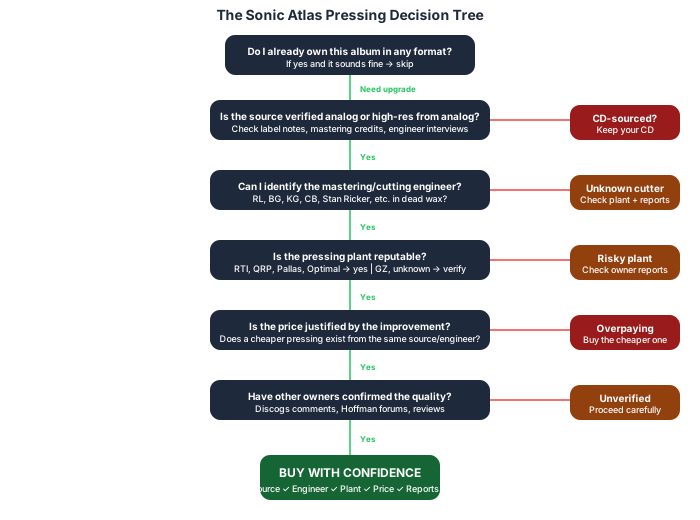
When evaluating whether to buy a specific pressing, we walk through this sequence:
1. Do we already own this album in any format?
If yes → Is there a documented sonic problem with our current copy? If no problem → skip.
2. Is the source verified analog (or high-res digital from analog)?
If unknown or confirmed CD-sourced → strong caution. Our existing CD may be better.
3. Can we identify the mastering/cutting engineer?
Known quality engineer → confidence. Unknown → check pressing plant and price carefully.
4. Is the pressing plant reputable?
RTI, QRP, Pallas, Optimal → proceed. GZ, unknown → verify via owner reports first.
5. Is the price justified by the improvement?
If a $40 pressing exists from the same source/engineer → the $150 original needs a specific reason to justify 3.75x the cost.
6. Have other owners confirmed the quality?
Multiple positive reports on Discogs/Hoffman → buy with confidence. No reports or mixed reports → proceed carefully or wait.
Real-World Examples
From the archive — cases where the "obvious" choice would have been wrong:
- Led Zeppelin II — The Robert Ludwig mastering (RL/SS in the dead wax) is dramatically superior to the standard US pressing. Same cover, same label, same year. Completely different sound. The RL commands $1000+; the standard version is $20. In this case, the Analogue Productions reissue (cut by Kevin Gray from the original tape) at $40 gets you 95% of the RL experience for 4% of the price.
- Supertramp — Crime Of The Century — The Mobile Fidelity pressing (half-speed mastered by Stan Ricker, pressed in Japan) was MOFI's first rock title and remains a reference. It reveals spatial information and low-frequency detail that standard A&M pressings cannot approach. The 2025 half-speed remaster by Miles Showell at Abbey Road is also excellent and far easier to find.
- Pink Floyd — The Dark Side of the Moon — Over 40 pressings exist. The UK first pressing (Porky/Pecko cut, solid blue triangle labels) is superb but expensive. The 30th anniversary remaster is excellent and affordable. The 2016 reissue pressed at Optimal is also very good. Several other pressings sound thin or harsh by comparison. Matrix information separates them.
- Steely Dan — Aja — The Bernie Grundman original US pressing is outstanding. The Japanese pressing is cleaner but slightly less dynamic. The Cisco reissue (cut by Kevin Gray) is arguably the best of all — wider soundstage, better separation, from the original tape. The recent Craft Recordings reissue is cut by Bernie Grundman from high-res digital and sounds very good but slightly less dimensional than the all-analog Cisco.
What This Means for Sonic Atlas
Every vinyl purchase in the archive follows this framework. When the database shows we own both a CD and a vinyl pressing of the same album, the reason is always documented: the vinyl exists because a specific pressing was identified as sonically superior to the CD — not because "vinyl is better" as a blanket statement.
When the best available version of an album is the CD — because every vinyl pressing was sourced from digital, or because the vinyl mastering is inferior — the CD is what stays in the archive. Format loyalty is not the point. Sound quality is the point. The format is just the delivery mechanism.
The work described in this article — identifying mastering engineers, tracing sources, reading dead wax, checking plants, comparing reports — is the work that makes a 3,600-album collection a curated archive rather than an accumulation. Every record earned its place.
Keep Reading
Why Do Different Vinyl Pressings Sound Different? Mastering, Matrix Numbers & Pressing Plants Explained
Two records can contain the same album and still sound conspicuously different. Learn why mastering, lacquer cutting, metalwork, and pressing plants all leave an audible fingerprint on vinyl.
Best Audiophile Vinyl Reissue Labels in 2026: Who Actually Makes the Best-Sounding Records?
We don't rank the packaging. We rank the records. A tier-based evaluation of Analogue Productions, Mobile Fidelity, Speakers Corner, Tone Poet, Impex, Intervention, and more — judged by mastering, pressing, and real-world listening.
Does 180-Gram Vinyl Sound Better? The Audiophile Myth Explained
Does 180-gram vinyl really sound better than standard vinyl? Learn what record weight actually changes — and why mastering, cutting and pressing quality matter far more.
The Original Pressing Myth: Why the First Pressing Isn't Always the Best
'First pressing' is a statement of chronology, not a guarantee of sonic superiority. When reissues, recuts, and later stampers actually outperform the original.