
Aja vs. Gaucho: Which Steely Dan Album Sounds Better?
Aja breathes; Gaucho merely has excellent manners — why Steely Dan's 1977 masterpiece remains sonically preferable to its immaculately upholstered successor.
The Short Answer
Both are canonical demonstrations of studio craft. On a resolving system, Aja is the more persuasive listen — it uses perfection to disclose human presence, where Gaucho uses perfection to suppress it. Three dimensions decide it:
Rhythmic feel: Aja — inhabited motion (Gadd, Purdie, Marotta leaning on the beat). Gaucho — polished, metronomic infrastructure.
Spatial presentation: Aja — shared acoustic air and depth. Gaucho — immaculate separation that can read as climate-controlled.
Tonal character: Aja — saturated midrange, detail as evidence of life. Gaucho — detail as evidence of control.
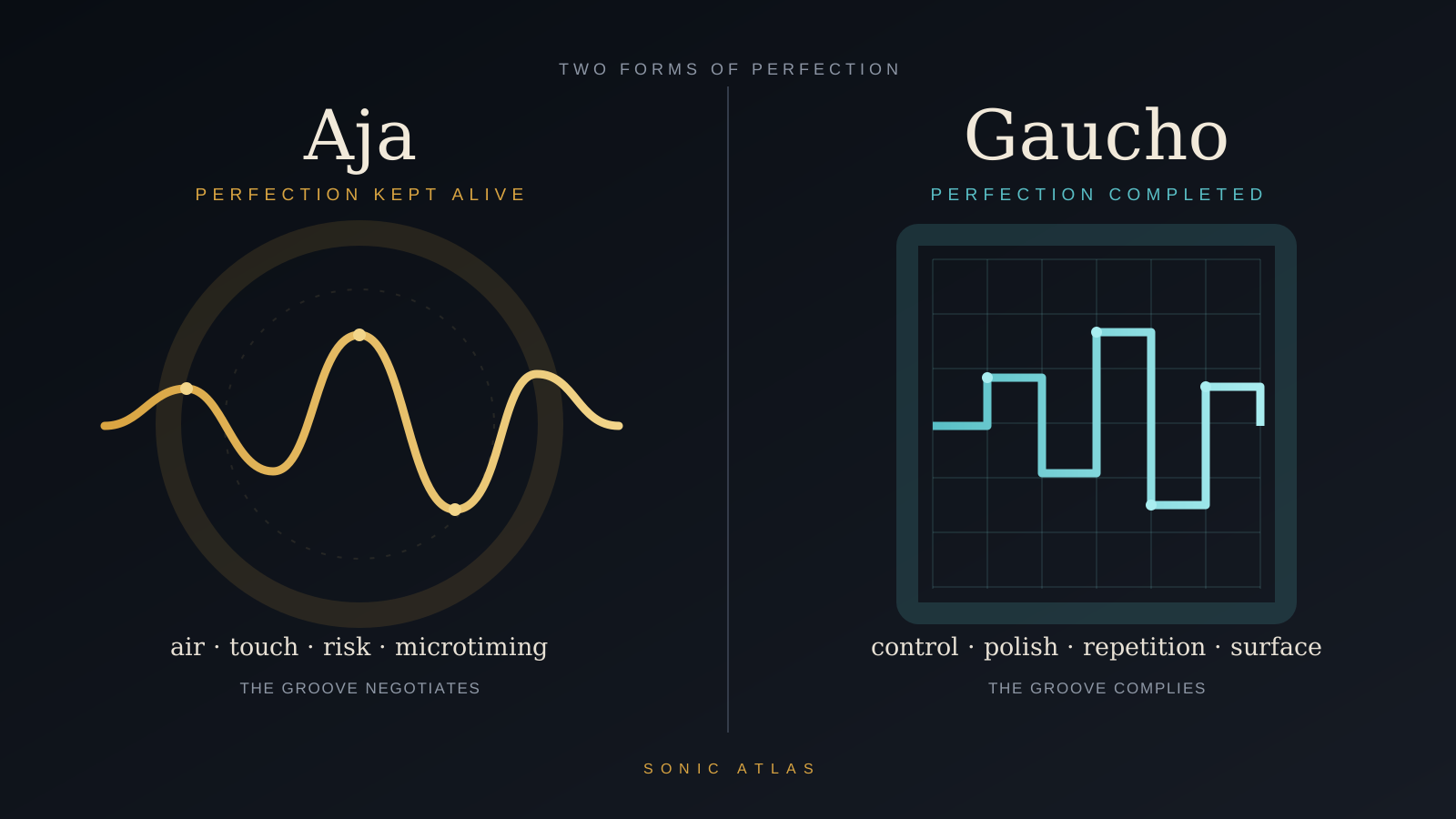
Gaucho is perfection completed. Aja is perfection kept alive. The essay below makes the full case.
There are, broadly speaking, two kinds of Steely Dan listeners. The first hears Gaucho and marvels at its cleanliness, its polished low end, its surgical stereo placement, and its almost indecent refusal to make an engineering mistake. The second hears all of that, nods appreciatively, and then puts on Aja because he would like to hear music rather than inspect a luxury condominium whose occupants have been discreetly removed.
This is not an argument that Gaucho is poorly recorded. Such a proposition would be philistine, demonstrably false, and rather beneath us. Gaucho is an engineering triumph of almost pathological exactitude. The question is more discriminating: why, when both records are canonical demonstrations of studio craft, does Aja so often provide the more persuasive experience on a serious playback system? The answer is that Aja uses perfection to disclose human presence, whereas Gaucho uses perfection to suppress human contingency. One breathes through its polish. The other has been polished until breathing would constitute a surface defect.
The Ontology of the Groove, for Those Who Require the Term Explained
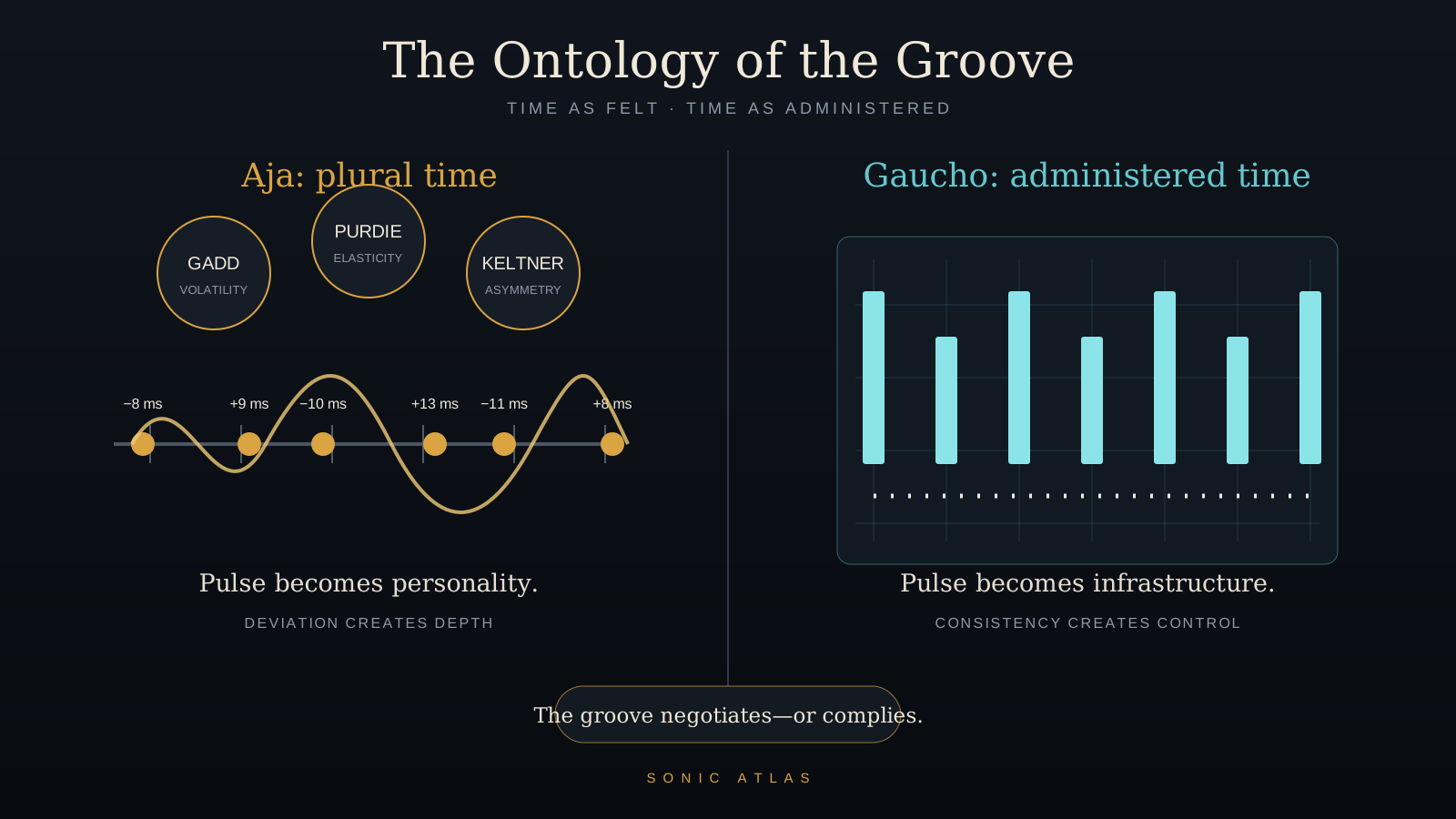
One must begin with rhythm, because rhythm is where the distinction ceases to be merely tonal and becomes philosophical. Aja does not possess a single house groove. It convenes a symposium of temporal sensibilities. Steve Gadd's performance on the title track is not simply virtuosic; it is architectural volatility. Bernard Purdie's work on “Deacon Blues” and “Home at Last” reclines behind the beat with the confidence of a man who understands that punctuality is not the same thing as authority. Rick Marotta makes “Peg” bounce without trivializing it, while Jim Keltner gives “Josie” a prowling asymmetry that lesser drummers would have ironed into obedience.
These are not different “drum sounds,” as the brochure-reading audiophile may be tempted to say. They are different theories of musical time. Each player establishes a distinctive relationship among pulse, anticipation, hesitation, and release. On a sufficiently resolving system, microtiming becomes spatial information: the bass and drums do not merely synchronize but lean toward and away from one another, generating a three-dimensional rhythmic field. The groove possesses musculature.
Gaucho proceeds from a more authoritarian premise. Roger Nichols's Wendel system—an extraordinary technological achievement used in shaping the drum foundations of “Hey Nineteen,” “Glamour Profession,” and “My Rival”—made repetition unnervingly stable. Transients arrive with diplomatic precision. The kick drum never oversleeps; the snare never has an opinion; the hi-hat has apparently signed a nondisclosure agreement. The result is hypnotic, expensive, and entirely appropriate to an album populated by chemical leisure, transactional sex, fading status, and men whose emotional lives resemble corporate expense accounts.
That conceptual congruence deserves admiration. It does not, however, require sonic preference. Gaucho's rhythm is polished infrastructure; Aja's rhythm is inhabited motion. The former tells time. The latter experiences it.
Air Is Not an Engineering Error
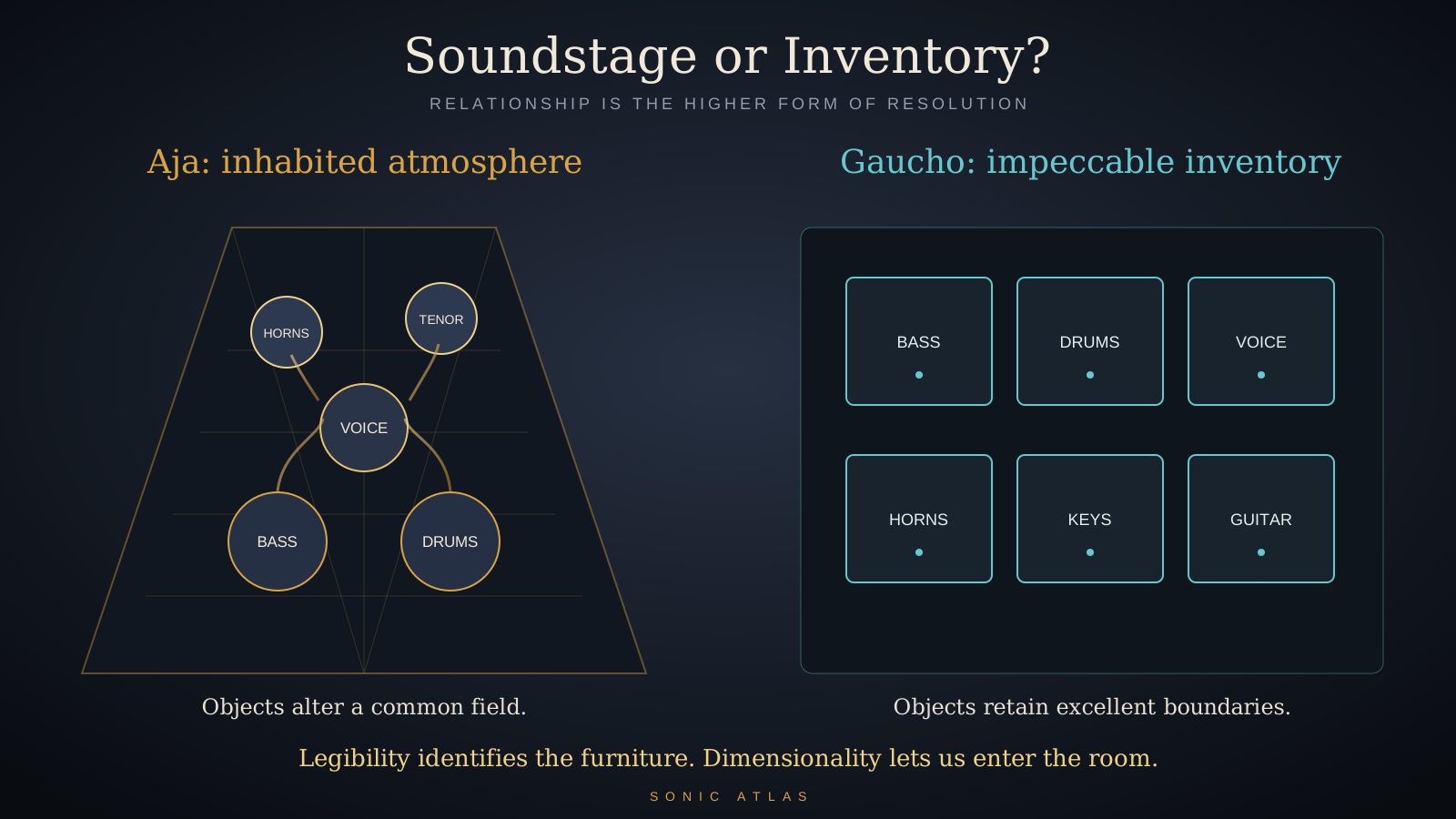
The second distinction concerns space—or, more precisely, whether the listener encounters a soundstage or an inventory. Aja resolves instrumental detail while preserving the acoustic implication that musicians exist in relation to one another. “Black Cow” establishes a dry, tactile foreground: electric piano, bass, drums, and voice appear close enough to possess temperature. “Deacon Blues” opens laterally and vertically as horns and backing vocals accumulate, yet it never degenerates into the vulgar showroom trick of placing every instrument beneath its own spotlight.
The title track is the decisive exhibit. Wayne Shorter's tenor does not materialize as a collectible object displayed at center stage; it enters an already breathing harmonic climate and disturbs it. Gadd's culminating drum eruption expands the perceived scale of the room because the performance changes the pressure within the mix. This is what genuine dimensionality sounds like. It is not the simplistic localization of objects from left to right—the sonic equivalent of labeling drawers. It is the perception of changing relationships inside a common atmosphere.
Gaucho is often even more explicit in its separation, and this is precisely where many listeners confuse legibility with realism. Its bass notes are superbly bounded. Its background vocals arrive lacquered and immaculate. Percussion occupies coordinates so exact one could presumably file a zoning application. Yet the absence of acoustic friction can weaken the illusion of shared air. “Babylon Sisters” is undeniably sumptuous, but its luxury is upholstered. “Glamour Profession” stretches across the stereo field like Los Angeles at midnight viewed from behind the sealed window of a very costly automobile. Everything is visible; nothing can touch you.
This is not sterility in the crude sense. Gaucho has color, weight, and atmosphere. But its atmosphere is climate-controlled. Aja, by contrast, permits small amounts of weather.
Timbre, or Why More Detail Is Not Necessarily More Truth
A revealing audio system does not merely expose detail; it exposes the quality and organization of detail. This is where Aja demonstrates its superior breeding. The record balances warmth and articulation without advertising either. Chuck Rainey's bass is not merely extended downward but harmonically intelligible: one hears pitch, finger, string, and bloom rather than an anonymous quantity of premium low frequency. Cymbals retain metallic complexity without being reduced to audiophile-approved shimmer. Fagen's voice has texture, nasal contour, and human scale without being thrust forward as a sibilance test.
Most importantly, Aja's midrange remains saturated. This is the region where musical identity resides, despite the industry's recurring attempts to distract consumers with sub-bass excavation and ultrasonic garnish. Horns possess body before brilliance. Keyboards have harmonic density rather than synthetic gloss. Voices emerge from arrangements instead of floating above them like expensive decals. The record's resolution is therefore cumulative: detail reveals itself as attention deepens. It does not leap from the loudspeakers waving a certificate of authenticity.
Gaucho announces mastery more readily. Its low end is governed with almost juridical authority; its transients are immaculate; its backgrounds are pristine enough to make lesser productions seek legal counsel. Yet on highly resolving equipment, this order can become the subject of the listening experience. One begins to hear not simply music but the production's refusal of accident. Every surface has been inspected. Every edge has been chamfered. Every spontaneous gesture appears to have passed through a committee chaired by a very elegant sociopath.
The distinction may be stated simply. Gaucho presents detail as evidence of control. Aja presents detail as evidence of life.
Dynamic Life Below the Volume Knob
The usual discussion of dynamics is embarrassingly primitive: quiet passages are quiet, loud passages are loud, and everyone congratulates the waveform. The more consequential dynamics operate inside phrases. They reside in the pressure of a snare stroke, the bloom of a bass note, the changing density of a horn voicing, and the moment a solo reorganizes the apparent dimensions of the mix.
Aja is extraordinarily responsive to such local transformations. Gadd's solo does not merely increase in complexity; it alters the gravitational field of the title track. Purdie's half-time shuffle on “Home at Last” produces monumental weight without sacrificing elasticity. “Peg” derives its exhilaration from a paradox: the arrangement is compressed into pop concision while the attacks remain irrepressibly human. Even “Deacon Blues,” a song built around languor and self-mythology, continuously adjusts its internal pressure through horn entrances, vocal layering, and rhythmic inflection.
Gaucho tends to subordinate these micro-events to continuity. Its dynamic envelope is luxurious, stable, and magnificently managed. But stability extracts a price: the music seems to know at every instant precisely how it will land. There is pleasure in that assurance, certainly, just as there is pleasure in a hotel suite where the towels have been folded into mute submission. Aja knows where it is going while retaining the sensation that something consequential may occur on the way.
Perfection, Properly Understood
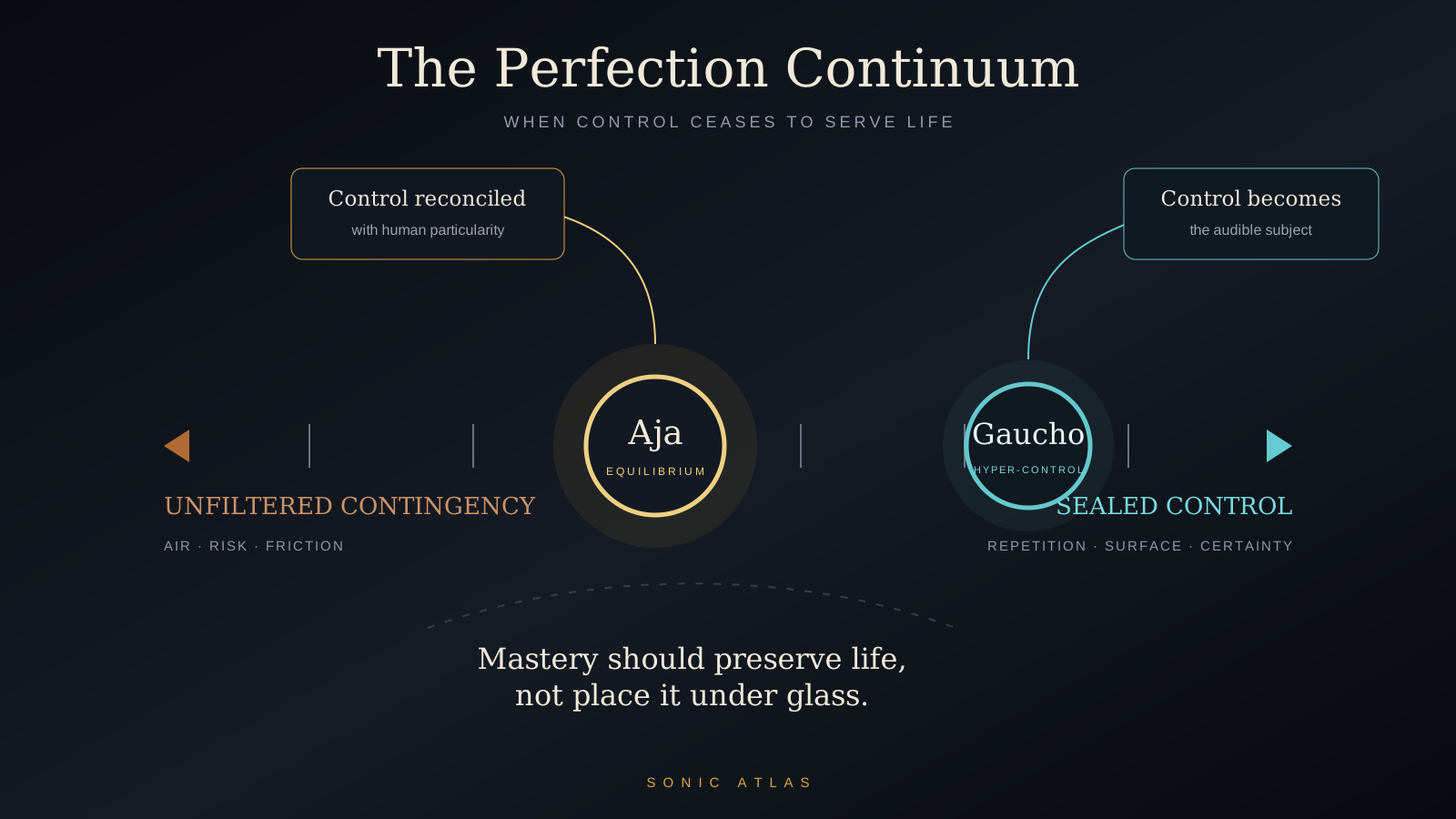
The preference for Aja is ultimately philosophical because high fidelity itself is philosophical. The vulgar account of fidelity treats it as subtraction: remove noise, reduce distortion, stabilize timing, isolate instruments, and one approaches truth. Yet music is not a laboratory specimen awaiting decontamination. Recorded truth also depends upon preserving irreducible particularity—this drummer leaning behind this beat, this bassist converting notation into pressure, this saxophonist destabilizing this harmonic atmosphere at precisely this moment.
Gaucho offers a nearly peerless image of control. Indeed, its slightly embalmed grandeur is inseparable from its thematic power. These songs concern people who have converted appetite into routine and luxury into anesthesia; the record sounds like their world. But Aja achieves something more difficult. It reconciles control with contingency, polish with porosity, and compositional intelligence with the dangerous fact of musicians touching time.
Thus Gaucho may be the cleaner window, but Aja provides the more compelling view. Gaucho gives us surfaces of extraordinary finish. Aja lets us hear through the finish into grain, air, touch, and intention. The distinction is the difference between technical perfection as conclusion and technical perfection as medium.
Naturally, one may still prefer Gaucho. Taste is free, and civilization has always required tolerance toward the aesthetically wayward. But on a system capable of preserving tone, timing, dimensionality, and microdynamic nuance, Aja more completely fulfills the promise of high-fidelity reproduction. It does not merely demonstrate that the studio can eliminate error. It demonstrates that mastery can leave life intact.
Gaucho is perfection completed. Aja is perfection kept alive.
Selected Sources
- The METAlliance, “The Recording of Steely Dan's Aja,” Mix, August 4, 2020.
- Jake Malooley, “Roger Nichols Interview: Steely Dan's Mad Scientist,” Expanding Dan.
- Roger Nichols, “Biography,” official archive.
Keep Reading
Vinyl vs. CD: Can You Actually Hear the Difference?
After ripping hundreds of LPs at 24-bit/192kHz through a tube signal chain, we have a clear answer — and it's not what purists on either side want to hear.
Phil Lynott and Donald Fagen: Two Masters of the Crooked Sentence
Thin Lizzy and Steely Dan sit in different filing cabinets, but their singers share one craft: conversational prosody. A comparative close reading of how Phil Lynott and Donald Fagen make disciplined arrangements sound like speech — and how phrasing builds a character syllable by syllable.
Why Do Different Vinyl Pressings Sound Different? Mastering, Matrix Numbers & Pressing Plants Explained
Two records can contain the same album and still sound conspicuously different. Learn why mastering, lacquer cutting, metalwork, and pressing plants all leave an audible fingerprint on vinyl.
Vinyl vs. Streaming: Which Sounds Better on a Serious System?
On a serious system, it becomes a contest between two complete reproduction chains. Neither format always wins. The decisive variable is which master you are hearing — and what happens to it before it reaches the loudspeakers.