
Phil Lynott and Donald Fagen: Two Masters of the Crooked Sentence
Thin Lizzy, Steely Dan, and the art of making a precisely arranged song sound as though somebody has just thought of something rather dangerous to say.
I. The unfortunate business of genre
Rock criticism has an understandable attachment to filing cabinets. Thin Lizzy belongs under hard rock, Steely Dan under jazz rock, and the critic may then retire, exhausted by this considerable intellectual achievement. Unfortunately, the records keep speaking after the labels have been applied. Listen to the vocal sentences rather than the guitar equipment, and Phil Lynott and Donald Fagen begin to resemble distant relatives who would find each other fascinating and probably unbearable.
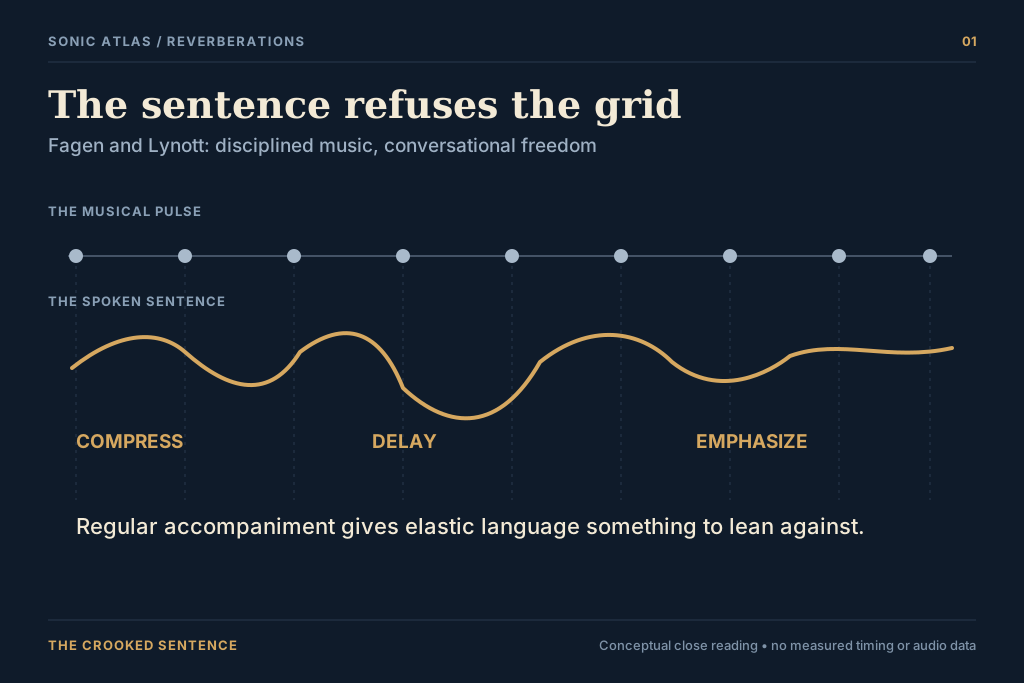
Their shared accomplishment is conversational prosody: arranging words so that melody retains the pressure, hesitation, emphasis, and irregular momentum of speech. Both understand that a sentence can lean across a beat, gather speed through its subordinate clauses, and arrive with an apparently casual sting. The music supplies discipline; the voice supplies the impression of freedom. This essay proposes an affinity of technique, not a documented chain of influence. Historical genealogy requires evidence. Listening requires ears. Confusing these activities has sustained several respectable careers.
II. The sentence refuses the grid
“Reelin’ in the Years” offers the obvious point of entry. Fagen's verses carry arguments rather than decorative sentiments. He sounds occupied with correcting somebody's account of the past, and the succession of clauses gives his delivery its impatient propulsion. The shuffle continues with splendid indifference. Against it, the vocal alternates compression and emphasis, making recollection sound like cross-examination. The chorus releases that verbal congestion into a more readily repeatable shape. One can sing along without having understood the grievance, a useful accommodation for radio.
Lynott achieves a related elasticity in “Dancing in the Moonlight.” His account of youthful wandering, attraction, and domestic consequences moves with the apparent informality of a story being retold. Some words receive a little extra affection; connective language slips past without ceremony. The bass establishes an inviting continuity while the vocal makes room for the narrator's personality. Fagen's sentence presses its case. Lynott's sentence enjoys the telling. In both performances, the relationship between verbal stress and musical pulse produces character before any critic arrives to explain it.
This is more specific than saying both singers possess swagger. Swagger is criticism's emergency substitute for describing rhythm. The meaningful questions concern which syllable receives weight, where a clause gathers momentum, and whether the singer makes a landing sound settled or provisional. Neither performance needs virtuosic range to achieve its effect. Their intelligence resides in placement. A small inflection can imply amusement, accusation, intimacy, or a conveniently edited memory. The singer is directing our interpretation of the speaker, syllable by syllable.
III. Two jurisdictions of the underworld
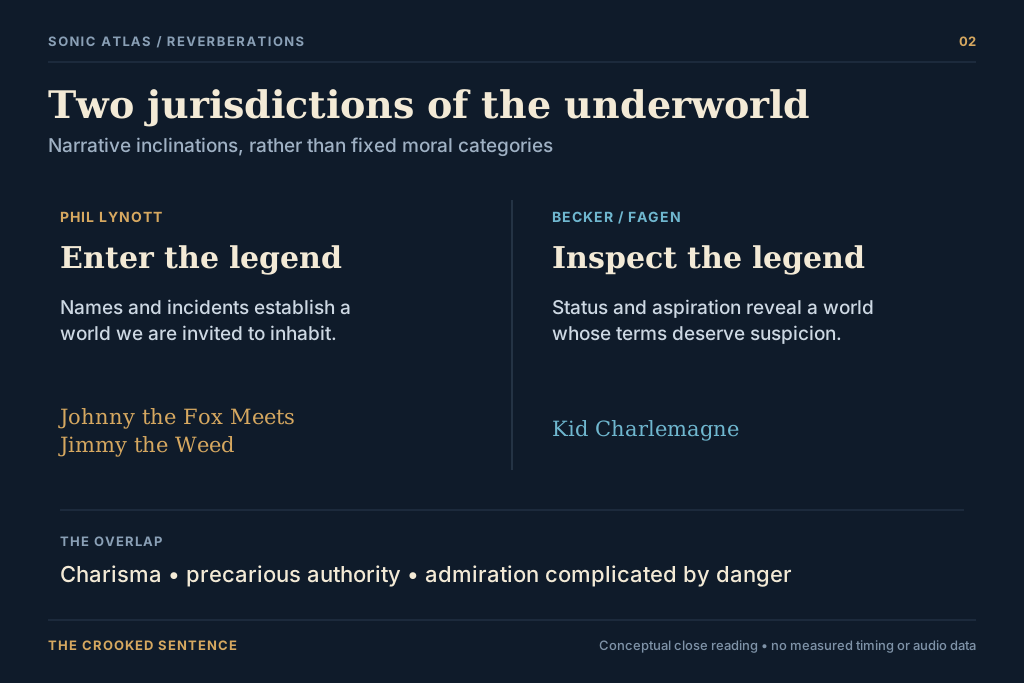
Pair “Johnny the Fox Meets Jimmy the Weed” with “Kid Charlemagne,” and the resemblance acquires a social address. Both songs inhabit worlds of illicit enterprise, reputation, and precarious authority. Names do considerable work. They suggest that a whole local mythology exists beyond the recording: people know these figures, tell stories about them, and understand rules the newcomer has yet to learn. Such economy distinguishes a convincing lyric from a screenplay that has accidentally wandered into a recording studio.
Lynott's funk-inflected delivery gives Johnny and Jimmy theatrical presence. The rhythmic confidence belongs to their world; the voice understands its appetite for performance. In “Kid Charlemagne,” Fagen's delivery travels through admiration, obsolescence, and impending trouble. The music remains extraordinarily composed while the subject's command of events deteriorates. That discrepancy matters. Professional poise in the arrangement does not certify competence in the character. Indeed, the cleaner the musical surface, the more conspicuous the human disorder beneath it becomes. Elegance can be an exceptionally cruel witness.
The distinction is one of narrative inclination, not moral citizenship. Lynott frequently grants his outsiders the dignity of legend. Becker and Fagen frequently expose the cost of believing one's legend. Yet admiration survives inside “Kid Charlemagne,” just as danger survives inside Lynott's exuberance. These are songs about charismatic people whose charisma cannot guarantee their safety. Reducing them to warm Irish humanity versus cold American cleverness would require ignoring the music. Naturally, the temptation is considerable.
A useful supplementary pairing is “Waiting for an Alibi” with “Don't Take Me Alive.” Each compresses danger into a sharply voiced situation, allowing a figure's predicament to emerge through selective disclosure. Listen to how assurance sits beside instability. The dramatic force comes from what the speaker chooses to emphasize while events close around him. Narrative compression makes every verbal gesture answerable for more than its immediate melodic function.
IV. The invented self
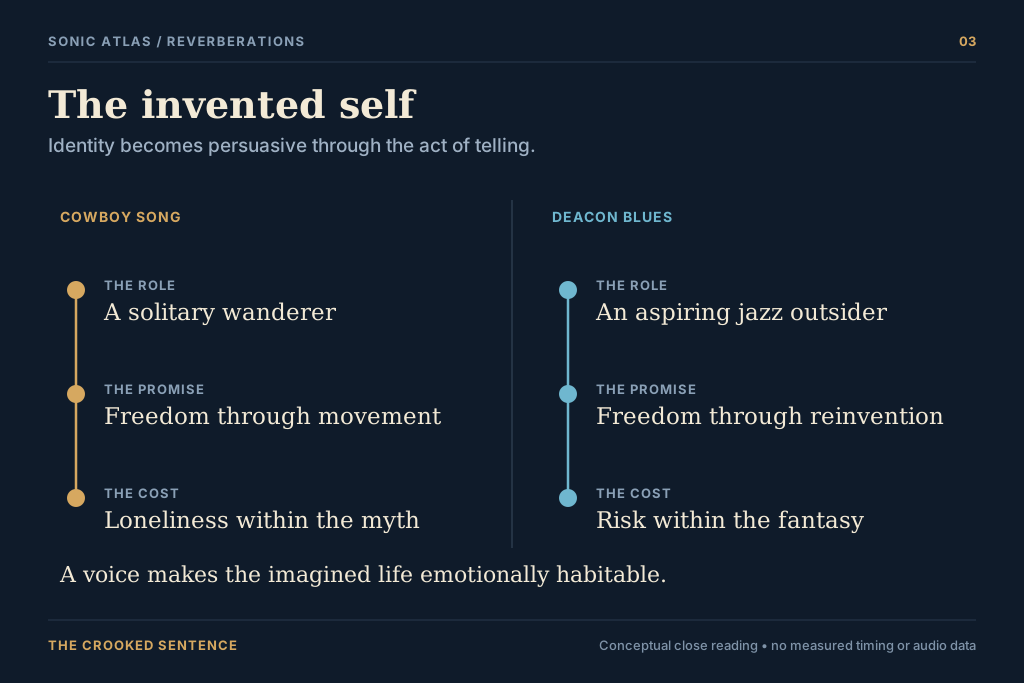
“Cowboy Song” and “Deacon Blues” deepen the comparison because their speakers build identities through narration. Lynott's cowboy inhabits an imagined landscape of movement, solitude, and remembered desire. The vocal begins with reflective space; the arrangement's expansion gives that solitude a public, exhilarating scale. The private figure becomes someone an audience can inhabit. Myth here is emotionally productive: a language through which loneliness acquires posture, direction, and a horizon.
The speaker in “Deacon Blues” also needs a usable identity. His desired life has a vocabulary, a sound, and finally a name. Becker and Fagen's account of writing the song explicitly connects its naming conceit to granting losers the grandeur normally reserved for winners.[1] That premise supports irony, but it also makes room for compassion. Fagen lets aspiration breathe. The spacious arrangement grants the fantasy enough beauty that the listener can understand its attraction before considering its hazards.
This is where the tidy distinction between romantic Lynott and prosecutorial Dan begins to fail. Both songs permit an imagined self to become moving without declaring it trustworthy. The cowboy's freedom contains loneliness; the aspiring jazz outsider's freedom contains self-destruction. Neither narrator should be mistaken for an unmediated authorial confession. They are constructed voices, and their persuasive power lies partly in the distance between the lives they describe and the identities they wish to possess. Self-invention is a performance with consequences.
V. Memory has an excellent publicist
“The Boys Are Back in Town” and “My Old School” disclose another shared method: reconstructing a social world through selected incidents. Lynott invokes familiar figures and remembered behavior as though the audience already belongs to the circle. That implied familiarity is the trick. We receive fragments, supply the missing context, and find ourselves nostalgic for people we have never met. Biographer Graeme Thomson identifies the song's transformation of remembered exploits into communal legend.[2] The recollection becomes an event in its own right.
“My Old School” turns remembered experience into a buoyant declaration of estrangement. Its animation makes refusal sound sociable: a grievance acquires the pleasures of an ensemble performance. Where Lynott's refrain welcomes a returning community, Fagen's insists upon distance from an institution. Yet both convert particular histories into repeatable public gestures. The listener need not share the original circumstances. The delivery teaches us how to feel about them, and the arrangement makes that feeling wonderfully easy to rehearse.
“Dancing in the Moonlight” and “Hey Nineteen” offer a less comfortable variation. Lynott's youthful narrator slips through consequences with affectionate insouciance. Fagen's older speaker discovers that assumed cultural familiarity has failed him. The conversational ease of the latter song becomes evidence of an encounter he cannot successfully manage. Charm remains audible while mutual understanding recedes. The comparison concerns remembered or attempted intimacy and the uses of social confidence; the songs occupy different situations, and their speakers deserve different degrees of suspicion.
VI. Precision makes room for a person
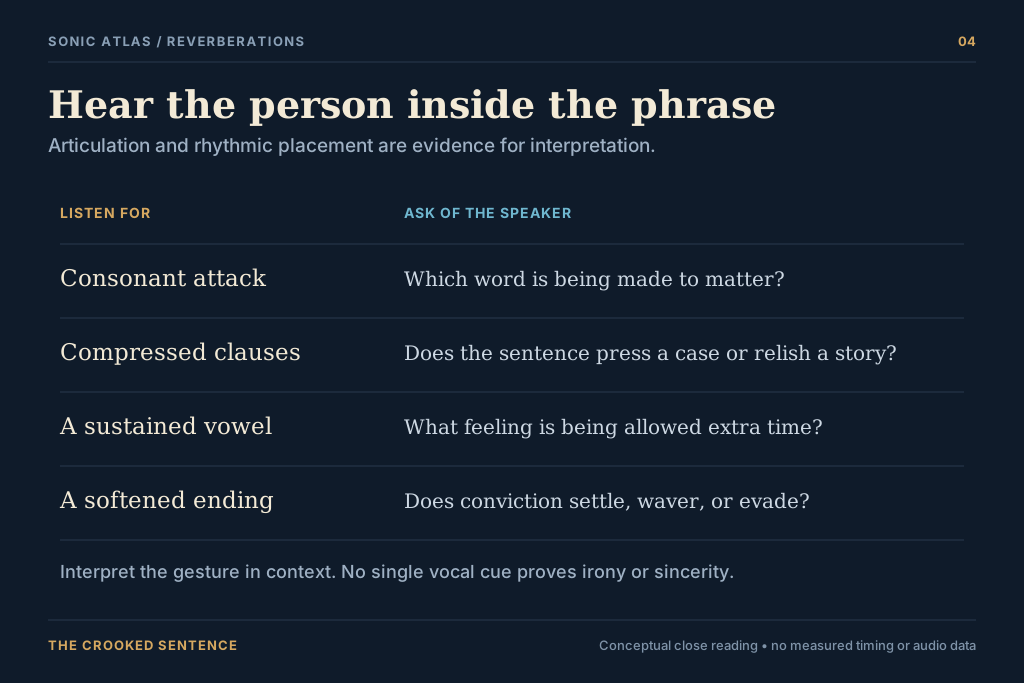
There is an audiophile consequence to all this, although the cartridge will not write your dissertation. Listen for the relationship between consonant attack, sustained vowel, bass movement, and drum accent. Can you hear the sentence gather speed without the underlying pulse becoming uncertain? Does a softened ending change the speaker's apparent conviction? Playback that preserves articulation and rhythmic relationships makes these choices easier to follow. A larger soundstage alone cannot tell you whether the man inside it is lying.
Lynott's delivery benefits from hearing its rounded tone and verbal edges together. Fagen's benefits from hearing the grain and emphatic bite without reducing the voice to nasal caricature. Neither should be polished into anonymous smoothness. Their phrasing depends upon distinctions small enough to escape a casual audition and consequential enough to alter a character. The impressive system is the one that lets the sentence remain intelligible as behavior, rather than merely presenting an attractively illuminated singer between the loudspeakers.
VII. The crooked sentence, properly understood
Lynott and Becker/Fagen make vernacular language carry literary weight without requiring it to dress for a poetry recital. Their songs derive meaning from the friction between disciplined accompaniment and a voice that appears to negotiate its own terms. The comparison reaches beyond guitar harmonies and neighboring radio memories. It concerns the making of a speaker: how rhythm gives a person an attitude, how diction establishes a social world, and how an apparently incidental inflection can expose an entire vanity.
Lynott often invites us to participate in the legend. Becker and Fagen often invite us to notice its structural weaknesses. Both, at their best, let affection and skepticism coexist. That is the achievement worth hearing. The crooked sentence is an engineered asymmetry: sufficiently controlled to remain musical, sufficiently unruly to remain human. Anyone can place a lyric over a chord progression. These writers made it sound as though someone with a past had entered the room and begun choosing what to tell us.
Sources and listening notes
This is a comparative critical reading of the original studio recordings, not a claim of direct influence, an exhaustive literature review, or a measured timing analysis. The illustrations are conceptual; positions and shapes do not represent transcribed syllables or measured audio. No song lyrics are reproduced.
- Maria Henson, “Mystery solved: ‘Deacon Blues’,” Wake Forest Magazine, September 17, 2015. Reprints excerpts from Becker and Fagen's Wall Street Journal songwriting interview. ↩
- Graeme Thomson, “Philip Lynott biographer Graeme Thomson shares his favorite Thin Lizzy songs and the cultural influences that inspired their writing,” Chicago Review Press, 2017. Publisher-hosted commentary and excerpts from Cowboy Song, including discussion of Lynott's timing, vocal inflection, and communal storytelling. ↩
- Chris Salewicz, “Phil Lynott: The Interview (1976),” Louder. Archival interview and later contextual commentary; Lynott discusses lyrics, poetry, and sharing experience through songs.
Listening pairs: “Reelin’ in the Years” / “Dancing in the Moonlight”; “Johnny the Fox Meets Jimmy the Weed” / “Kid Charlemagne”; “Cowboy Song” / “Deacon Blues”; “The Boys Are Back in Town” / “My Old School”; “Dancing in the Moonlight” / “Hey Nineteen.”
Keep Reading
Aja Breathes; Gaucho Merely Has Excellent Manners
Why Steely Dan's 1977 masterpiece Aja remains sonically preferable to its immaculately upholstered successor Gaucho. Gaucho is perfection completed; Aja is perfection kept alive.
Why UFO's Strangers In The Night Edges Out Thin Lizzy's Live And Dangerous
Both are canonical live hard rock recordings. Both capture bands at their absolute peak. But only one is an honest document of what actually happened on stage.
The Case Against Coldplay: A Study in the Industrial Management of Risk
Not a band so much as a hedge. How the music industry solved for the stadium-anthem vacancy by installing its least volatile candidate — and what Radiohead, U2, and Oasis reveal about the choice. A Sonic Atlas essay.
Architecting the Steven Wilson Universe
How one obsessive English auteur turned progressive rock into a modular system of bands, alter egos, sonic laboratories, archival interventions and spatial-audio evangelism — mapped across Porcupine Tree, the side-project laboratories, the solo canon and the remix work.