
The Case Against Coldplay: A Study in the Industrial Management of Risk
Not a band so much as a hedge: the safest possible heir to the stadium throne, hired precisely because it would never surprise anyone. What U2, Oasis, and — above all — Radiohead reveal about the appointment.
Coldplay are not bad. Incompetence would be something — a jagged edge, a wrong note, a pulse. Coldplay are worse than bad. They are safe: the most thoroughly de-risked enterprise in the history of popular music, four chords and one weeping build, engineered to never surprise you, never offend you, never ask a thing of you. Not an accident of limited talent. A business plan. Treat it as one and the whole beige empire snaps into focus.
The critics have been saying it for twenty years. Jon Pareles, in The New York Times in 2005, called them “the most insufferable band of the decade.” The Guardian: “grindingly tedious.” The National: “mundane muzak for the masses.” This is not contrarianism. It is what people conclude after listening closely and finding nothing there.
Four chords and a cattle prod
The charge is sameness, and it is not a matter of taste — it is a matter of inventory. Same major key, same tempo, same arpeggiated piano, same obligatory swell from hush to arena-wide sob. Four chords and one dynamic gesture, run through every record since 2000 with the discipline of a drive-thru.
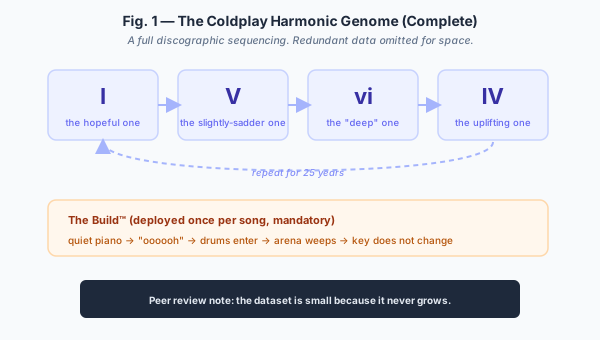
A great three-minute single owes the world no innovation; fair enough. But Coldplay don't sell the single. They sell the appearance of grandeur — the lighting rig of profundity bolted to a jingle. The build arrives on schedule. The “oooh” is administered like a sedative. The drums enter exactly where the focus group said they should. Nothing is risked because nothing is at stake. The sample size never grows because the band never move.
The hedge the industry wanted
Here is the part the apologists never reckon with: Coldplay didn't win the throne. They were appointed to it. By the late 1990s the earnest-stadium slot was emptying, and the industry — which hates a vacancy the way it hates a flop — went shopping for the lowest-volatility heir it could find.
Look at who was failing, and how. U2, the emperors of sincerity-at-scale, had curdled into self-importance — the long slide from Pop (1997) to the day they shoved Songs of Innocence onto half a billion iTunes accounts uninvited, converting the world's biggest band into a notification people clawed to delete. Oasis had the one thing Coldplay would never have — swagger, actual songs, a tune you'd fight for — and set fire to all of it in a backstage brawl in Paris in 2009, too combustible to insure. Two cautionary tales: ego, and chaos.
And then the band the industry would rather you forget: Radiohead. The real heir apparent. OK Computer (1997) had made them the most talked-about guitar band on earth. The throne was theirs to sit on.
They burned it down on purpose.
In 2000 — the exact year Coldplay released Parachutes — Radiohead released Kid A: no guitars, no anthem, none of the formula that had made them bankable. The press, expecting a victory lap, howled: “art-school sulk,” “commercial suicide.” Within the decade those same outlets called it the album of the 2000s. Two British guitar bands, same crossroads, same year. One treated the throne as a trap and risked everything to escape it. The other saw a franchise opportunity and signed the lease.
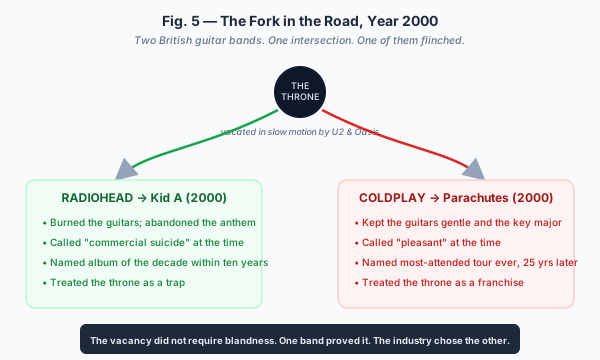
That is the whole indictment. The vacancy did not require blandness — Radiohead proved a guitar band could inherit that scale and spend it on something dangerous. The industry just preferred the one that wouldn't: all of U2's cathedral reach with none of the ego, all of Oasis's audience with none of the fists, standing on Radiohead's exact starting line with none of the nerve. Grammy.com says the quiet part out loud, crediting Parachutes with ushering in “a new wave of mild-mannered guitar bands.” Mild-mannered. They read the risk profile and signed the hedge.
Bigger room, same four chords
The hedge paid out — which the faithful mistake for a verdict. The Music of the Spheres tour grossed roughly $1.52 billion across 13.1 million tickets, the most-attended tour ever mounted. Stupendous numbers. Also completely silent on whether a single song is any good.
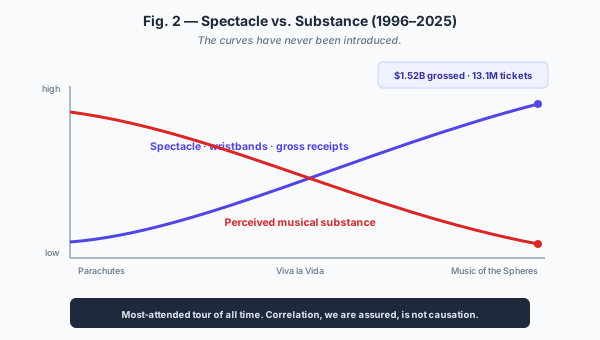
Even the sympathisers buckled: The Guardian watched the spectacle and concluded there was “simply too much going on” — wristbands, lore, a companion app where you can learn the fictional inhabitants of a water planet speak a language called “Aquamarine.” That is the elimination of risk at industrial scale: when the songs can't carry the room, build a bigger room and flood it with light. Grandeur, line-itemed. Catharsis, outsourced to the LED budget. The chords themselves decline to earn a thing.
A sincerity that means nothing
And the words — the portable, all-purpose uplift that sticks to anything because it's about nothing. Paradises, skies full of stars, lights to guide you home: a sincerity so sanded of specifics it slots cleanly into an insurance ad, a graduation reel, or the financing offer on a mid-range SUV.
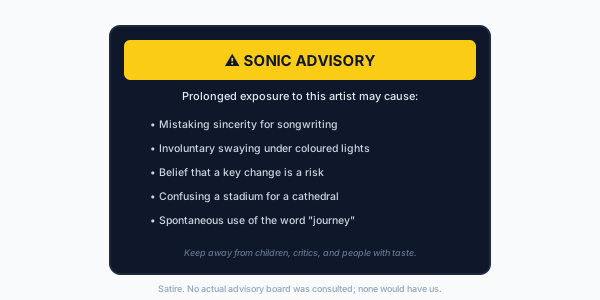
No one doubts the sincerity. The sincerity is the problem — earnest about everything, therefore about nothing, every edge that might snag on a real life carefully filed off. Chris Martin, as one critic had it, resembles “an employee eating a cheese sandwich in his cubicle.” Affectionate. Accurate. Still too kind. (And lest this read as stale: their most-discussed cultural moment of 2025 wasn't a song at all but a stray jumbotron shot that ended a stranger's career — the one piece of genuine drama the machine ever produced, and the band had nothing to do with it.)
The verdict
Popularity isn't the crime; a famous chorus can beat a forgotten concept album in a fair fight. The crime is that Coldplay's defining quality is the absence of risk — thrown into pitiless relief by three contemporaries who each took one. U2 risked overreach. Oasis risked self-destruction and duly obliged. Radiohead risked the whole career on a record that didn't sound like them, and were immortalised. Coldplay risked nothing, were handed everything, and built a billion-dollar monument to the proposition that nothing is precisely what the market ordered.
That is the case. Not that they failed — they've failed at nothing, because they attempted nothing a serious listener would call the point. They were hired to fill a seat. They filled it. The seat was warm, the lighting flattered, and no one, the band least of all, was ever in the slightest danger of being surprised.
A note on method. This is an opinion essay in the Sonic Atlas register — satire and criticism aimed at a body of recorded work and the industry that promoted it. Factual claims (the Pareles essay, the Kid A reception, the Oasis split, the U2 iTunes release, the Music of the Spheres grosses, the 2025 concert incident) are drawn from the public record; the figures are original parody. Sources include The New York Times, Grammy.com, tour box-office reporting, and the critical reassessment of Kid A. Content was paraphrased for compliance with licensing restrictions.
Keep Reading
Phil Lynott and Donald Fagen: Two Masters of the Crooked Sentence
Thin Lizzy and Steely Dan sit in different filing cabinets, but their singers share one craft: conversational prosody. A comparative close reading of how Phil Lynott and Donald Fagen make disciplined arrangements sound like speech — and how phrasing builds a character syllable by syllable.
Architecting the Steven Wilson Universe
How one obsessive English auteur turned progressive rock into a modular system of bands, alter egos, sonic laboratories, archival interventions and spatial-audio evangelism — mapped across Porcupine Tree, the side-project laboratories, the solo canon and the remix work.
Aja Breathes; Gaucho Merely Has Excellent Manners
Why Steely Dan's 1977 masterpiece Aja remains sonically preferable to its immaculately upholstered successor Gaucho. Gaucho is perfection completed; Aja is perfection kept alive.
Why UFO's Strangers In The Night Edges Out Thin Lizzy's Live And Dangerous
Both are canonical live hard rock recordings. Both capture bands at their absolute peak. But only one is an honest document of what actually happened on stage.