
Architecting the Steven Wilson Universe
How one obsessive English auteur turned progressive rock into a modular system of bands, alter egos, sonic laboratories, archival interventions, and spatial-audio evangelism — while the rest of the genre was still arguing about Mellotrons.
There are artists with discographies, artists with side projects, and artists whose careers eventually become so internally connected that the word discography begins to feel intellectually inadequate.
Steven Wilson belongs to the third category.
Calling Wilson merely a progressive-rock musician is rather like describing a cathedral as “a building with some windows.” Technically defensible, perhaps, but useful only if one’s goal is to announce that nuance has packed its bags and left the premises. Porcupine Tree alone would have been enough to secure Wilson a durable place in the post-1970s progressive canon. But Porcupine Tree is only one jurisdiction inside a much larger system: no-man, Bass Communion, I.E.M., Blackfield, Storm Corrosion, Continuum, the solo catalogue, production work, collaborations, archival remixes, multichannel reconstruction, Dolby Atmos, and now an increasingly explicit curatorial philosophy about how recorded music ought to survive the collapse of physical-media culture.
The proper unit of analysis, therefore, is not the album.
It is the Wilson ecosystem.
And ecosystems are best understood not by listing their inhabitants alphabetically, but by examining their architecture: which functions are centralized, which are deliberately isolated, which ideas migrate between projects, which collaborators act as bridges, which aesthetic constraints generate novelty, and why the whole thing somehow remains recognizably Wilsonian even when the music itself changes almost beyond recognition.
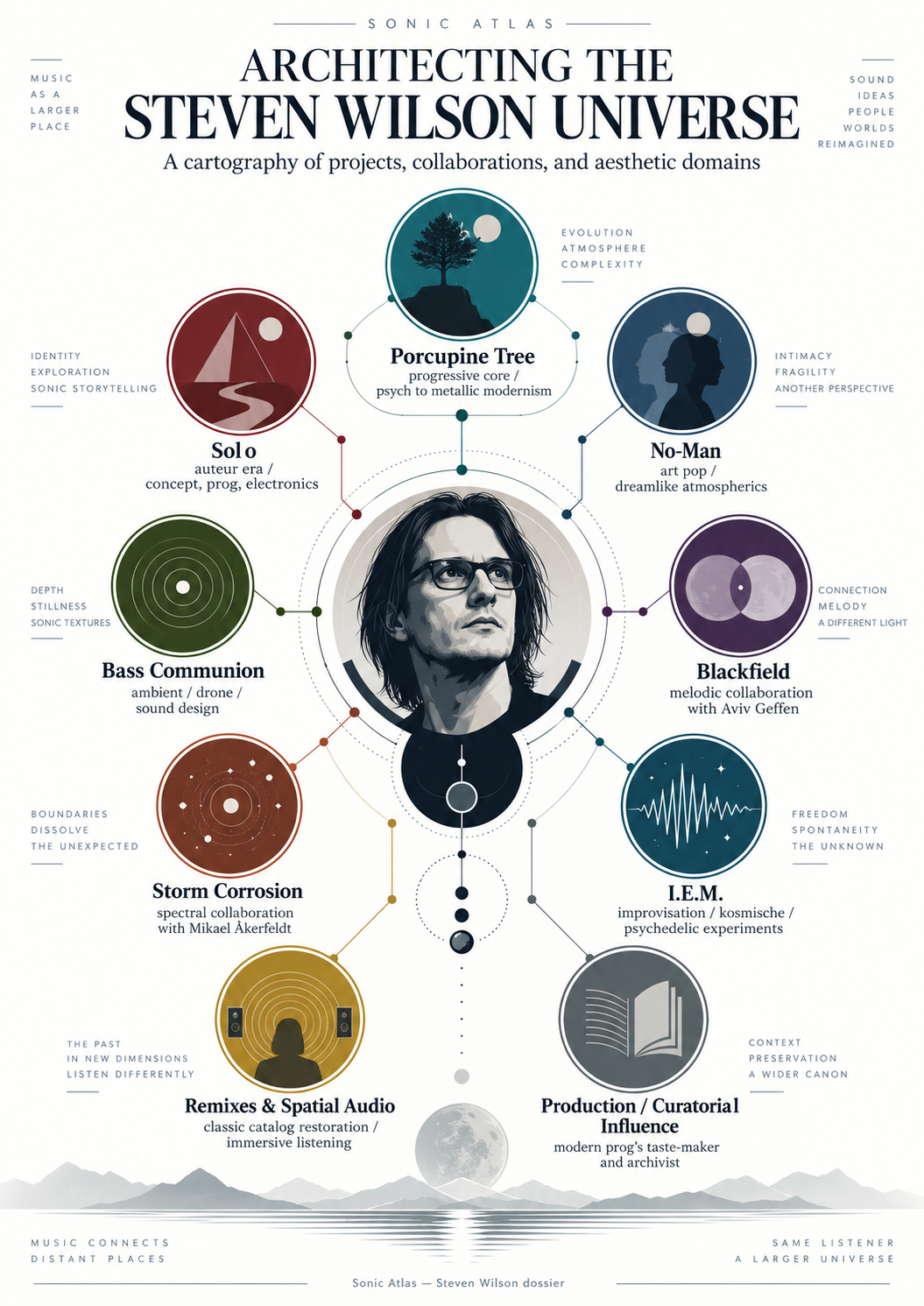
Figure 1 — The System Map: The entire Wilson ecosystem before it is decomposed into domains — Porcupine Tree at the center, with the solo canon, the side-project laboratories, and the curatorial work radiating outward.
First Contact: Palace of Fine Arts, San Francisco
Before the taxonomy, before the graphs, before In Absentia, before Fear of a Blank Planet, before Wilson became a solo artist capable of filling theaters under his own name, there was a room.
For us, that room was the Palace of Fine Arts in San Francisco.
We had carried the memory around for years as “May 2000, ProgFest,” which is the sort of thing human memory does when it is busy preserving the emotional truth and considers bookkeeping someone else’s problem. Porcupine Tree’s own tour archive is less romantic and more useful: the Palace of Fine Arts performance was May 30, 1999, at the Progressive Music Festival in San Francisco.
Fine. The archive wins the date.
Memory keeps the consequence.
That performance was our first introduction to Steven Wilson, and in retrospect it now feels almost absurdly well timed. We encountered Porcupine Tree during the Stupid Dream period: after Wilson’s psychedelic and space-rock apprenticeship, but before the band’s transformation into the darker, heavier, globally consequential organism that would emerge with In Absentia. Lightbulb Sun had not yet arrived. Gavin Harrison had not yet rewritten the rhythmic grammar of the band. The great post-millennial run was still in the future.
What we saw, therefore, was not the finished monument.
We saw the construction site.
And even then there was something difficult to classify. Porcupine Tree had the long-form patience and atmospheric intelligence that progressive-rock listeners recognized, but without the cosplay. There was little interest in merely reproducing the signifiers of 1973. The music contained Floydian space, post-punk reserve, art-rock melancholy, psychedelic drift, pop instinct, studio obsession and the faint suspicion that the guitarist at center stage was already thinking several records ahead.
This matters because encountering Wilson at that point permanently alters the way the later career is understood. For listeners who discovered him through The Raven That Refused to Sing, Hand. Cannot. Erase., or the surround remixes of King Crimson and Jethro Tull, the breadth can appear to be the accumulation of an already-established auteur.
From the Palace of Fine Arts, it looked different.
It looked like restlessness becoming a method.
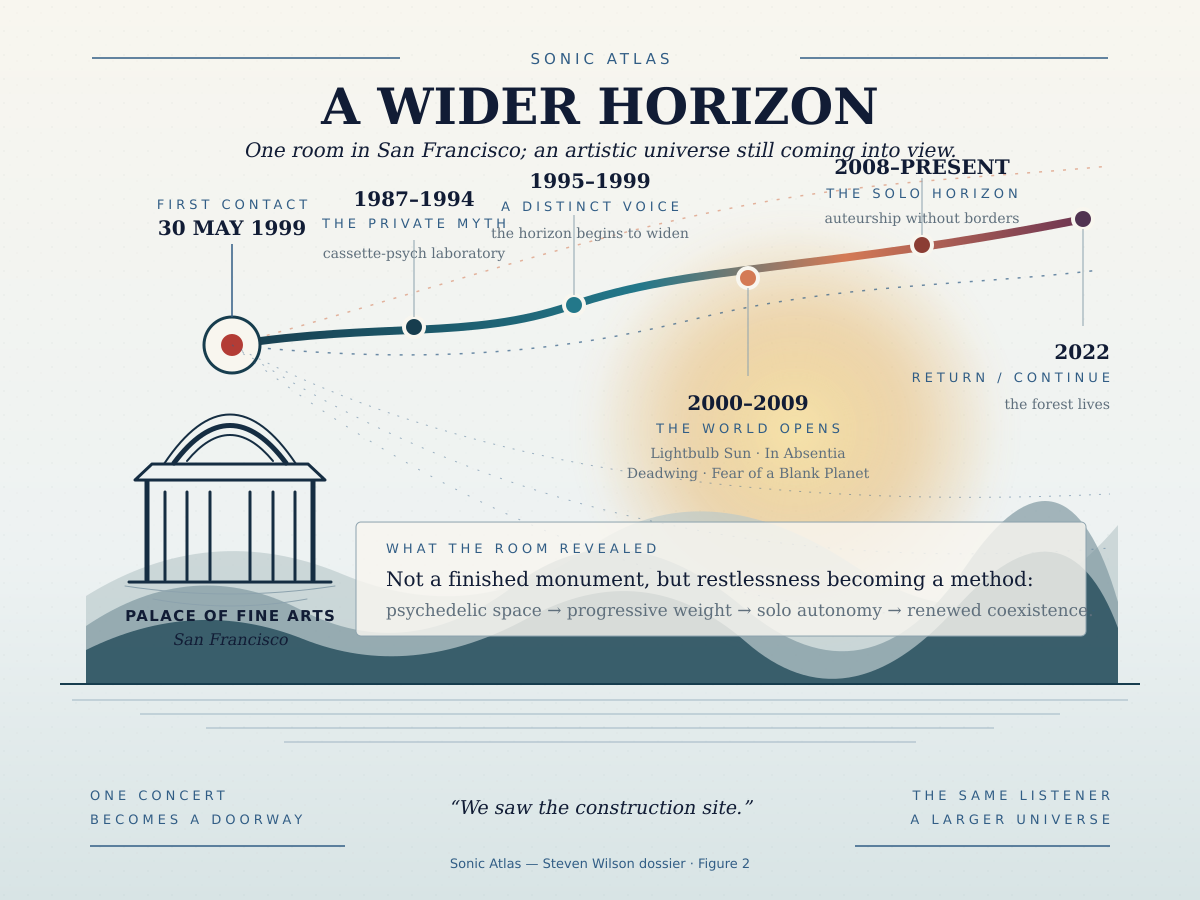
Figure 2 — A Wider Horizon: The personal San Francisco encounter tied to the broader Porcupine-Tree-to-solo evolutionary timeline.
I. The Core Organism: Porcupine Tree as Research Laboratory
The most common mistake in writing about Steven Wilson is to treat Porcupine Tree as his “band” and the rest as ancillary activity.
That gets the hierarchy almost exactly backwards.
Porcupine Tree is better understood as Wilson’s primary long-duration research laboratory: the environment in which ideas about song form, atmosphere, technology, alienation, heaviness, arrangement, production and musical identity were repeatedly stress-tested in public.
The earliest Porcupine Tree material emerged from an almost private mythology — cassette culture, psychedelic pastiche, invented band history, studio experimentation and the wonderfully unfashionable conviction that imagination did not require permission from the marketplace. The Delerium-era records widened that language into something more coherent: extended structures, electronic textures, trance repetition, guitar atmospherics and cosmic scale.
Then Wilson did something far more dangerous than becoming technically better.
He became concise.
Stupid Dream and Lightbulb Sun represent a decisive architectural shift because they demonstrate that Wilson had absorbed a fact some progressive musicians spend entire careers heroically avoiding: complexity is not the same thing as sophistication. A four-minute song can carry as much structural intelligence as a twenty-minute suite if the writer understands harmony, arrangement, negative space, timbral hierarchy and emotional pacing.
That lesson never left.
Even at his most elaborate, Wilson’s best work rarely feels complicated for the sake of being complicated. The machinery may be intricate, but the listener experiences narrative. Odd meters arrive as motion rather than arithmetic. Production detail functions as dramaturgy. Atmosphere is not garnish; it is structural material.
In Absentia: the system learns weight
By 2002, Porcupine Tree had absorbed metal without becoming a metal band.
That distinction is crucial.
The arrival of heavier guitar architecture on In Absentia did not erase the atmospheric or melodic DNA; it expanded the dynamic envelope. Wilson recognized that distorted guitars become far more violent when they emerge from silence, acoustic intimacy or spectral ambience. He treated heaviness as contrast, not as continuous surface area.
This is one reason so much turn-of-the-century progressive metal now sounds oddly beige by comparison. Plenty of bands had distortion. Plenty had virtuosity. Plenty had seven-string guitars tuned low enough to frighten livestock.
What Porcupine Tree increasingly possessed was dynamic dramaturgy.
The listener was not merely hit.
The listener was prepared to be hit.
Deadwing broadened that cinematic sensibility. Fear of a Blank Planet sharpened it into cultural diagnosis: screen-mediated childhood, pharmaceutical numbness, digital alienation, boredom intensified by limitless stimulation. The Incident stretched the architecture toward suite form and brought the first great Porcupine Tree epoch to an uneasy close.
Then the supposedly dead organism returned.
Closure/Continuation in 2022 did not attempt the pathetic nostalgia trick of pretending that no time had passed. Wilson, Richard Barbieri and Gavin Harrison reconvened as an older and more rhythmically decentralized unit. Harrison’s writing contribution became foundational; Barbieri’s sound design remained less “keyboard playing” than environmental engineering; Wilson occupied the role of connective tissue — voice, guitar, bass, production, composition.
The title was unusually accurate.
Not reunion. Not resurrection. Closure / Continuation.
The slash is doing more intellectual work than many bands manage across entire comeback albums.
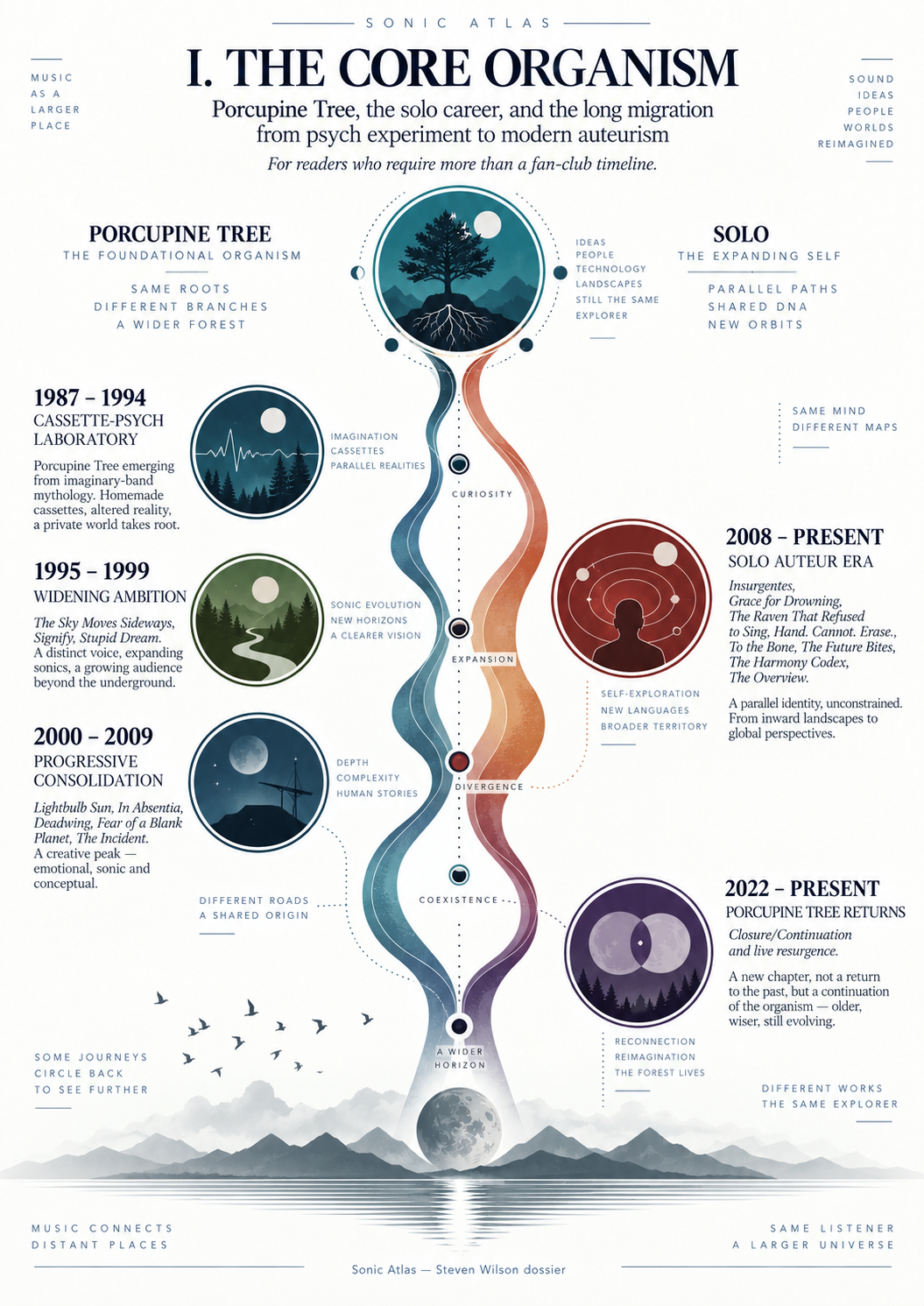
Figure 3 — The Core Organism: Porcupine Tree and the solo career visualized as branching expressions of shared creative DNA.
II. The Outer Orbits: Why the Side Projects Are Not Side Projects
If Porcupine Tree is the central laboratory, Wilson’s other projects are controlled environments.
Each removes certain possibilities in order to expose others.
This is the key to understanding the apparent sprawl. The projects are not random outlets for surplus material. At their best, they function like modular research domains, each governed by a different set of constraints.
And constraint, as serious artists eventually discover, is one of the most productive forms of freedom.
no-man: intimacy without the armor of rock
Wilson’s long partnership with Tim Bowness is essential because no-man reveals a version of his musical personality that the louder bands can obscure.
Dream pop, ambient music, art rock, jazz coloration, minimalist repetition, electronica and emotionally exposed songwriting all enter the frame. Flowermouth could host Robert Fripp, Mel Collins, Lisa Gerrard and members of Japan/Rain Tree Crow without collapsing into guest-star tourism because the musical identity was already sufficiently porous.
Later works such as Returning Jesus, Together We’re Stranger, Schoolyard Ghosts and 2019’s Love You to Bits demonstrate how durable that partnership is. The surface language changes, but the deeper function remains: no-man is where Wilson’s compositional architecture is forced to coexist with Bowness’s lyrical interiority and vocal restraint.
Porcupine Tree often examines alienation from the outside.
no-man frequently lives inside it.
Bass Communion: remove the song, study the sound
Bass Communion is what happens when Wilson strips away one of his most obvious gifts: conventional songwriting.
Beginning in the mid-1990s as what Wilson’s own site describes as experiments in texture, Bass Communion makes sound itself the subject. Processed acoustic sources, drones, field-like environments, decaying media, resonance, repetition and psychoacoustic patience replace verse-chorus expectation.
This work is not peripheral to the “real” Wilson catalogue.
It explains it.
Once one has spent time with Bass Communion, the environmental logic inside Porcupine Tree becomes easier to hear. The long decays, the attention to depth, the use of noise as architecture, the refusal to fill every frequency band simply because Pro Tools makes it possible — these are not accidents of production. They are the residue of a composer who has repeatedly treated timbre as primary material.
Bass Communion also exposes something that audiophile culture occasionally forgets while measuring pressing weights and arguing over power cables: sound quality is not identical to prettiness.
A beautifully reproduced unsettling sound remains unsettling. Good. That is what fidelity is supposed to do.
I.E.M.: the private krautrock engine room
I.E.M. is another controlled experiment, this time around improvisation, kosmische repetition, early electronic music, cosmic jazz and the non-song structures of the late 1960s and 1970s.
Wilson’s official archive describes the project as largely instrumental and improvised, with particular inspiration from experimental music, krautrock and Sun Ra.
In other words, I.E.M. is where the listener can observe Wilson testing process over composition.
The significance becomes obvious later. Repetition in Wilson’s work is rarely mere repetition. A pattern becomes useful because of what changes around it: filtering, density, stereo placement, harmonic context, dynamic intrusion, rhythmic mutation. I.E.M. is one of the places where that patience was cultivated without having to worry about whether anyone was waiting for a chorus.
Blackfield: melody under compression
Blackfield, created with Israeli songwriter Aviv Geffen, performs almost the opposite experiment.
Here the architecture contracts.
Songs become concise, emotionally direct and melodically ruthless. Wilson’s taste for melancholy remains, but the instrumental apparatus is reduced. The first two Blackfield albums in particular demonstrate how effectively his production instincts serve music that does not need to advertise progressive credentials at all.
This is important because Wilson’s detractors have occasionally mistaken his interest in complexity for dependence upon it.
Blackfield disproves the charge.
Give him three or four minutes and a properly wounded melody and he does not require a 13/8 instrumental section to justify his existence. A relief, surely, for the neighbors.
Storm Corrosion: refuse the obvious collaboration
Storm Corrosion may be the most revealing project in the entire network because its governing principle was essentially: do not make the record everyone expects.
Wilson and Opeth’s Mikael Åkerfeldt could easily have produced a monument to progressive metal — riffs, odd meters, virtuoso flourishes, gloomy forests, several metric tons of expensive guitar tone.
Instead they made something closer to psychedelic chamber folk: orchestral dissonance, negative space, acoustic unease, ritualistic pacing, texture, decay and the strong sense that something terrible may have happened in the woods twenty minutes before you arrived.
Wilson has described the record as deliberately far from both metal and the obvious Damnation-style expectation. In 2024 he called it one of his favorite releases in his catalogue and emphasized that the pair followed almost any strange idea precisely because neither wanted the predictable result.
That is the Wilson universe in miniature.
Expectation is not a brief. Expectation is a thing to route around.
Continuum and the further periphery
The collaboration with Belgian experimental musician Dirk Serries under the Continuum name pushes further into ambient, drone and doom-derived abstraction. Wilson’s own collaborations page also points outward to OSI, Marillion, JBK, Orphaned Land, Paatos, Theo Travis, Yoko Ono, Fish, Cipher, Anja Garbarek and others.
This outer layer matters less as a checklist than as evidence of network permeability.
Wilson’s universe is not closed.
It behaves like a system with unusually well-defined identity but unusually open interfaces.
That is rare.
Most artists protect identity by reducing contact.
Wilson appears to protect identity by having enough of it to survive contact.
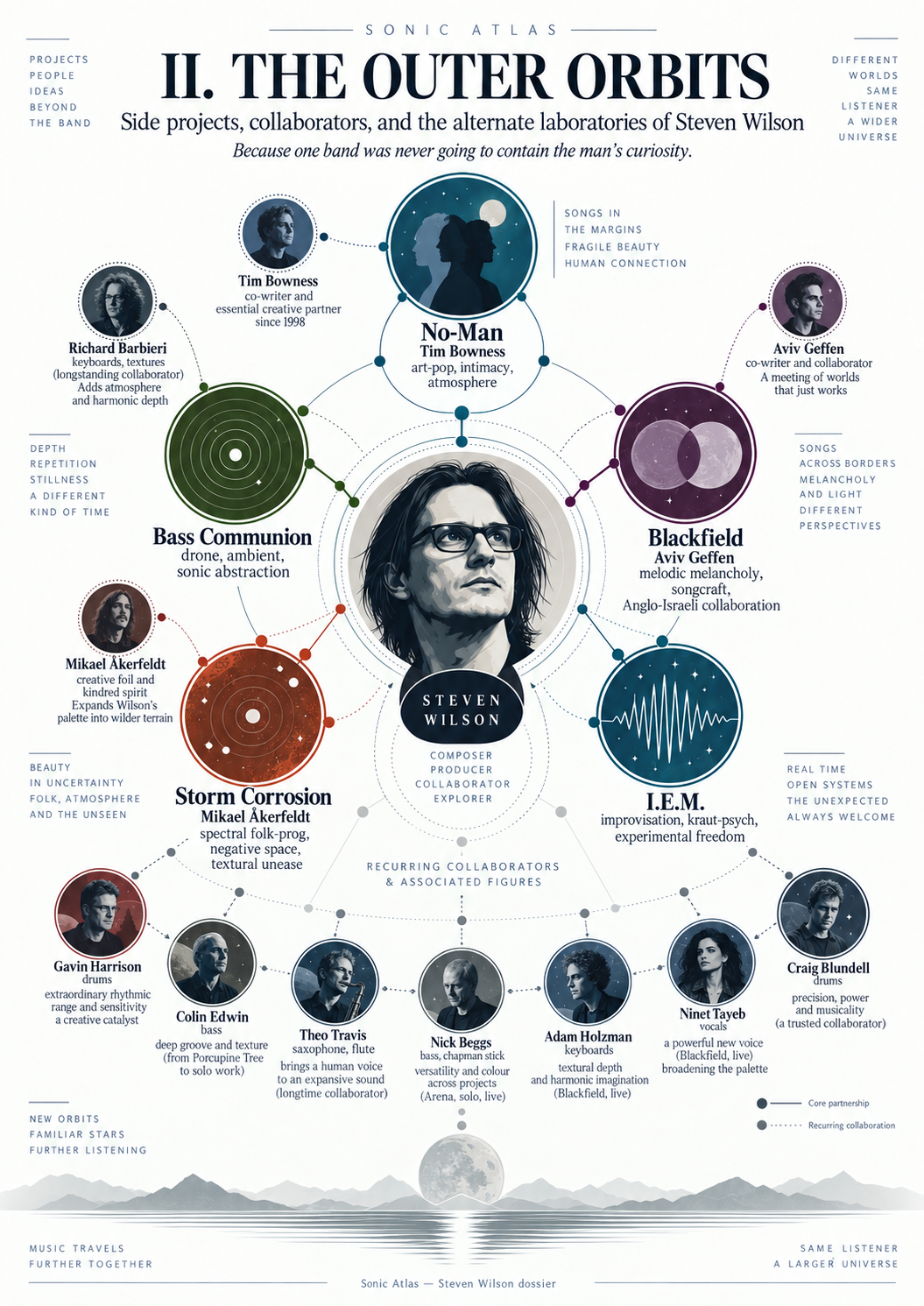
Figure 4 — The Outer Orbits: no-man, Bass Communion, Blackfield, I.E.M., Storm Corrosion and recurring collaborators shown as distinct but connected laboratories.
III. The Solo Canon: The Dissertation, Not the Appendix
If Porcupine Tree is the laboratory and the side projects are controlled experiments, the solo catalogue is the dissertation.
This is where Wilson increasingly stops asking what a particular band identity permits and instead asks what the record itself requires.
That sounds like a small distinction.
It is the entire point.
Insurgentes (2008): identity through deliberate destabilization
Wilson’s first full solo album did not announce freedom by becoming bigger than Porcupine Tree. It announced freedom by becoming less obligated to coherence in the conventional sense.
Noise, industrial texture, shoegaze density, post-punk, piano, electronics and disorienting space coexist. The album is less a declaration of a new genre than a demolition of the idea that Wilson required a stable one.
The solo career begins, appropriately, with a refusal.
Grace for Drowning (2011): maximalism with historical memory
If Insurgentes fractures identity, Grace for Drowning demonstrates that Wilson can absorb the progressive canon without becoming its tribute act.
Jazz harmony, extended structures, Mellotron vocabulary, King Crimson-like abrasion, pastoral interludes, choral texture and cinematic transitions all appear — but they are processed through a modern production intellect.
This is an important difference.
Retro-prog often treats historical style as destination.
Wilson treats it as source code.
The distinction is why one feels archaeology in lesser hands and recombination in his.
The Raven That Refused to Sing (2013): classicism perfected
The Raven That Refused to Sing (And Other Stories) is perhaps the solo album most likely to satisfy the listener who wants “progressive rock” in a recognizable canonical sense: virtuosic ensemble writing, elaborate forms, jazz-rock interplay, vintage tonal colors and macabre storytelling.
Yet the record succeeds because the virtuosity is subordinated to narrative function.
Guthrie Govan can be astonishing without the music turning into an equipment demonstration. Marco Minnemann can perform rhythmic witchcraft without forcing the listener to carry a calculator. Adam Holzman, Nick Beggs and Theo Travis contribute color rather than résumé.
This should not be remarkable.
In progressive rock, unfortunately, restraint frequently qualifies as a supernatural event.
Hand. Cannot. Erase. (2015): the emotional apex
Then Wilson made the record that collapses nearly every major strand of his work into one architecture.
Hand. Cannot. Erase. combines progressive structure, electronic detail, urban isolation, pop melody, virtuoso ensemble writing, domestic imagery, narrative concept and cinematic sequencing. Inspired by the case of Joyce Carol Vincent, the album constructs loneliness not as gothic abstraction but as a failure of social visibility.
This is where Wilson’s recurring themes become almost sociological:
- connection without intimacy,
- technological mediation without human presence,
- physical proximity without community,
- memory as an unstable archive,
- identity as something partly constructed by who notices when it disappears.
The technical accomplishment is considerable.
The emotional accomplishment is greater.
That ordering matters.
To the Bone (2017): the scandal of melody
Some progressive-rock listeners reacted to To the Bone as though Wilson had been discovered selling classified NATO documents to ABBA.
There were pop songs. There were bright surfaces. There were choruses one might remember without first diagramming them.
Civilization, somehow, continued.
In reality, the record merely made explicit something that had been present since Stupid Dream and no-man: Wilson admires sophisticated pop. His musical worldview was never confined to progressive rock, and his podcast conversations with Tim Bowness later made this ecumenism impossible to miss.
For listeners who require their heroes to remain genre mascots, this can be upsetting.
Artists, inconsiderately, are not employed by their fan clubs.
The Future Bites (2021): consumer identity as interface
The Future Bites turns toward electronic pop, digital surfaces and the commodification of identity. Its subject is not merely technology but the way consumption, branding and selfhood collapse into one another.
The production becomes cleaner, more synthetic and more aggressively contemporary.
This is not Wilson abandoning his “real” sound.
It is Wilson refusing the intellectually lazy premise that authenticity resides in one instrumentation set.
A distorted guitar is no more inherently authentic than a synthesizer.
It is merely older hardware with better public relations.
The Harmony Codex (2023): synthesis without nostalgia
The Harmony Codex is less interested in choosing among Wilson’s identities than in allowing them to coexist: electronic composition, progressive structure, ambient space, rock dynamics, detailed sound design and immersive mixing.
By this stage, genre categorization becomes actively counterproductive.
The useful question is no longer “what style is this?”
The useful question is “what spatial and emotional problem is the arrangement solving?”
That is a much more adult conversation.
The Overview (2025): scale returns, but transformed
Then, after years spent irritating anyone who wanted him to repeat The Raven, Wilson released The Overview: two long pieces, roughly 42 minutes in total, structured around the “overview effect” — the cognitive shift associated with viewing Earth from space.
The gesture is progressive in the most obvious formal sense: long-form composition, conceptual unity, sectional development.
But the palette is not 1974.
Electronics, post-rock scale, immersive sound, cinematic sequencing and contemporary production prevent the record from collapsing into historical reenactment.
Wilson’s own description calls it a Kubrickian journey into cosmic scale and human insignificance.
The mature Wilsonian paradox is therefore complete:
He can return to the long-form progressive epic without returning backward.
As of 2026, the next solo album is already gestating; Wilson has publicly requested archival-looking village photographs for its artwork and described a search for a sense of “otherness” and something lost. The system is still moving.
Of course it is.
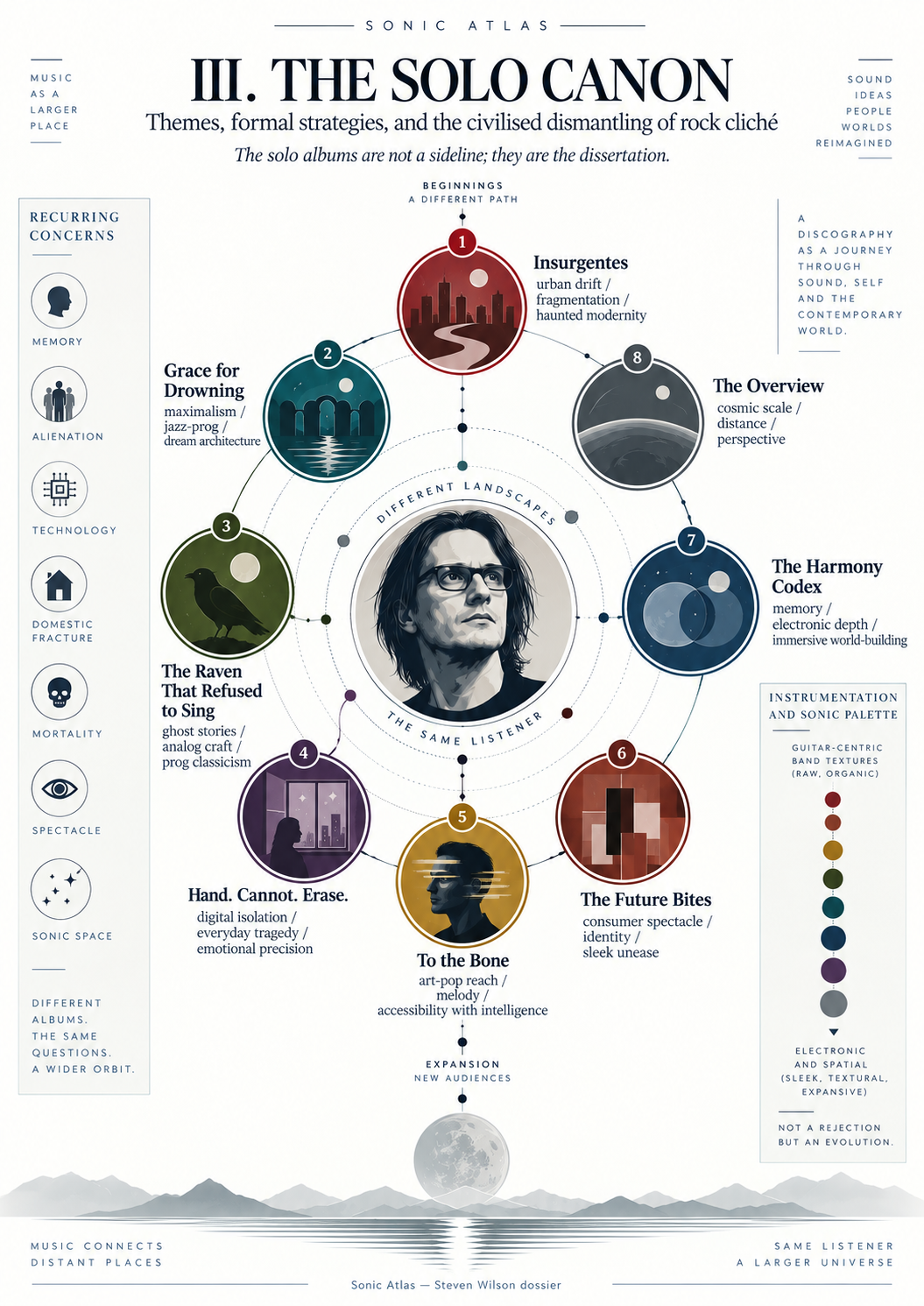
Figure 5 — The Solo Canon: The solo catalogue presented as a conceptual progression — themes, strategies and the steady dismantling of rock cliché — rather than a chronological list.
IV. The Curator’s Hand: When Remixing Becomes Historiography
At some point, the Steven Wilson story becomes larger than composition.
This is the point at which many profiles become clumsy because “remixer” sounds secondary — almost technical — next to “artist.”
That interpretation misunderstands the scale of the intervention.
Wilson’s work on historic catalogues places him inside a peculiar role that sits somewhere between mixer, preservationist, translator, historian and extremely opinionated custodian of multitrack tape.
King Crimson. Jethro Tull. Yes. Gentle Giant. XTC. Caravan. Emerson, Lake & Palmer. Tears for Fears. Ultravox. Black Sabbath. Rush. Pink Floyd. The Who. Roxy Music. Chic. Suede. New Order. Deep Purple. The Rolling Stones. Phil Collins. Marillion. Tangerine Dream.
The list has become almost comically broad.
The important thing, however, is not the celebrity of the catalogue.
It is the philosophy implied by the work.
Remixing is not remastering
Audiophile discourse often mangles these terms with the enthusiasm of a drunk man reorganizing a cartridge-alignment drawer.
A remaster works from an existing mix.
A remix returns to the multitrack — the individual tracks of the original recording — and rebuilds the balance, the space and the perspective from the ground up. It is closer to re-photographing a scene than to retouching a print. Done carelessly, it is vandalism. Done well, it is a second act of authorship performed in respectful dialogue with the first.
Wilson’s reputation rests on the fact that he treats the assignment as the latter. He resists the modern temptation to make everything louder, closer and more aggressive. He tends to preserve the intent while restoring the depth that decades of tape degradation, generational copying and loudness-era mastering had flattened.
The result is a body of work that functions as historiography: not merely reissuing the past, but re-reading it, and in the process arguing for a particular theory of how these records were always supposed to breathe.
The spatial turn: 5.1, then Atmos
The multichannel work is the logical endpoint. If stereo is a window, surround and Dolby Atmos are a room. For an artist who has spent his entire career treating space as structural material, immersive audio was never a gimmick. It was the medium finally catching up to the way he had always heard.
This is where the composer, the producer, the preservationist and the evangelist finally become a single figure. The curatorial philosophy — that recorded music deserves to survive the collapse of physical media in the highest fidelity the format can offer — is not separate from the art. It is the art’s insurance policy.
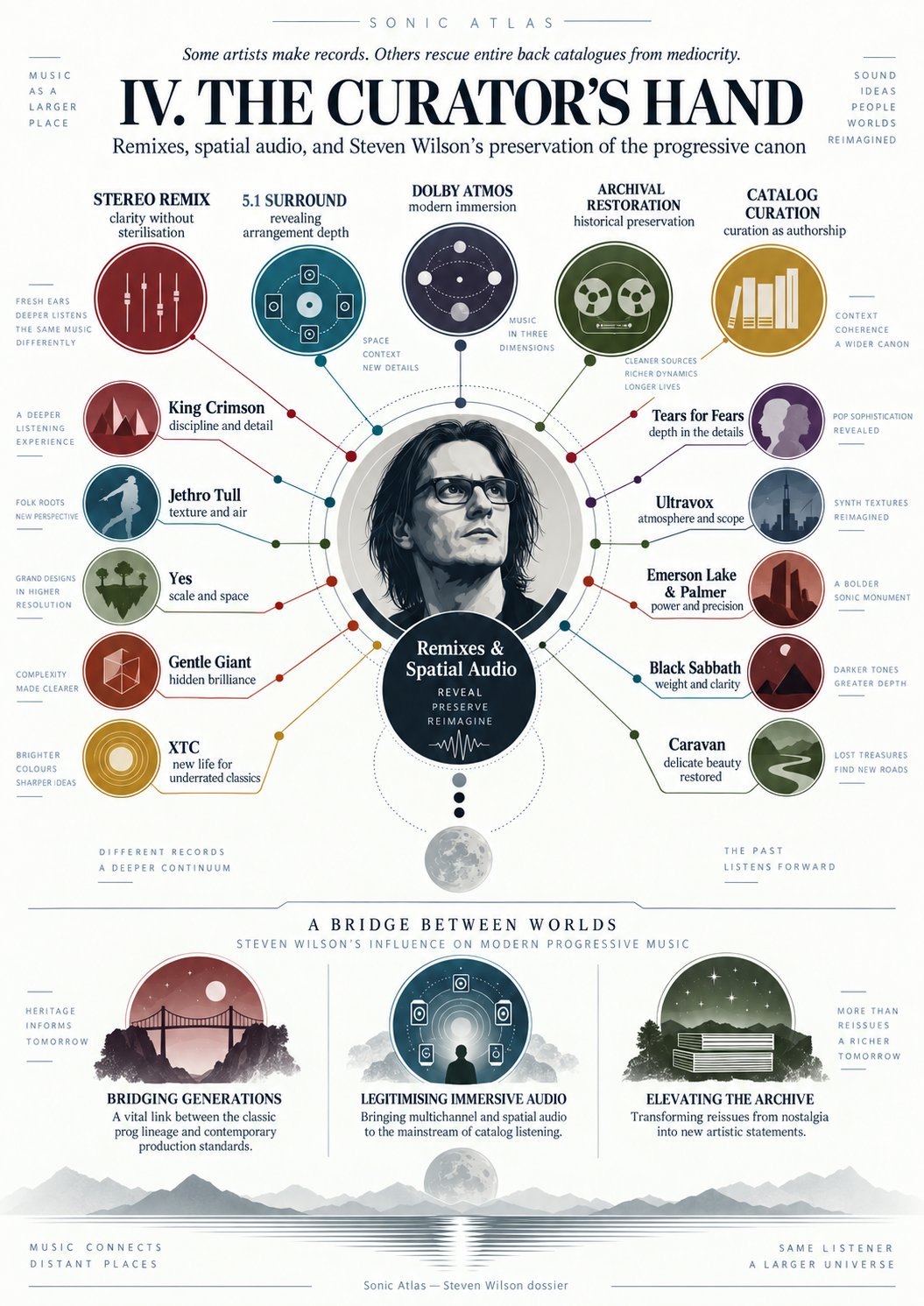
Figure 6 — The Curator’s Hand: The remixing, archival interpretation, 5.1 and Dolby Atmos work connected as one continuous practice — a philosophy of listening made into geometry.
Conclusion: The Universe Is the Work
The most impressive thing about Steven Wilson is not that he has made progressive rock, art pop, ambient music, metal-adjacent music, experimental electronics, cinematic long-form works and multichannel remixes.
Many talented musicians are eclectic.
Eclecticism by itself proves very little.
The achievement is that Wilson has built an artistic system in which those forms interrogate one another.
- Bass Communion teaches us how to hear the space inside Porcupine Tree.
- no-man reveals the melodic and emotional architecture beneath the heavier material.
- I.E.M. exposes the improvisational and kosmische machinery.
- Blackfield proves the songs can survive compression.
- Storm Corrosion demonstrates the value of refusing the obvious.
- The solo albums show an auteur progressively removing institutional constraints.
- The remix work reveals a philosophy of listening.
- The spatial-audio work turns that philosophy into geometry.
And Porcupine Tree remains the great central organism: not because everything else is subordinate to it, but because so many of Wilson’s core questions were first made audible there.
That is why “Steven Wilson universe” is not fan hyperbole.
It is the most accurate available description.
A universe is not defined by uniformity.
It is defined by laws that remain consistent across enormous variation.
Wilson’s laws are recognizable by now: contrast over blunt force; atmosphere as structure; melody without embarrassment; technology without worship; complexity without obligation; history without nostalgia; fidelity as revelation rather than polish; and, above all, the conviction that an artist who has found a successful formula should immediately begin looking for the nearest exit.
There are easier ways to build a career.
There are also easier records to make.
Fortunately, Steven Wilson has shown remarkably little interest in either.
And some of us have been following the construction since a night at the Palace of Fine Arts, when we had no idea just how large the building was going to become.
Keep Reading
The Canterbury Scene: A Cartography of English Eccentricity
A complete critical map of the Canterbury scene — from the Wilde Flowers and Soft Machine to Caravan, Gong, Hatfield and the North, National Health, the international diaspora, and the bands that merely borrowed the waistcoat.
Even in the Quietest of Moments, a Thunderous Applause
From their formation in 1970 to the landmark Breakfast In America and beyond — a personal journey through the catalogue of Supertramp.
The Reason Why Progressive Rock Reigns Supreme
Syncopated rhythms, odd time meters, and stellar musicianship — why progressive rock from the 1970s still commands repeated listens 50 years later.
The Authority of Absence: The Caesura in Progressive Rock
Progressive rock defends its right to play more notes than anyone requested — but its sharper achievement is knowing when to withhold them. How King Crimson, Yes, Rush, Genesis and others use the caesura to intensify an entrance, mark a boundary, and pivot into a new musical world.