
The Canterbury Scene: A Cartography of English Eccentricity
How a few school friends, itinerant Australians, jazz obsessives, difficult organists, and serially unemployable geniuses constructed progressive rock's most civilized nervous system.
There are two customary ways to misunderstand the Canterbury scene. The first is to imagine that it describes music made in Canterbury. The second, only fractionally less embarrassing, is to treat it as a genre: a tidy stylistic drawer into which one may deposit any British band that owns an electric piano, knows a diminished chord, and appears reluctant to discuss motorcycles.
Canterbury is neither place nor genre in the ordinary sense. It is a network: a social, musical, and personnel system whose original nodes happened to form around Canterbury and nearby Lydden during the early 1960s. Its members then migrated through London, Paris, Mallorca, France, Virgin Records, progressive jazz, political song, and one another's rehearsal rooms. The sound traveled because the people traveled. The family resemblance persisted because the musicians kept exchanging harmonic habits, rhythm sections, absurdist manners, and — in a display of resource efficiency that modern corporations could only envy — the same half-dozen keyboard players.
This distinction matters. Caravan and Third-era Soft Machine scarcely sound like the same genre. Kevin Ayers' languid art-pop, Gong's planetary mythology, Robert Wyatt's bruised political intimacy, Hatfield and the North's chamber-jazz wit, and National Health's architectural fusion are not stylistic duplicates. They are related organisms. To flatten them into “quirky prog” is to describe Burgundy as “red drink”: not strictly false, merely evidence that the speaker should be moved away from the cellar.
What follows is therefore not another best-of list. It is a cartography: the ancestry, migrations, musical grammar, canonical recordings, and disputed borders of the Canterbury continuum.
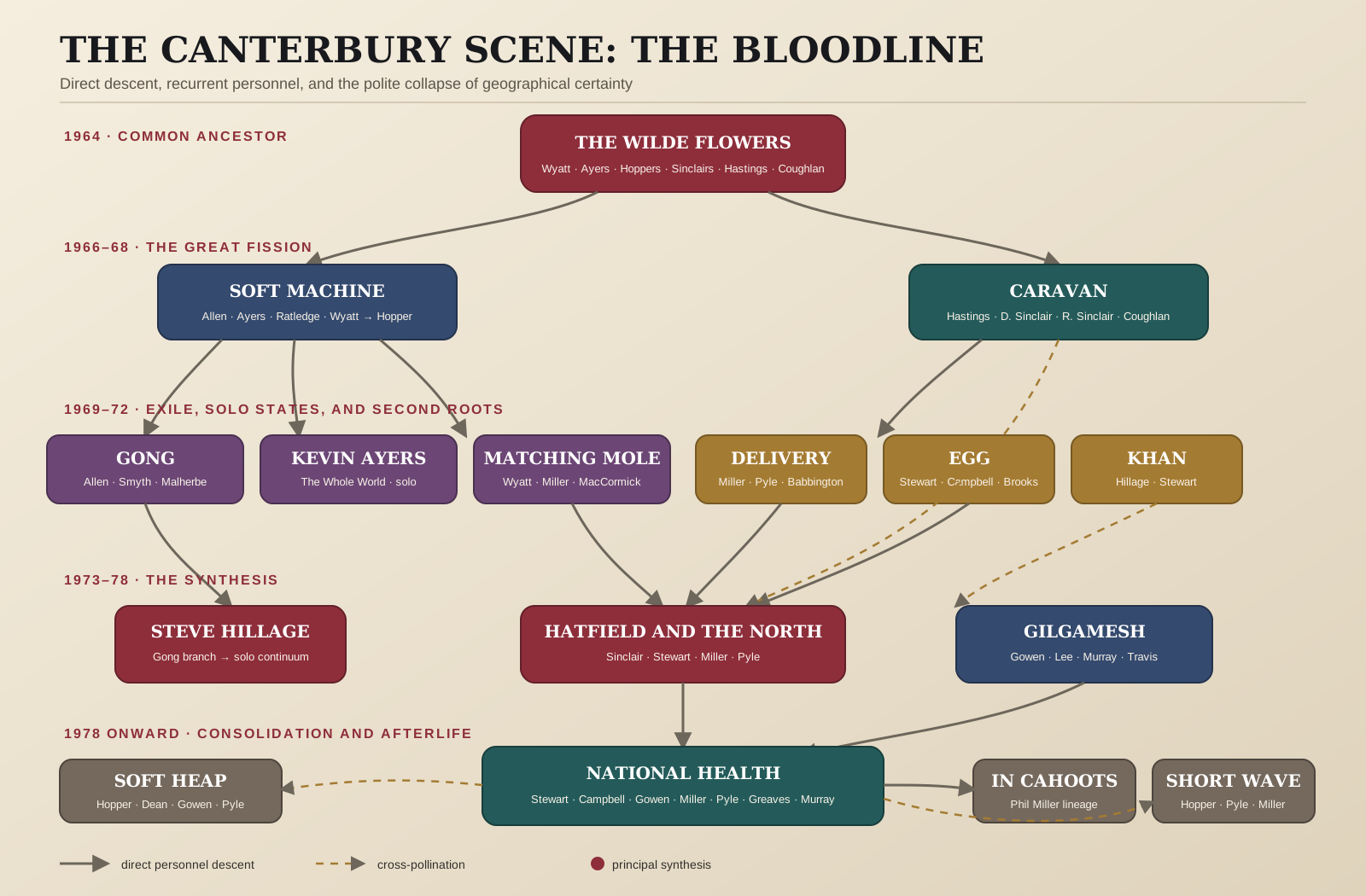
Figure 1 — The Bloodline: Solid routes indicate direct personnel descent; dashed routes indicate strong cross-pollination. Geography is already losing the argument.
I. A Methodological Nicety: Bloodline Before Adjective
Membership in the Canterbury scene is best judged through three tests.
- Genealogy: Did the artist descend directly from the Wilde Flowers, Soft Machine, Caravan, Delivery, Uriel/Egg, or their immediate circles?
- Circulation: Did key musicians move between recognized Canterbury groups, carrying compositional or performance practices with them?
- Grammar: Does the music use the scene's characteristic language — jazz-derived harmony, elastic meter, fuzz organ, composed counterpoint, dry vocal whimsy, and an unusually permeable border between song and improvisation?
The first two tests establish the historical core. The third explains the international afterlife. An artist may pass the grammar test without possessing the bloodline: Supersister, Picchio dal Pozzo, The Muffins, Moving Gelatine Plates, and later groups such as Zopp or Homunculus Res belong to the Canterbury diaspora, not the original scene. This is not demotion. Champagne made in Kent may be splendid, but nomenclature exists because civilization occasionally requires standards.
The useful model is concentric. At the center sit the people and bands formed by direct association. Around them lie immediate satellites, then stylistic descendants, then boundary cases. Beyond that perimeter is ordinary progressive rock wearing a slightly whimsical expression.
II. The Prehistory: Before the Cathedral Acquired a Rhythm Section
The origin story begins not with a record contract but with an adolescent social circle. Robert Wyatt, Hugh and Brian Hopper, Mike Ratledge, and their friends absorbed modern jazz, Dada, Beat writing, early electronics, and continental bohemianism. Australian guitarist Daevid Allen entered this orbit after meeting Wyatt; Kevin Ayers arrived with charisma, a magnificent baritone, and the durable intuition that effort should never be allowed to spoil one's afternoon.
The Wilde Flowers formed in 1964. Their changing membership included Wyatt, Ayers, Hugh Hopper, Brian Hopper, Richard Sinclair, Pye Hastings, Richard Coughlan, and Dave Sinclair. They released nothing during their original life, which is almost too perfect: the foundational Canterbury band existed principally so that later scholars could draw arrows away from it. Archival collections eventually preserved its demos and rehearsals, but its historical importance lies in human topology. Nearly every primary branch begins here.
By 1966 the circle split into the two foundational propositions:
- Soft Machine took Wyatt, Ayers, Ratledge, and Allen toward psychedelic experimentation, modern jazz, tape manipulation, and eventually instrumental severity.
- Caravan gathered Pye Hastings, Richard and Dave Sinclair, and Richard Coughlan into a more pastoral, melodic, and domestically English form.
One branch investigated consciousness. The other investigated what might happen if a perfect pop melody were invited to tea and detained for twenty-two minutes.
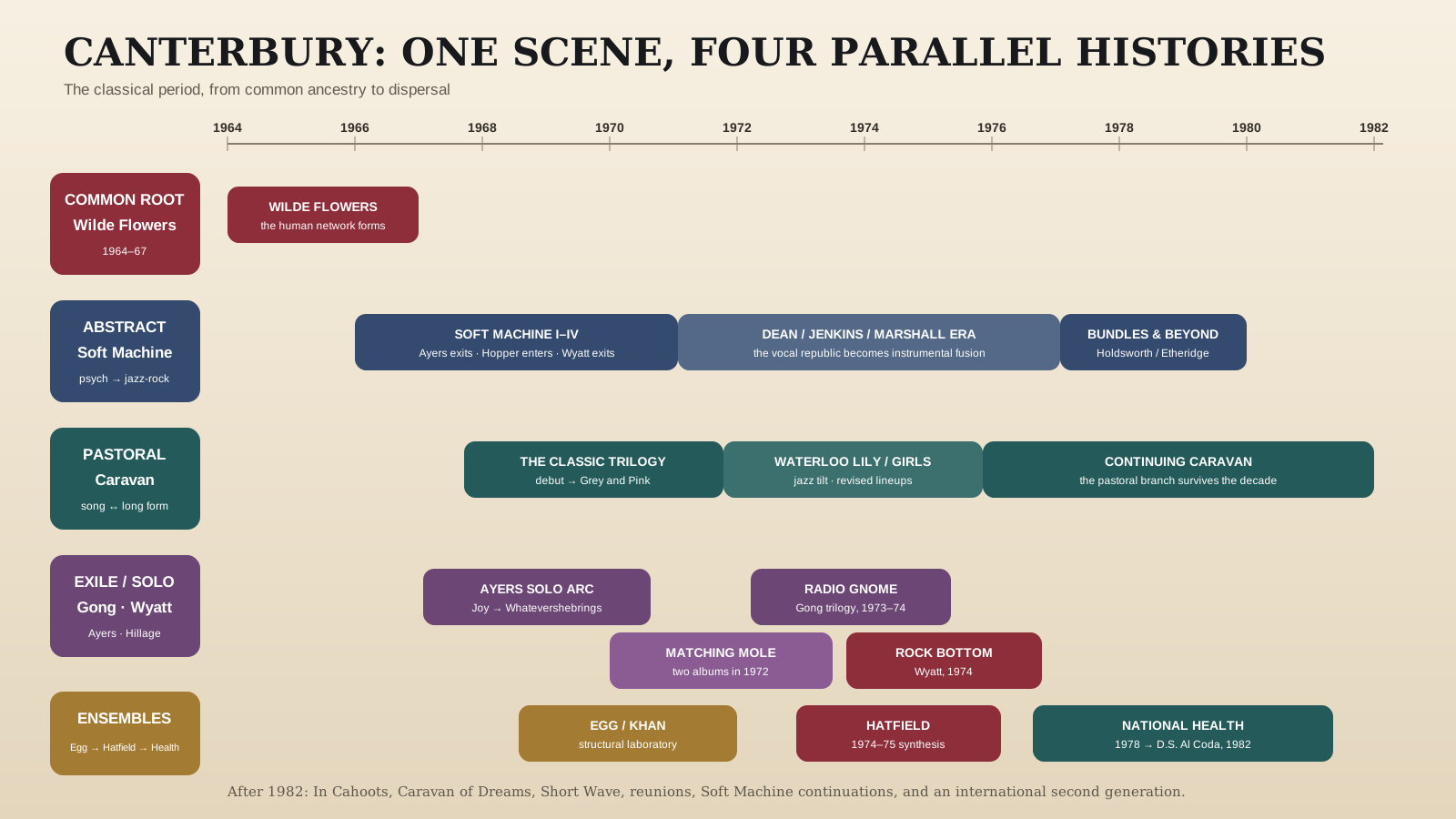
Figure 2 — The Principal Chronology: The scene does not “end” in 1982; it ceases to behave like one generation and becomes a repertoire, a diaspora, and a method.
III. The Great Fission: Soft Machine and Caravan
Soft Machine: from psychedelic cabaret to post-vocal republic
Soft Machine's early identity was inherently unstable. Allen's guitar and conceptual mischief, Ayers' songs and bass, Ratledge's organ, and Wyatt's drumming and voice created a band that could be comic, abrasive, melodic, and rhythmically implausible within the same few minutes. Allen was denied re-entry to Britain in 1967 after a French trip; the remaining trio continued and toured the United States with the Jimi Hendrix Experience. Ayers departed after the first album, and Hugh Hopper's arrival pushed the group further toward composed jazz-rock.
The canonical ascent is brutally clear: The Soft Machine (1968), Volume Two (1969), Third (1970), and Fourth (1971). Across those records, song form is gradually dissolved into modular composition and improvisation. Ratledge's Lowrey organ — frequently overdriven into a grainy, horn-like abrasion — became one of the scene's defining timbres. Hopper's fuzz bass could act as foundation, counter-line, or controlled electrical disturbance. Wyatt's drumming remained buoyant even when the writing became geometrical; his voice made the earlier music human enough to prevent it from turning into a mathematics department with amplifiers.
Wyatt's dismissal in 1971 was more than a personnel change. It removed the group's most vulnerable and song-oriented element. Elton Dean's saxophone had already intensified the jazz vector. Later arrivals from Nucleus — Karl Jenkins and John Marshall — helped convert Soft Machine into an increasingly polished instrumental fusion unit. Allan Holdsworth's guitar made Bundles (1975) a formidable record, but by then “Soft Machine” described a corporate lineage more convincingly than the original social chemistry. Excellent music, certainly. The same organism? That depends on how much philosophical violence one is willing to commit upon the Ship of Theseus.
Caravan: the pastoral constitution
Caravan's first great period answered Soft Machine's urban abstraction with melody, narrative, warmth, and the floating sustain of Dave Sinclair's organ. The essential sequence — Caravan (1968), If I Could Do It All Over Again, I'd Do It All Over You (1970), and In the Land of Grey and Pink (1971) — established the accessible face of Canterbury without becoming musically simple.
Pye Hastings brought English pop craft and a gently rueful voice. Richard Sinclair supplied melodic bass playing, a warmer and more characterful baritone, and songs whose humor seemed to have escaped from a very literate pub. Dave Sinclair favored long, lyrical keyboard lines over Ratledge's acidic attack. Richard Coughlan kept irregular structures coherent without advertising the difficulty.
In the Land of Grey and Pink is the gateway because it reconciles the entire proposition: compact songs on one side, the extended “Nine Feet Underground” on the other, whimsy without infantilism, virtuosity without the usual progressive-rock need to arrive wearing ceremonial armor. Waterloo Lily (1972), with Delivery pianist Steve Miller entering and Richard Sinclair soon departing, tilted toward jazz. For Girls Who Grow Plump in the Night (1973) restored some of the melodic equilibrium with a revised cast.
Soft Machine and Caravan thus define the field's primary axis: abrasion versus warmth, laboratory versus garden, discontinuity versus song. Every later Canterbury act locates itself somewhere between those poles — or, in Gong's case, leaves the planet entirely.
IV. The Exiles: Allen, Ayers, and Wyatt Build Private Countries
Daevid Allen and Gong: Canterbury acquires a cosmology
Stranded outside Britain, Daevid Allen settled in France and co-founded Gong with poet and vocalist Gilli Smyth. Didier Malherbe's reeds, Tim Blake's synthesizers, Steve Hillage's guitar, Mike Howlett's bass, and Pierre Moerlen's percussion eventually produced the celebrated Radio Gnome Invisible trilogy: Flying Teapot (1973), Angel's Egg (1973), and You (1974).
Gong belongs to Canterbury genealogically but expands its grammar beyond English reserve. Smyth's “space whisper,” Allen's glissando guitar, Malherbe's liquid saxophone, Blake's electronics, and the mythology of Pot Head Pixies and Zero the Hero turn the scene into communal psychedelic theater. Yet beneath the flying crockery lies serious rhythmic and timbral intelligence. You in particular balances ritual groove, electronic atmosphere, composed motifs, and improvisational release with an ease that many later space-rock bands reproduced only cosmetically.
After Allen and Smyth left, the ensemble moved toward percussion-rich fusion, eventually becoming Pierre Moerlen's Gong. Hillage's Fish Rising (1975) distilled the cosmic branch into a guitar-centered solo language. Gong is therefore both branch and portal: Canterbury moving into French counterculture, jazz fusion, electronic music, and a durable international mythology.
Kevin Ayers: indolence as advanced compositional strategy
Ayers' solo records demonstrate that Canterbury sophistication need not announce itself through velocity or density. Joy of a Toy (1969), Shooting at the Moon (1970), and Whatevershebringswesing (1971) combine pop, cabaret, psychedelia, orchestration, and surreal humor. The Whole World brought him into contact with David Bedford, Lol Coxhill, and a young Mike Oldfield.
Ayers could make the avant-garde sound as though it had overslept in a deck chair. This was not naïveté. It was refusal: refusal of bombast, of careerist consistency, and of the progressive assumption that complexity must perspire visibly. His records sit at the scene's most languorous edge, but their harmonic side doors and sudden formal turns reveal the same intelligence.
Robert Wyatt: the conscience of the network
Wyatt formed Matching Mole after Soft Machine, its name a bilingual joke derived from machine molle. The group's two 1972 albums joined Wyatt with Phil Miller, Bill MacCormick, and first Dave Sinclair, then New Zealand keyboardist Dave MacRae. Matching Mole restored songs, fragile vocals, collective improvisation, and political unease to the post-Softs vocabulary.
Following Wyatt's 1973 accident and paralysis, his music became still more singular. Rock Bottom (1974) is not merely a Canterbury masterpiece; it is one of the central works of British art music in the rock era. Its slowly unfolding keyboard harmonies, inward pulse, Alfreda Benge's imagery, and Wyatt's unguarded voice create a world too intimate for ordinary progressive display. Ruth Is Stranger Than Richard (1975) turns outward again toward ensemble playing and jazz. His later work grew more explicitly political while retaining that unmistakable mixture of tenderness, obliquity, and harmonic ambiguity.
If Canterbury has a moral center, it is Wyatt: the musician who made vulnerability structurally rigorous.
V. The Secondary Metabolism: Delivery, Egg, Khan, and Matching Mole
The scene's family tree is routinely simplified into Wilde Flowers → Soft Machine/Caravan → everyone else. That is convenient and wrong. A second root system supplied many of the players who would construct the mid-1970s synthesis.
Delivery began as a blues-oriented group involving guitarist Phil Miller, pianist Steve Miller, drummer Pip Pyle, saxophonist Lol Coxhill, vocalist Carol Grimes, and bassist Roy Babbington at different points. Its importance lies less in a unified “Canterbury sound” than in the subsequent circulation of Phil Miller, Steve Miller, Pyle, and Babbington. Delivery is the capillary system through which jazz instincts entered the later network.
Uriel, formed by Dave Stewart, Mont Campbell, Clive Brooks, and Steve Hillage, became Egg after Hillage left. The same quartet briefly recorded as Arzachel for contractual reasons. Egg's Egg (1970), The Polite Force (1971), and belated The Civil Surface (1974) favor organ-led structures, odd meters, contrapuntal discipline, and a colder species of wit. Where Caravan smiles, Egg raises one eyebrow and asks whether you have completed the required reading.
Hillage reunited with Campbell in Khan, whose sole album Space Shanty (1972) links Egg's structural intricacy to Hillage's emerging cosmic guitar language. It is a crucial hinge record: too compositionally exact to be merely space rock, too ecstatic to remain in Egg's seminar room.
Matching Mole, meanwhile, joined Wyatt's Soft Machine inheritance to Phil Miller's Delivery lineage. That conjunction prepared the ground for the scene's most elegant ensemble.
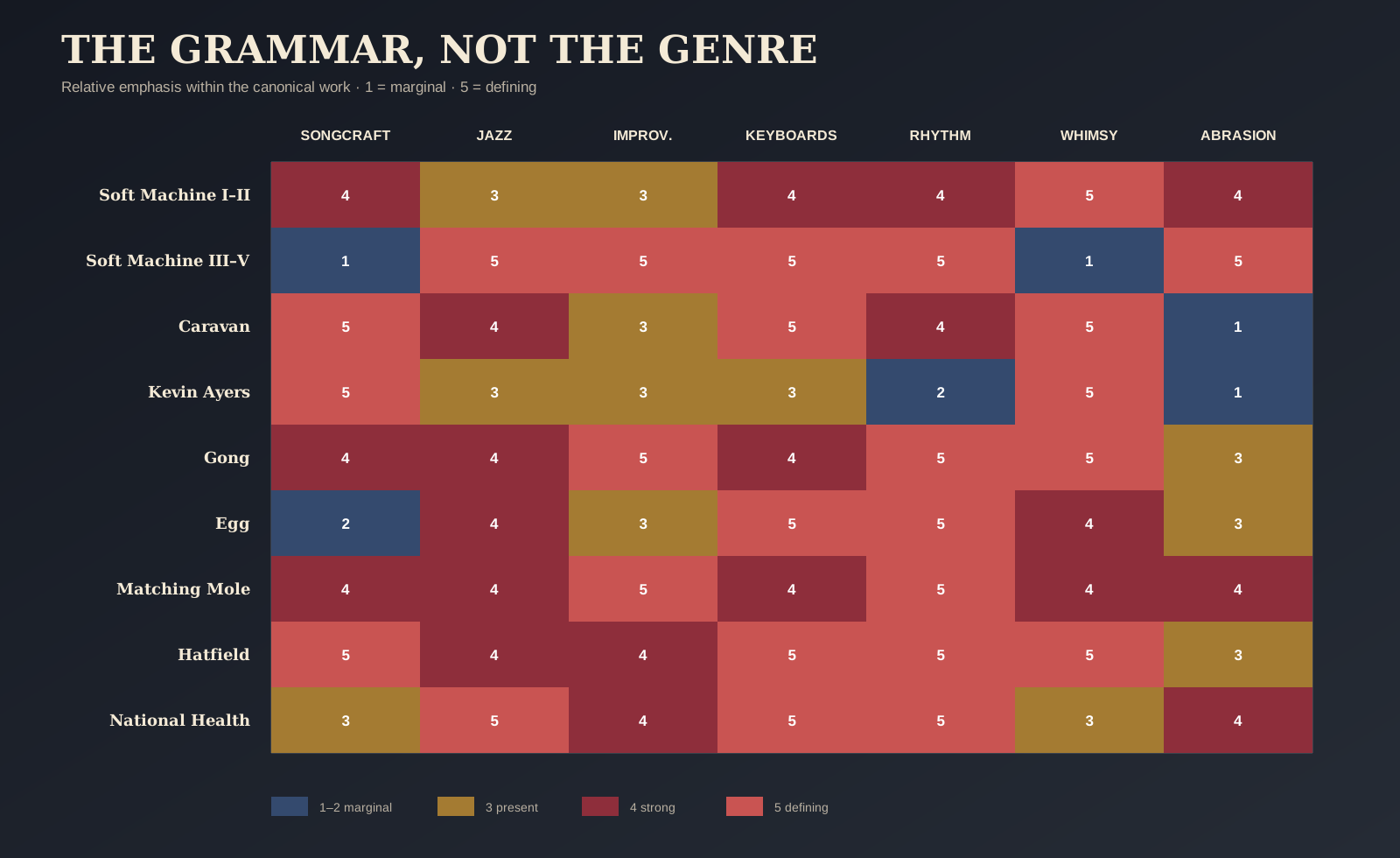
Figure 3 — A Comparative Grammar, Not a Quality Ranking: Anyone attempting to reduce this field to a single “Canterbury sound” is invited to explain how Kevin Ayers and Fourth are the same genre without the assistance of hand-waving.
VI. Hatfield and the North: The Republic of Perfect Proportion
Hatfield and the North assembled in 1972 from Phil Miller, Pip Pyle, Richard Sinclair, and Dave Stewart, after a brief transitional phase involving Steve Miller and Dave Sinclair. The personnel alone reads like a constitutional convention: Delivery, Caravan, Gong-adjacent drumming, and Egg brought into one room and persuaded to behave.
The two studio albums, Hatfield and the North (1974) and The Rotters' Club (1975), may be the purest expression of the Canterbury synthesis. Sinclair's voice and bass supply warmth; Miller's guitar avoids heroic posturing in favor of angular, searching lines; Stewart's keyboards and compositions impose intricate form; Pyle's drumming makes asymmetry swing. The Northettes — Barbara Gaskin, Amanda Parsons, and Ann Rosenthal — add wordless vocal color that functions as instrumentation rather than decoration.
Hatfield's achievement is proportion. Pop miniature, jazz improvisation, chamber counterpoint, obscene pun, and extended composition coexist without the joints showing. “Son of ‘There's No Place Like Homerton’,” “Mumps,” “Share It,” and “Fitter Stoke Has a Bath” occupy different formal scales yet share the same cultivated irreverence.
This is also the point at which the famous “Canterbury whimsy” reaches adulthood. The humor is not decorative nonsense pasted onto clever music. It is an anti-pomp mechanism. Hatfield could write structures as demanding as nearly any British progressive group, then puncture the grandeur before it curdled into self-worship. One wishes several cape-owning contemporaries had taken notes.
VII. National Health: The Grand Synthesis Arrives After the Market Has Left
When Hatfield dissolved, Dave Stewart and keyboardist Alan Gowen conceived National Health, drawing initially on Phil Miller, Mont Campbell, Bill Bruford, Amanda Parsons, and others before settling through several formations. Neil Murray, John Greaves, Pip Pyle, and Gowen himself all became important to the group's history.
The debut National Health (1978) and Of Queues and Cures (1978) are the scene at maximum architectural density. The writing is long-form, contrapuntal, rhythmically elaborate, and meticulously voiced. Yet the best passages retain the Canterbury refusal to equate seriousness with solemnity. Greaves' bass gives Of Queues and Cures unusual force; Miller remains a master of the anti-cliché guitar phrase; Stewart's keyboards organize large structures without bleaching them of personality.
National Health arrived at a commercially absurd moment. Punk had redrawn the cultural map, progressive rock had become an accusation, and the economics of touring a large ensemble were punitive. Naturally, the band responded by producing some of the most sophisticated music in the entire lineage. History is often vulgar in this way.
After Gowen's death in 1981, D.S. Al Coda (1982) served as tribute and closing statement. National Health marks the end of Canterbury's classical period not because the music vanished, but because the original network could no longer sustain itself as a concentrated scene.
VIII. The Circulatory System: Why the Names Keep Reappearing
The Canterbury story becomes intelligible when musicians, rather than band logos, are treated as the unit of analysis.
- Robert Wyatt connects Wilde Flowers, Soft Machine, Matching Mole, solo work, and a large collaborative avant-garde.
- Hugh Hopper connects Wilde Flowers, Soft Machine, solo electronics, Soft Heap, and later ensembles including Short Wave.
- Richard Sinclair connects Wilde Flowers, Caravan, Hatfield and the North, Camel, and Caravan of Dreams.
- Dave Stewart connects Uriel/Arzachel, Egg, Hatfield, National Health, Bruford, and his long partnership with Barbara Gaskin.
- Phil Miller connects Delivery, Matching Mole, Hatfield, National Health, and In Cahoots.
- Pip Pyle connects Delivery, Gong, Hatfield, National Health, Soft Heap, In Cahoots, and later projects.
- Daevid Allen connects Soft Machine's conception to Gong's multinational universe.
- Steve Hillage connects Uriel, Arzachel, Khan, Gong, solo work, and later electronic production.
- Alan Gowen connects Gilgamesh, National Health, and Soft Heap, and supplies the late scene with one of its most distinctive compositional minds.
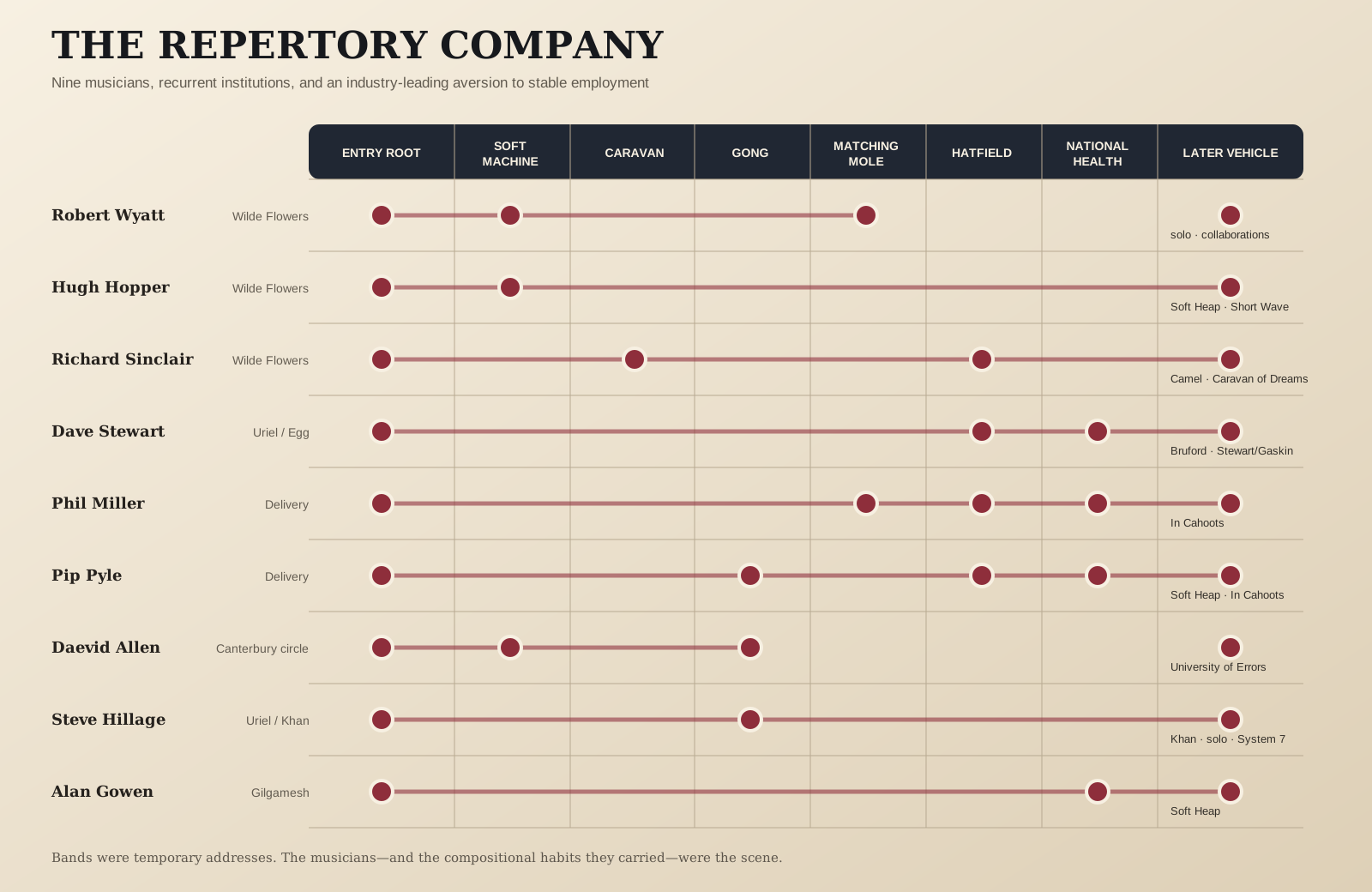
Figure 4 — Personnel, Not Publicity Photographs: The same musicians repeatedly recombined, which is why the scene behaves more like a repertory company than a genre.
Two additional bridges complicate the family portrait. Gilgamesh, led by Gowen, developed a parallel keyboard-centered jazz-rock language and shared a celebrated double-quartet concert with Hatfield; Gowen's move into National Health completed the connection. Soft Heap — Hugh Hopper, Elton Dean, Alan Gowen, and Pip Pyle, with Dave Sheen involved in the Soft Head variation — recombined Soft Machine, Gilgamesh, and Hatfield/National Health lineages into improvisation-heavy fusion.
Phil Miller's In Cahoots carried the instrumental language forward from the early 1980s. Richard Sinclair's Caravan of Dreams restored the vocal, melodic branch in the 1990s. Short Wave reunited Hopper, Pyle, Didier Malherbe, and Phil Miller. These were not nostalgic replicas. They were later configurations of the same network logic.
IX. The Border Tribunal: Camel, Henry Cow, Quiet Sun, and Other Petitioners
No serious map is complete until it marks the disputed territory.
Camel: related by marriage, not birth
Camel is routinely labeled Canterbury because Richard Sinclair and Jan Schelhaas joined the band in the later 1970s, and because Camel's melodic jazz-rock can sit comfortably beside Caravan. The personnel link is real; the original genealogy is not. Camel formed independently in London and developed its own language. Rain Dances (1977) and Breathless (1978) contain genuine Canterbury blood in the lineup. Mirage and Moonmadness, magnificent though they are, do not become Canterbury retroactively merely because the record shelf is arranged sympathetically.
Verdict: adjacent, later cross-pollinated, not core.
Henry Cow: intellectual neighbors with a shared driveway
Henry Cow emerged from Cambridge, not Canterbury, and developed a more radical compositional and political program that fed the Rock in Opposition movement. Yet the scenes overlapped through musicians and collaborators: John Greaves moved into National Health; Fred Frith and Dagmar Krause intersected with Wyatt and the wider art-rock network. The affinity is substantial, but the lineage remains distinct.
Verdict: allied avant-garde, not Canterbury proper.
Quiet Sun and 801: the Roxy-side annex
Quiet Sun included Phil Manzanera, Bill MacCormick, Charles Hayward, and Dave Jarrett. Its Mainstream (1975), recorded after the group had effectively dispersed, shares jazz-rock complexity and direct connections through MacCormick and the broader scene. Manzanera's 801 projects then gathered musicians including Brian Eno, MacCormick, and others into a cosmopolitan art-rock setting.
Verdict: strong satellite.
Nucleus and Isotope: jazz-rock suppliers
Nucleus contributed Karl Jenkins and John Marshall to Soft Machine; Isotope involved Gary Boyle and, at one stage, Hugh Hopper. Both belong primarily to British jazz-rock, but their personnel exchanges altered Canterbury's later instrumental vocabulary.
Verdict: critical tributaries, distinct rivers.
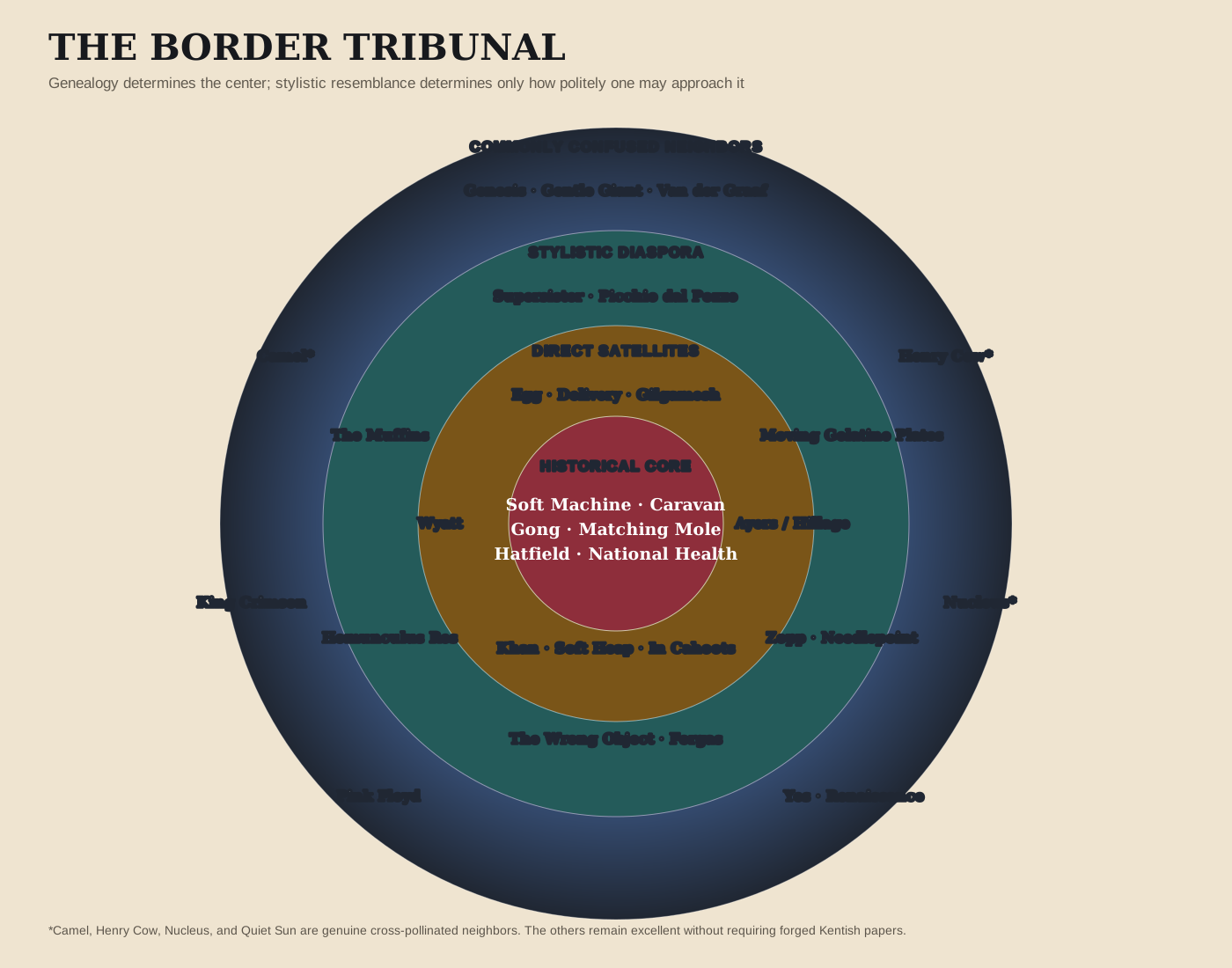
Figure 5 — The Border Tribunal: Musical excellence does not confer citizenship. Genesis remains outside, however many times someone plays a twelve-string guitar near a lawn.
X. The Canterbury Grammar: What the Ear Actually Hears
A social network alone does not explain why musicians in Italy, France, the Netherlands, Spain, Norway, and the United States later produced music instantly recognized as Canterbury-derived. The network generated a grammar.
1. Harmony that smiles while changing the locks
Canterbury writing frequently uses extended jazz harmony, non-functional chord movement, modal ambiguity, and stepwise voice-leading. The effect is neither blues orthodoxy nor symphonic-prog triumphalism. Chords drift sideways; major and minor colors coexist; resolution arrives obliquely. Dave Stewart's writing can make a cadence feel like a theorem with a punch line. Caravan uses similar sophistication beneath melodies that remain gracious enough to hum.
2. The organ as weather system
Ratledge's fuzz organ, Dave Sinclair's sustained melodic lines, Steve Miller's electric-piano inflections, Stewart's tightly voiced keyboards, and Gowen's lucid complexity are not interchangeable. Together, however, they establish keyboards as structural atmosphere — not merely accompaniment and not the baroque upholstery favored elsewhere in progressive rock.
3. Rhythm without marching orders
Odd meter appears frequently, but Canterbury drummers tend to preserve lift. Wyatt, Pyle, Coughlan, Brooks, Marshall, and Moerlen approach pulse differently; the shared principle is mobility. Bars expand, contract, and pivot without becoming an athletic demonstration. The listener should feel momentum before noticing arithmetic.
4. Anti-heroic virtuosity
Phil Miller may be the exemplary Canterbury guitarist because his lines resist grandstanding. His tone can be dry, his phrasing angular, his note choices unsettlingly exact. Hillage is more ecstatic and Holdsworth more fluid, yet the core culture generally mistrusts the heroic solo as public monument. Technique serves ensemble argument.
5. Humor as epistemology
The puns, domestic surrealism, naughty jokes, nonsense syllables, and absurd titles are often treated as charming garnish. They are more fundamental. Canterbury humor rejects rock's appetite for inflated self-importance. It creates distance between the composer and the composition, allowing formidable technique to coexist with doubt, play, and human scale.
6. The porous membrane between song and improvisation
The finest Canterbury records do not alternate dutifully between “song” and “solo.” They let one state mutate into the other. A vocal miniature opens into instrumental architecture; a written line loosens into collective play; improvisation returns carrying altered thematic material. Form behaves organically even when its construction is ferociously deliberate.
XI. The International Diaspora: Canterbury Without Kent
Once a grammar exists, geography becomes optional.
The Dutch group Supersister developed witty, keyboard-led progressive rock close enough to the Canterbury temperament to become an honorary relation. France produced Moving Gelatine Plates and Forgas Band Phenomena; Italy produced Picchio dal Pozzo and, much later, Homunculus Res; Belgium contributed Cos and later The Wrong Object; the United States produced The Muffins and Glass; Sweden's Kultivator joined pastoral texture to more aggressive ensemble writing. None belongs to the original social scene, but all demonstrate the portability of its syntax.
The twenty-first-century continuation is not mere revivalism. Syd Arthur possessed an actual Kentish connection while recombining psychedelic song and progressive rhythm. Zopp revived organ and electric-piano sonorities with modern production. Needlepoint, Amoeba Split, Lunophone, Tom Penaguin, and Magick Brother Mystic Sister represent different international refractions. The Facelift archive's “Canterbury 2.0” series usefully documents this second-generation field.
The important distinction is between imitation and continuation. Imitation reproduces surface markers: fuzz organ, whimsical title, irregular meter. Continuation understands the deeper contract — complexity without pomposity, improvisation without shapelessness, and humor without novelty-song collapse.
XII. A Canon for People Who Intend to Listen Rather Than Collect Names
The following route is chronological in logic, not release date. It is designed to reveal the network one mutation at a time.
Foundation
- The Wilde Flowers — The Wilde Flowers: archival prehistory; listen for identities not yet separated into bands.
- Soft Machine — Volume Two: the pivot from psychedelic song to modular, jazz-informed composition.
- Caravan — In the Land of Grey and Pink: the pastoral-pop constitution and the long-form ideal in equilibrium.
Expansion
- Soft Machine — Third: the decisive move into extended electric jazz composition.
- Kevin Ayers — Whatevershebringswesing: cultivated indolence, orchestration, and art-pop side doors.
- Gong — You: the cosmological branch at peak instrumental integration.
- Robert Wyatt — Rock Bottom: private catastrophe transmuted into formal beauty.
Synthesis
- Egg — The Polite Force: organ-led rigor and metric gamesmanship without symphonic perfume.
- Khan — Space Shanty: the Stewart/Campbell architecture meeting Hillage's ascent.
- Matching Mole — Matching Mole's Little Red Record: wit, politics, and ensemble fracture.
- Hatfield and the North — The Rotters' Club: the scene's most balanced statement.
- National Health — Of Queues and Cures: contrapuntal grandeur after grandeur had become commercially inadvisable.
Afterlife
- Hugh Hopper — 1984: tape, fuzz bass, and experimental solitude.
- Gilgamesh — Another Fine Tune You've Got Me Into: Gowen's parallel line brought into focus.
- Soft Heap — Soft Heap: the improvising bloodstream exposed.
- In Cahoots — Cutting Both Ways: Phil Miller carries the language beyond the canonical decade.
- Picchio dal Pozzo — Picchio dal Pozzo: proof that the grammar survived export.
- The Muffins — Manna/Mirage: the American branch with its own muscular intelligence.
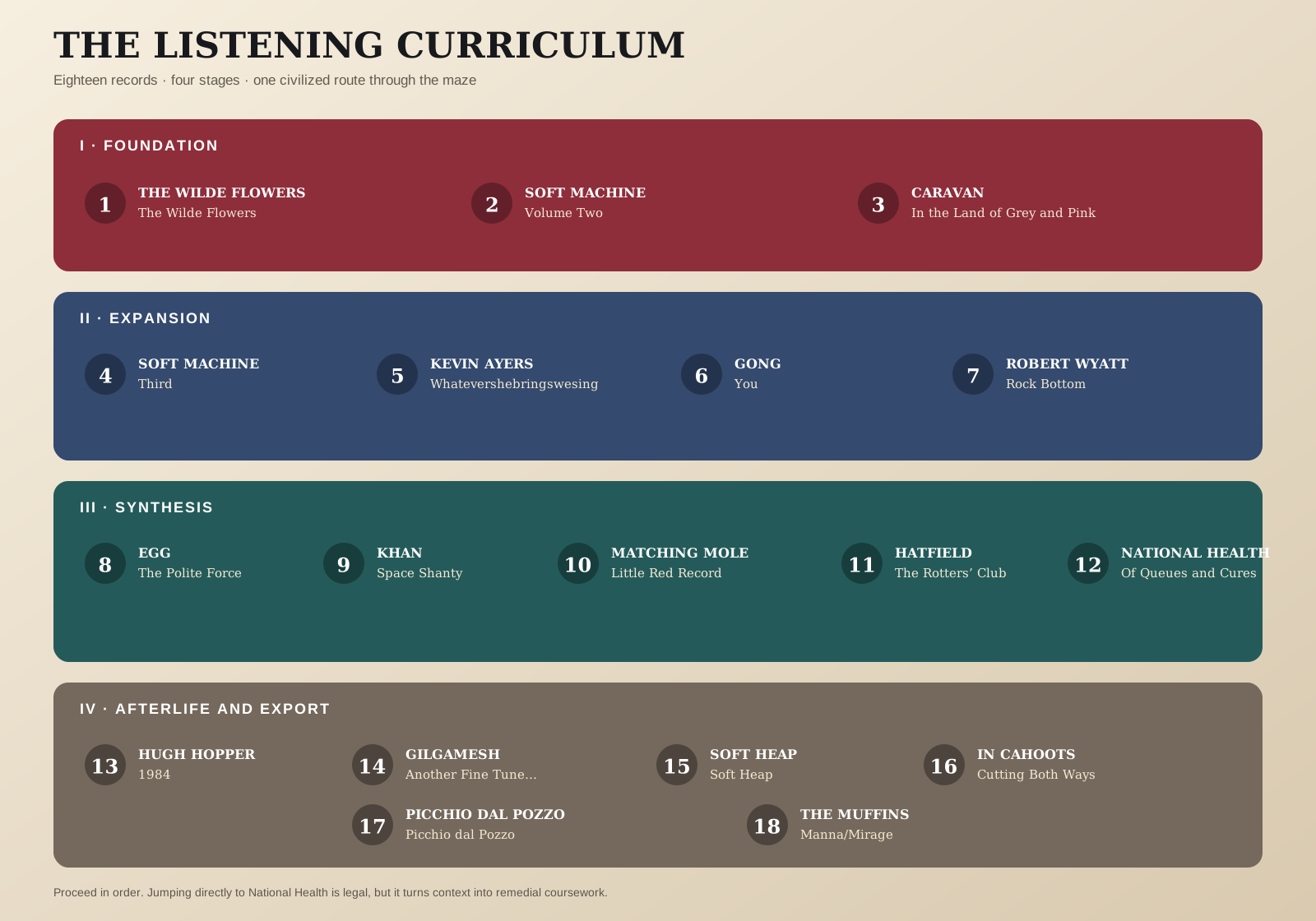
Figure 6 — The Listening Route: Skipping directly to National Health is permitted, just as one may begin philosophy with Wittgenstein; it merely advertises an avoidable appetite for confusion.
XIII. A Note for the Serious Playback System
Canterbury recordings are not uniformly audiophile spectaculars. Many were made under budget pressure, assembled across sessions, or balanced according to period expectations that did not include subwoofer-assisted litigation. Yet the music is unusually revealing of system behavior because its arrangements depend on timbral separation and low-level interaction.
On a resolving analog system, listen for four things:
- Organ texture: fuzz organ should retain harmonic grain rather than collapse into a flat buzz. Ratledge's sound is abrasive, not featureless.
- Bass articulation: Hugh Hopper's fuzz bass, Richard Sinclair's melodic lines, and John Greaves' forceful attack require pitch definition. Warmth without contour turns the family tree into shrubbery.
- Dense ensemble separation: Hatfield and National Health need lateral placement and depth. If keyboards, reeds, guitar, and voices congeal at the center, the system is summarizing instead of reproducing.
- Transient elasticity: Wyatt and Pyle depend on quick attack followed by natural decay. Excessive damping makes the odd meters dutiful; excessive bloom makes them drunk.
Original pressings are not automatically sovereign. Several titles exist in variable condition, with noisy surfaces or mastering differences that can matter more than label-country fetishism. Buy by identifiable edition, condition, and credible cutting information where available. “First pressing” is not a sacrament, and Discogs median price is not peer review.
XIV. What the Map Finally Reveals
The Canterbury scene's greatness lies in the refusal to choose between opposites. It made music that could be cerebral without becoming bloodless, funny without becoming trivial, pastoral without becoming quaint, and technically difficult without demanding applause for the difficulty. Its major figures distrusted rock grandeur but not ambition. They replaced spectacle with structure, domination with interplay, and mythology of the solitary genius with a dense network of collaboration.
That network is why the scene survived its own historical moment. Soft Machine's modern-jazz severity, Caravan's melodic domesticity, Gong's interplanetary commune, Wyatt's radical intimacy, Hatfield's perfect proportions, and National Health's late monumentalism all remain legible as one extended culture because musicians and ideas continually crossed the boundaries.
Canterbury was never a cathedral of progressive rock. Cathedrals imply hierarchy, permanence, and reverent silence. It was closer to an exceptionally well-stocked common room: doors ajar, tea going cold, cigarette smoke in the curtains, someone explaining an impossible time signature, someone else making a filthy pun, and Robert Wyatt quietly discovering that the human voice could hold the whole unstable arrangement together.
The map is untidy because the music was alive. Only lesser genres fit neatly in boxes.
Research Notes and Further Reading
This essay distinguishes direct personnel lineage from later stylistic influence. Dates and personnel routes were cross-checked against the following historical and specialist sources:
- Aymeric Leroy, Legends in Their Own Lunchtime: An Exploration of the Canterbury Scene (Cuneiform Records, 2026). Bibliographic record.
- Graham Bennett, Soft Machine: Out-Bloody-Rageous (SAF Publishing, 2005).
- Marcus O'Dair, Different Every Time: The Authorised Biography of Robert Wyatt (Serpent's Tail, 2014).
- Calyx: The Canterbury Website, founded by Aymeric Leroy; biographies, interviews, chronologies, family trees, and discographies.
- Facelift: The Canterbury Scene and Beyond, including archival interviews and the “Canterbury 2.0” series.
- Romantic Warriors III: Canterbury Tales (Zeitgeist Media, 2015), a documentary history built around interviews with surviving participants.
- Official Caravan, Soft Machine, and Gong band archives.
Editorial scope: “Entire” here means the traceable historical network, its principal recordings, direct successor ensembles, critical tributaries, and documented international diaspora. It does not mean that every session appearance by every participant has been converted into a ceremonial footnote. That would not be scholarship; it would be a hostage situation.
Keep Reading
Architecting the Steven Wilson Universe
How one obsessive English auteur turned progressive rock into a modular system of bands, alter egos, sonic laboratories, archival interventions and spatial-audio evangelism — mapped across Porcupine Tree, the side-project laboratories, the solo canon and the remix work.
The Progressive Rock Family Tree: How Yes, King Crimson, Genesis and the Entire Prog Genome Connect
A personnel-based map of progressive rock, from Yes, King Crimson, Genesis and ELP through Canterbury, U.K., Asia, neo-prog, Porcupine Tree, Dream Theater and the modern progressive ecosystem.
The Authority of Absence: The Caesura in Progressive Rock
Progressive rock defends its right to play more notes than anyone requested — but its sharper achievement is knowing when to withhold them. How King Crimson, Yes, Rush, Genesis and others use the caesura to intensify an entrance, mark a boundary, and pivot into a new musical world.
Even in the Quietest of Moments, a Thunderous Applause
From their formation in 1970 to the landmark Breakfast In America and beyond — a personal journey through the catalogue of Supertramp.