
The Progressive Rock Family Tree: How Yes, King Crimson, Genesis and the Entire Prog Genome Connect
A personnel-based map of progressive rock — from Yes, King Crimson, Genesis and ELP through Canterbury, U.K., Asia, neo-prog, Porcupine Tree and the modern progressive ecosystem.
Calling this a family tree is already a concession to readability.
Trees are orderly. Progressive rock is not.
The genre did not grow as a clean sequence in which one generation of bands neatly begat the next. It behaved more like a nervous system: musicians crossed scenes, rhythm sections migrated, keyboardists defected, guitarists joined supergroups, touring players became permanent members elsewhere, and supposedly separate branches repeatedly folded back into one another.
That is why this Sonic Atlas map is built around personnel connections rather than vague claims of influence.
If a line exists here, there is a human being on it.
The result is less a genealogy than a progressive-rock genome — a map of how Yes, King Crimson, Genesis, Emerson Lake & Palmer, Soft Machine, Gong, Camel, U.K., Asia, Marillion, Dream Theater, Porcupine Tree and dozens of related projects form one surprisingly interconnected system.
And one terminology point matters before going any further: this is progressive rock and neo-prog, not “neo-classical.” Neo-classical rock and metal is a different lineage associated with the deliberate adoption of classical compositional and virtuoso traditions. The post-Marillion ecosystem mapped here is conventionally called neo-progressive rock, or neo-prog.
How to Read the Maps
The diagrams are intentionally broken into composites. A single all-inclusive graph becomes nearly useless once several hundred relationships are drawn at once.
Across the diagrams:
- Large emphasized band nodes are important hubs.
- Gold-outlined musician nodes are major bridge figures.
- Solid connections represent meaningful band membership.
- Dashed connections, where used, represent touring, session or substantial collaborative relationships rather than full membership.
- Supergroups such as Asia, U.K., GTR and Transatlantic are important because they function as convergence points where previously separate lineages suddenly become visible.
The purpose is not merely to catalogue who played where. It is to reveal the architecture of progressive rock.
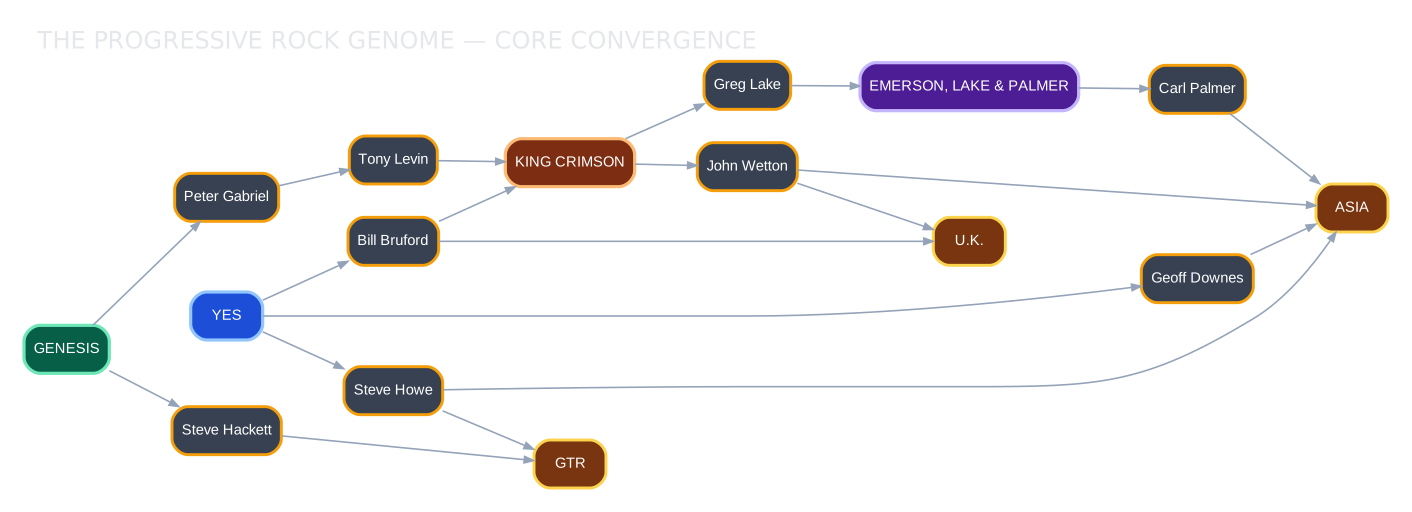
Figure 1 — The Core Progressive Rock Genome: The principal Yes, King Crimson, Genesis and ELP corridors converge through Bill Bruford, John Wetton, Steve Howe, Geoff Downes, Greg Lake, Carl Palmer, Steve Hackett, Peter Gabriel and Tony Levin.
The Four Great First-Wave Hubs
Begin with Yes, King Crimson, Genesis and Emerson, Lake & Palmer.
These bands are often discussed as separate pillars of progressive rock, each with a recognisable aesthetic. Yes became the cathedral: harmonic density, contrapuntal arrangements and almost architectural composition. Genesis became the theatre: narrative, character, atmosphere and unusually disciplined ensemble writing. ELP represented virtuoso force and classical bombast. King Crimson remained the dangerous one — the band most willing to destroy its own identity and rebuild it.
Personnel history tells a different story.
They were not isolated kingdoms.
Bill Bruford: The Structural Hinge
Bill Bruford is one of the most important people in the entire graph.
His path from Yes to King Crimson provides one of prog's fundamental direct bridges. His subsequent work in U.K. and Bruford, along with his temporary live role with Genesis and later jazz-oriented Earthworks, makes him less a drummer who happened to join several good bands than a structural hinge connecting entire musical ecosystems.
Follow Bruford two or three steps in almost any direction and the supposed borders between symphonic prog, Crimson-style experimentalism and Canterbury-derived jazz-rock start disappearing.
John Wetton: The Great Migratory Bassist
John Wetton may be even more geographically promiscuous.
King Crimson alone would make him historically central, but Wetton's route through Family, King Crimson, Roxy Music, Uriah Heep, U.K., Wishbone Ash and Asia makes him one of the strongest bridges between progressive rock, art rock and hard rock.
The importance of Wetton becomes especially obvious when the graph reaches U.K. and Asia.
Asia Is Not an '80s Footnote
Asia is often remembered through the commercial sheen of Heat of the Moment, which can obscure just how absurdly concentrated its pedigree was.
The original band brought together:
- Steve Howe from Yes
- Geoff Downes from The Buggles and Yes
- John Wetton from King Crimson and U.K.
- Carl Palmer from Emerson, Lake & Palmer
That makes Asia a literal convergence node for several major first-wave progressive lineages.
The band's radio-friendly sound did not erase its genealogy. It made that genealogy commercially successful.
Genesis Quietly Reconnects to Everyone
Genesis initially looks less interconnected than Yes or King Crimson.
That impression does not survive close inspection.
Steve Hackett joins Steve Howe in GTR, producing a direct Genesis-to-Yes bridge. Hackett later joins Chris Squire in Squackett, creating an entirely separate Genesis-to-Yes route.
Peter Gabriel provides another path: his solo work brings Tony Levin into the Genesis orbit, while Levin becomes one of the defining members of later King Crimson.
So the sequence becomes:
Genesis → Peter Gabriel → Tony Levin → King Crimson
Meanwhile Robert Fripp's own collaborations with Gabriel strengthen that bridge from the opposite direction.
Genesis was never an island. It merely concealed its roads better.
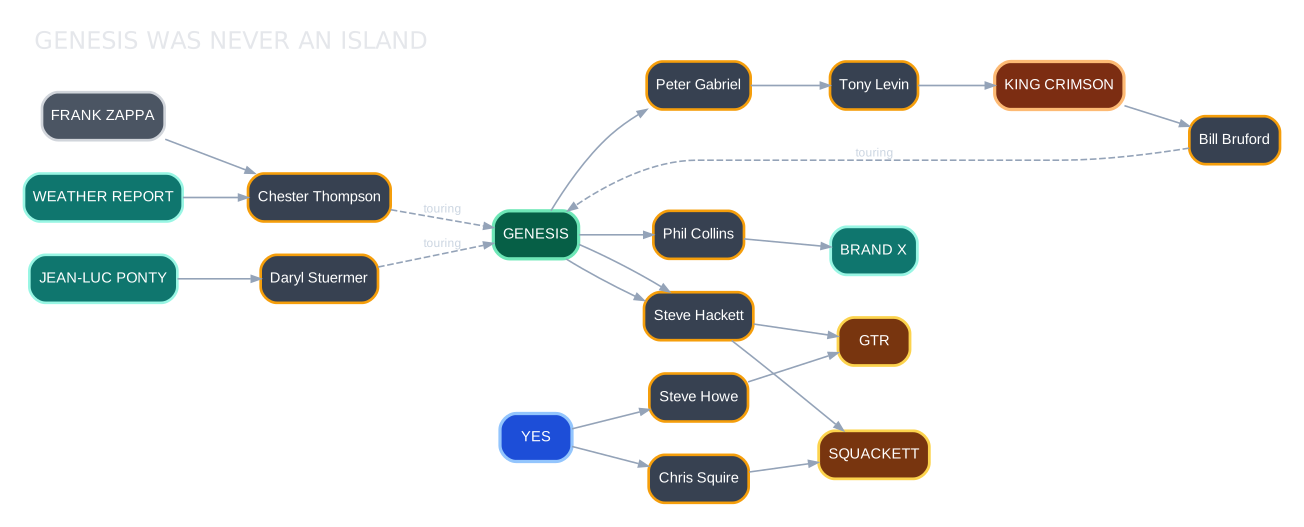
Figure 2 — Genesis Was Never an Island: Genesis connects outward through Gabriel and Levin to King Crimson, through Hackett to Yes, and through its touring and fusion personnel toward Zappa, Weather Report and Jean-Luc Ponty.
U.K.: Where the Network Becomes Ridiculous
If Asia is one convergence node, U.K. may be the more musically revealing one.
Its original lineup — John Wetton, Bill Bruford, Eddie Jobson and Allan Holdsworth — brings together King Crimson, Yes, Roxy Music, Frank Zappa's orbit and the Canterbury/fusion world.
Holdsworth is especially important.
His path through Tempest, Soft Machine, Gong, Tony Williams Lifetime, U.K. and Bruford creates a direct bridge between the Canterbury scene and the supposedly more formal first-wave British progressive hierarchy.
Eddie Jobson creates another improbable corridor:
Curved Air → Roxy Music → Frank Zappa → U.K. → Jethro Tull
Once those histories are drawn rather than merely listed, the idea of separate “scenes” begins to look suspiciously artificial.
Canterbury Is the Second Backbone
The Canterbury scene should not be treated as a quirky appendix to progressive rock.
It is one of the network's two great backbones.
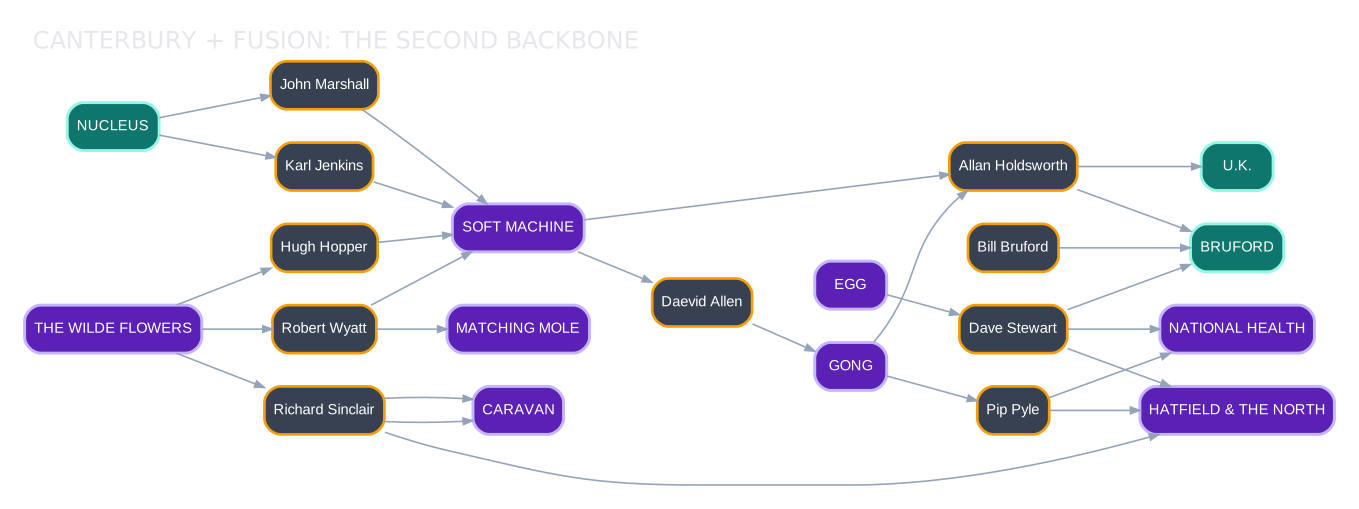
Figure 3 — Canterbury + Fusion: The Second Backbone: The Wilde Flowers, Soft Machine, Caravan, Gong, Matching Mole, Hatfield and the North, National Health and Nucleus connect outward through musicians including Robert Wyatt, Richard Sinclair, Dave Stewart, Pip Pyle, Karl Jenkins and Allan Holdsworth.
The Wilde Flowers as a Genetic Seed
The Wilde Flowers sit remarkably close to the beginning of the Canterbury story.
From their personnel emerge connections toward Soft Machine and Caravan, which in turn create separate but repeatedly intersecting branches.
Robert Wyatt moves into Soft Machine and later Matching Mole. Richard Sinclair moves into Caravan and then Hatfield and the North, eventually reaching Camel. Daevid Allen's Soft Machine history leads toward Gong.
By itself, that is already a substantial network.
Then the second wave arrives.
Nucleus Invades Soft Machine
The later Soft Machine story pulls musicians from the British jazz-rock group Nucleus, including Karl Jenkins and John Marshall.
That matters because Soft Machine ceases to be merely the Robert Wyatt-era psychedelic Canterbury institution and becomes a major fusion corridor.
Then Allan Holdsworth enters.
And once Holdsworth is present, the path runs outward toward Gong, U.K., Bruford and Tony Williams' fusion universe.
Soft Machine therefore occupies a much more important structural position than a conventional “great prog bands” list would ever reveal.
Dave Stewart: Another Bruford-Like Connector
Dave Stewart — very much not the Eurythmics musician of the same name — provides another critical bridge:
Egg → Hatfield and the North → National Health → Bruford
That route joins the most idiosyncratic Canterbury keyboard tradition directly to Bill Bruford's post-U.K. fusion work.
At that point there are multiple independent roads between Canterbury and the Yes/Crimson axis.
That is not influence.
That is shared DNA.
Camel as a Meeting Point
Camel is another band that looks more isolated on a record-store shelf than it does in the personnel graph.
Richard Sinclair provides a Canterbury route:
The Wilde Flowers → Caravan → Hatfield and the North → Camel
Mel Collins provides a completely different route:
King Crimson → Camel
Camel therefore sits between two worlds usually described separately: the Canterbury ecosystem and the Crimson-centered first wave.
The personnel network makes the connection visible.
Folk-Prog and Art-Rock Were Never Peripheral
Another layer appears when British folk-rock and art-rock are added.
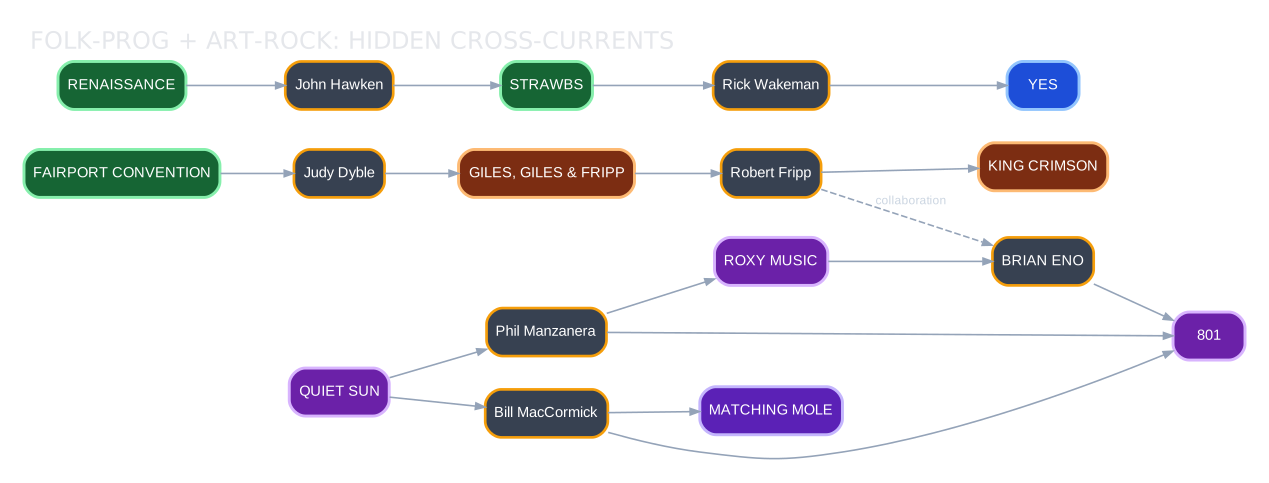
Figure 4 — Folk-Prog + Art-Rock Cross-Currents: Fairport Convention and Strawbs connect into the first-wave prog network while Quiet Sun, Matching Mole, Roxy Music, Brian Eno and Robert Fripp expose another art-rock/Canterbury corridor.
Rick Wakeman provides the obvious Strawbs → Yes connection.
But the more peculiar history is the pre-Crimson connection involving Judy Dyble and the Giles/Fripp orbit, placing the Fairport Convention world unusually close to the formation of King Crimson.
Art rock becomes just as tangled.
Quiet Sun produces two especially useful routes. Phil Manzanera moves toward Roxy Music. Bill MacCormick moves toward Matching Mole. Those lines reunite through 801 and the wider Brian Eno/Robert Fripp universe.
This makes Roxy Music far more than a neighboring glam/art-rock movement. Through personnel, it sits inside the same broader network.
Why Some Bands Look More Isolated
The graph should not force every canonical progressive band into a dense web.
That would falsify the history.
Gentle Giant, Van der Graaf Generator, Focus, PFM, Banco, Le Orme, Magma, Eloy, Grobschnitt and other important bands belong in the broader progressive story even when their personnel history does not generate Bruford-level connectivity.
That relative isolation is meaningful.
A network diagram should reveal where people did not move as well as where they did.
Some bands were porous institutions. Others were comparatively self-contained organisms.
Both patterns tell us something about how progressive music developed.
Neo-Prog: Not a Reboot, a New Network
The arrival of Marillion, IQ, Pendragon, Pallas and Twelfth Night in the 1980s is frequently treated as a second coming of 1970s symphonic prog.
That description is musically useful but structurally incomplete.
Over time, neo-prog generated its own intensely interconnected personnel network.
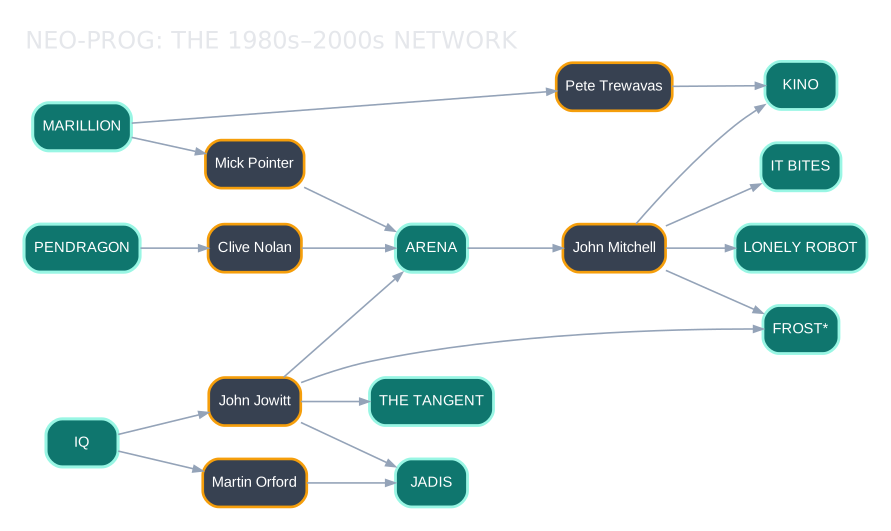
Figure 5 — The Neo-Prog Network: Marillion, IQ, Pendragon, Arena, Jadis, Frost*, The Tangent, It Bites and related projects are linked through musicians including Mick Pointer, Clive Nolan, John Jowitt, Martin Orford, Pete Trewavas and John Mitchell.
Arena as a Neo-Prog Convergence Node
Arena is particularly revealing.
Mick Pointer brings the Marillion lineage. Clive Nolan brings Pendragon. John Jowitt brings IQ and additional connections toward Jadis, Frost* and The Tangent. John Mitchell subsequently reaches It Bites, Frost*, Kino and Lonely Robot.
Arena therefore performs a role not unlike Asia or U.K. in an earlier era: it makes multiple established lineages collide visibly in one band.
John Jowitt and John Mitchell
Certain musicians become disproportionately important when the graph moves beyond the first wave.
John Jowitt's associations across IQ, Jadis, Arena, Frost* and The Tangent create a dense set of neo-prog bridges.
John Mitchell creates another:
Arena → Frost* → It Bites → Kino → Lonely Robot
The terminology changed. The underlying behavior did not.
Progressive musicians kept building new bands out of the human infrastructure of older ones.
Transatlantic: Modern Prog's Perfect Convergence Node
If one band demonstrates how the progressive-rock network regenerates itself, it may be Transatlantic.
Its core lineup draws directly from:
- Dream Theater — Mike Portnoy
- Spock's Beard — Neal Morse
- The Flower Kings — Roine Stolt
- Marillion — Pete Trewavas
That single project joins progressive metal, American '90s revival prog, Scandinavian prog and British neo-prog.
It is difficult to imagine a cleaner demonstration of the network principle.
Then the roads continue.
Portnoy reaches Liquid Tension Experiment and Flying Colors. Stolt reaches back toward classic-prog figures including Jon Anderson and Steve Hackett. Trewavas connects outward from Marillion into Kino.
The modern era does not represent a disconnected revival.
It is a recombination engine.
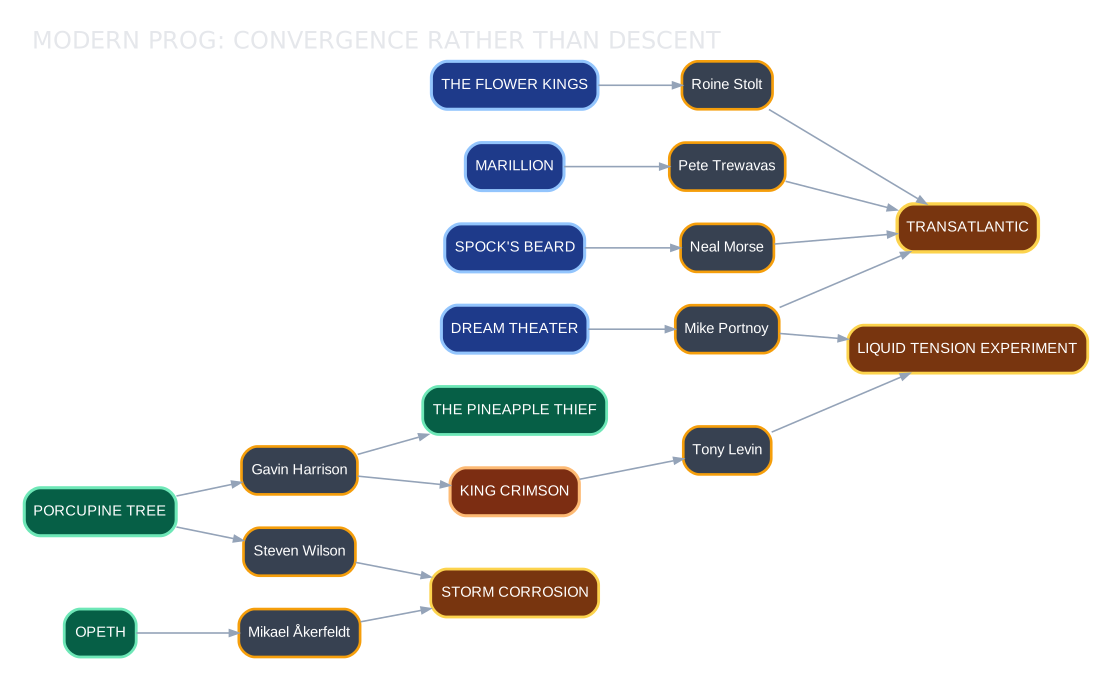
Figure 6 — Modern Prog: Convergence Rather Than Descent: Transatlantic, Liquid Tension Experiment, Porcupine Tree, King Crimson, Opeth and related projects demonstrate how the network continues through prog metal and modern progressive rock.
Porcupine Tree Reconnects the Present to King Crimson
Porcupine Tree provides one of the cleanest long-range connections in the entire map.
Gavin Harrison moves from Porcupine Tree into King Crimson and later becomes a major part of The Pineapple Thief.
That is an extraordinary bridge.
One musician directly connects one of the defining modern progressive bands to one of the foundational bands of 1969.
Steven Wilson produces a different constellation through No-Man, Blackfield, Opeth and Storm Corrosion. His work with Mikael Åkerfeldt creates a major modern link between progressive rock and progressive metal.
The wider Steven Wilson orbit also encounters figures such as Theo Travis, whose own history reaches into Gong, Soft Machine and Robert Fripp-related work.
Again the old branches reappear.
The Progressive Rock Genome
The larger conclusion is uncomfortable for anyone who prefers music history in neat boxes.
There is no clean line from King Crimson to Yes to Genesis to Marillion to Dream Theater to Porcupine Tree.
That is not how this music evolved.
Instead there are hundreds of overlapping routes.
King Crimson leads toward ELP through Greg Lake, toward Asia through John Wetton, toward Yes through Bill Bruford, toward Peter Gabriel through Robert Fripp and Tony Levin, and toward Porcupine Tree through Gavin Harrison.
Yes reaches Asia through Howe and Downes, Genesis through GTR and Squackett, King Crimson through Bruford, and later generations through Jon Anderson's collaborations.
Canterbury reaches U.K. and Bruford through Holdsworth and Dave Stewart. Neo-prog develops its own dense network around Arena, IQ, Pendragon and Marillion. Transatlantic later draws four separate modern traditions into a single room.
The family tree therefore has no trunk.
It has hubs.
It has bridges.
It has musicians whose careers function almost like railway junctions.
And that suggests a much more interesting analytical question than merely asking which bands influenced which others:
Who actually holds progressive rock together?
The Bridge-Musician Hypothesis
A future Sonic Atlas analysis should calculate this instead of relying purely on visual inspection.
The obvious candidates include:
- Bill Bruford
- John Wetton
- Steve Howe
- Geoff Downes
- Tony Levin
- Allan Holdsworth
- Eddie Jobson
- Mel Collins
- Dave Stewart
- Richard Sinclair
- John Jowitt
- John Mitchell
- Roine Stolt
- Mike Portnoy
- Gavin Harrison
- Theo Travis
Using network analysis, Sonic Atlas could calculate:
Degree centrality — who has the most direct connections?
Betweenness centrality — which musician most frequently lies on the shortest route between otherwise separate scenes?
Two-hop reach — how much of progressive rock becomes reachable within only two personnel moves?
Community detection — do the classic labels “Canterbury,” “neo-prog,” “symphonic prog” and “prog metal” actually emerge naturally from the personnel data?
Bridge score by decade — who connected the progressive ecosystem in 1972, 1985, 1998 or 2010?
That is where this stops being a retrospective article and becomes a genuine piece of Sonic Atlas data analysis.
A reader should eventually be able to select Bill Bruford and watch the relevant network illuminate.
Select Allan Holdsworth, and the route from Canterbury jazz-rock to U.K. and Bruford should reveal itself.
Select Gavin Harrison, and fifty years of progressive history should collapse into a handful of edges.
That is the real point of the family tree.
Progressive rock did not merely survive because later musicians listened to the old records.
It survived because its musicians kept crossing the borders.
And once those crossings are mapped, the supposedly sprawling history of progressive rock starts to look like one enormous, argumentative, endlessly recombining band.
Keep Reading
The Canterbury Scene: A Cartography of English Eccentricity
A complete critical map of the Canterbury scene — from the Wilde Flowers and Soft Machine to Caravan, Gong, Hatfield and the North, National Health, the international diaspora, and the bands that merely borrowed the waistcoat.
The Authority of Absence: The Caesura in Progressive Rock
Progressive rock defends its right to play more notes than anyone requested — but its sharper achievement is knowing when to withhold them. How King Crimson, Yes, Rush, Genesis and others use the caesura to intensify an entrance, mark a boundary, and pivot into a new musical world.
Architecting the Steven Wilson Universe
How one obsessive English auteur turned progressive rock into a modular system of bands, alter egos, sonic laboratories, archival interventions and spatial-audio evangelism — mapped across Porcupine Tree, the side-project laboratories, the solo canon and the remix work.
Even in the Quietest of Moments, a Thunderous Applause
From their formation in 1970 to the landmark Breakfast In America and beyond — a personal journey through the catalogue of Supertramp.