
Beyond Maiden: A Beginner's Atlas of the NWOBHM Underground
The first guide introduced the monuments. This one maps the machinery beneath them — the regional scenes, independent labels, and overlooked bands that taught heavy metal how to move faster than the industry could contain it.
The Monuments Are Not the Map
Sonic Atlas has already published a concise beginner's guide to NWOBHM. It did what a beginner's guide is supposed to do: identified the period, named the canonical bands, supplied five sensible records, and prevented the newly curious from wandering into a streaming service armed only with an acronym and misplaced confidence.
That was orientation. This is cartography.
Iron Maiden, Saxon, and Def Leppard all have legitimate roots in the New Wave of British Heavy Metal. Maiden converted East End urgency into a global mythology; Saxon gave industrial Britain anthems large enough to survive the factory closures; Def Leppard escaped Sheffield so efficiently that the movement eventually looked like a provincial inconvenience in the rear-view mirror. Their importance is not in dispute. Their dominance of the story, however, has become intellectually lazy.
NWOBHM was never merely three future arena bands surrounded by support acts. It was a temporary production system: local clubs, mail-order singles, cheaply hired studios, specialist shops, homemade sleeves, regional promoters, fanzines, Sounds, Neal Kay's playlists, Tommy Vance's radio show, and young bands learning that they did not need permission from London's established record business. The movement's decisive innovation was therefore not one guitar tone. It was the construction of a parallel infrastructure through which many incompatible versions of heavy metal could briefly coexist.
That is why Tank, Persian Risk, Fist, Mythra, Satan, Jaguar, Witchfinder General, Praying Mantis, Savage, and their peers matter. The famous bands demonstrated what NWOBHM could become. The smaller bands reveal what it actually was.
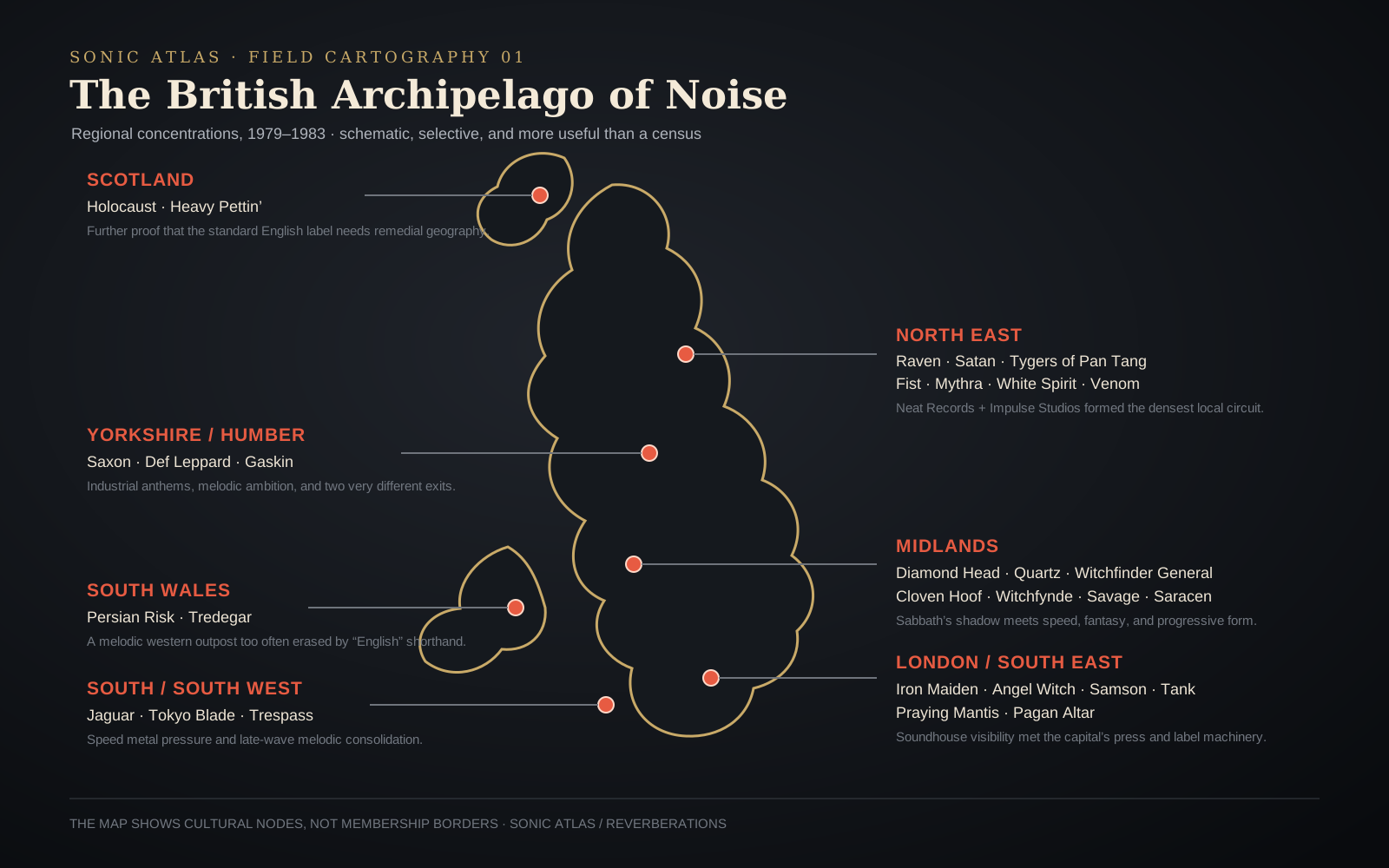
Figure 1 — The British Archipelago of Noise: NWOBHM was national in distribution but intensely local in operation. The map is schematic rather than cartographically exact; its purpose is to show clusters, not motorway exits.
First Correction: NWOBHM Was a Moment, Not a Sound
The term itself is a piece of journalistic compression. Editor Alan Lewis supplied the phrase for Geoff Barton's report in Sounds after the 8 May 1979 metal bill at London's Music Machine. Taxonomy followed activity, as it so often does. The bands had not assembled at a congress, approved a manifesto, and agreed upon the correct quantity of denim. They were grouped because they were young, British, heavy, active at roughly the same time, and able to exploit the same emerging network.
Listen across the category and any claim of strict sonic uniformity collapses before the second pint. Praying Mantis favored melody and harmony. Witchfinder General dragged Sabbathian dread into the new decade. Raven played as though the tape machine were about to be repossessed. Venom turned technical deficiency, volume, and imaginative excess into an entirely new extremity. Demon cultivated theatre and atmosphere. Tank drove Motörhead's street-level abrasion through a heavier chassis. Saracen entertained progressive structure. Def Leppard already heard the American radio horizon. These are not minor variations on one recipe. They are competing answers to the same historical opportunity.
The useful definition, then, is ecological: NWOBHM was the British heavy-metal resurgence that became visible between approximately 1979 and 1983 through a shared do-it-yourself circuit. Its borders were porous. Older bands could be adopted by it; newer bands could arrive late; Scottish and Welsh groups could belong despite the geographically illiterate “English” shorthand still encountered in casual accounts. A movement is not a laboratory specimen. It is an argument conducted through records, gigs, and borrowed amplifiers.
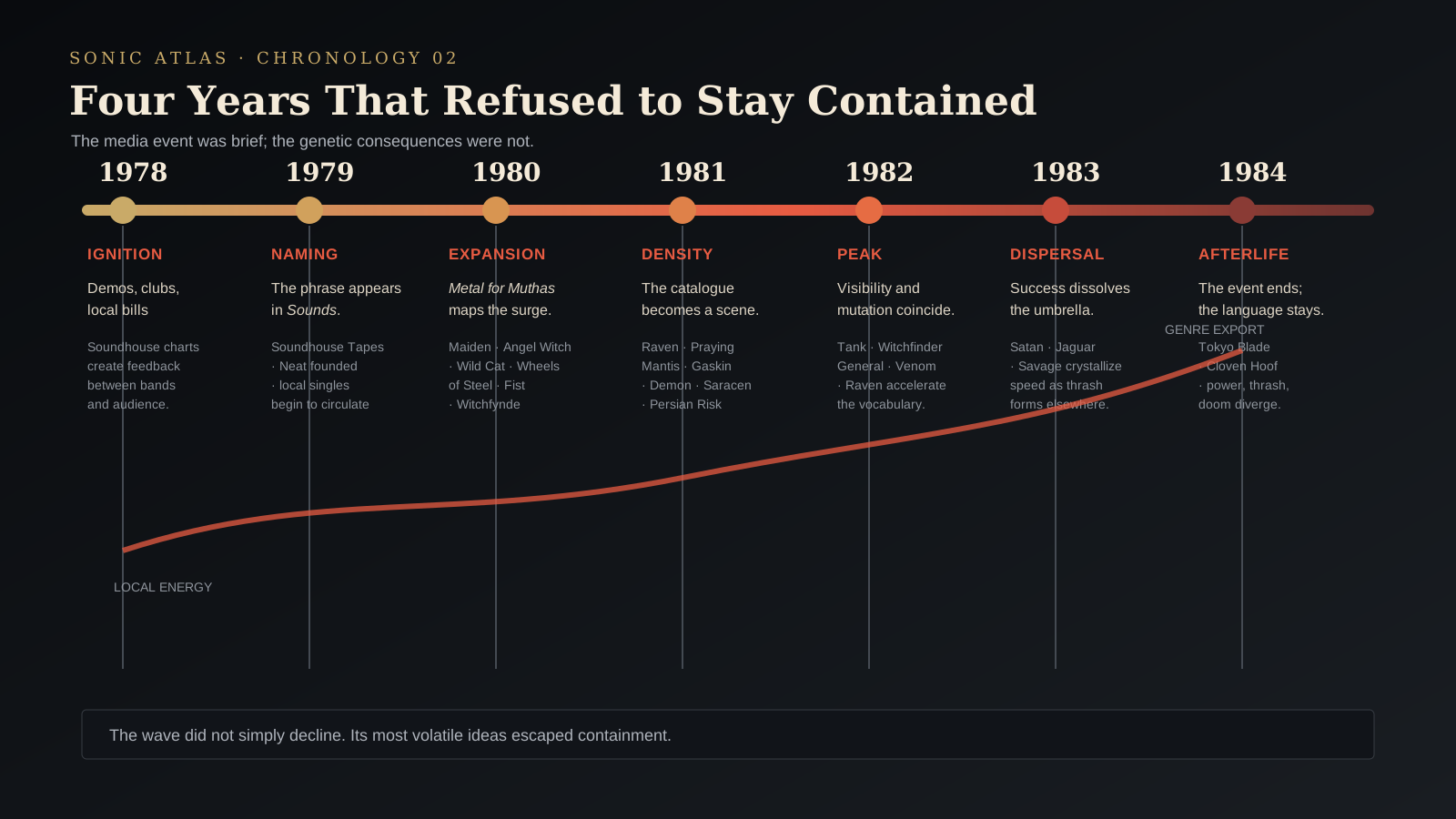
Figure 2 — A Short, Decisive Window: The useful window is short because the movement succeeded. By 1983–84, its leading ideas had escaped into distinct genres and international markets.
The Three Famous Escape Routes
Before descending into the glorious second division, we should position the three names that distort every retrospective.
Iron Maiden perfected the movement's compositional route. Steve Harris combined a propulsive bass-led gallop, twin-guitar counterpoint, abrupt sectional development, and a taste for history, literature, and grand narrative. The Paul Di'Anno records retain the club-floor grime; the Bruce Dickinson era enlarges the architecture. Progressive metal would later make the time signatures more conspicuous, but Maiden had already shown that heavy metal could think in chapters.
Saxon perfected the communal route. Their finest early work is less interested in labyrinths than in momentum, identity, machinery, travel, and collective voice. Wheels of Steel, Strong Arm of the Law, and Denim and Leather turn the audience into the subject. If Maiden built worlds, Saxon built a public.
Def Leppard perfected the export route. On Through the Night belongs unmistakably to the movement; High 'n' Dry refines the writing and production; Pyromania converts British metal into transatlantic pop engineering. Some purists regard that evolution as desertion. This is rather like accusing a successful prisoner of insufficient loyalty to the cell.
Those routes — composition, community, export — explain success. They do not explain the full mutation field. For that, one must go smaller.
The Underground, Arranged by What It Actually Contributed
Alphabetical lists are useful for telephone directories and tax auditors. Music requires a more revealing order. The bands below are grouped by the problem each helped solve for the metal that followed.
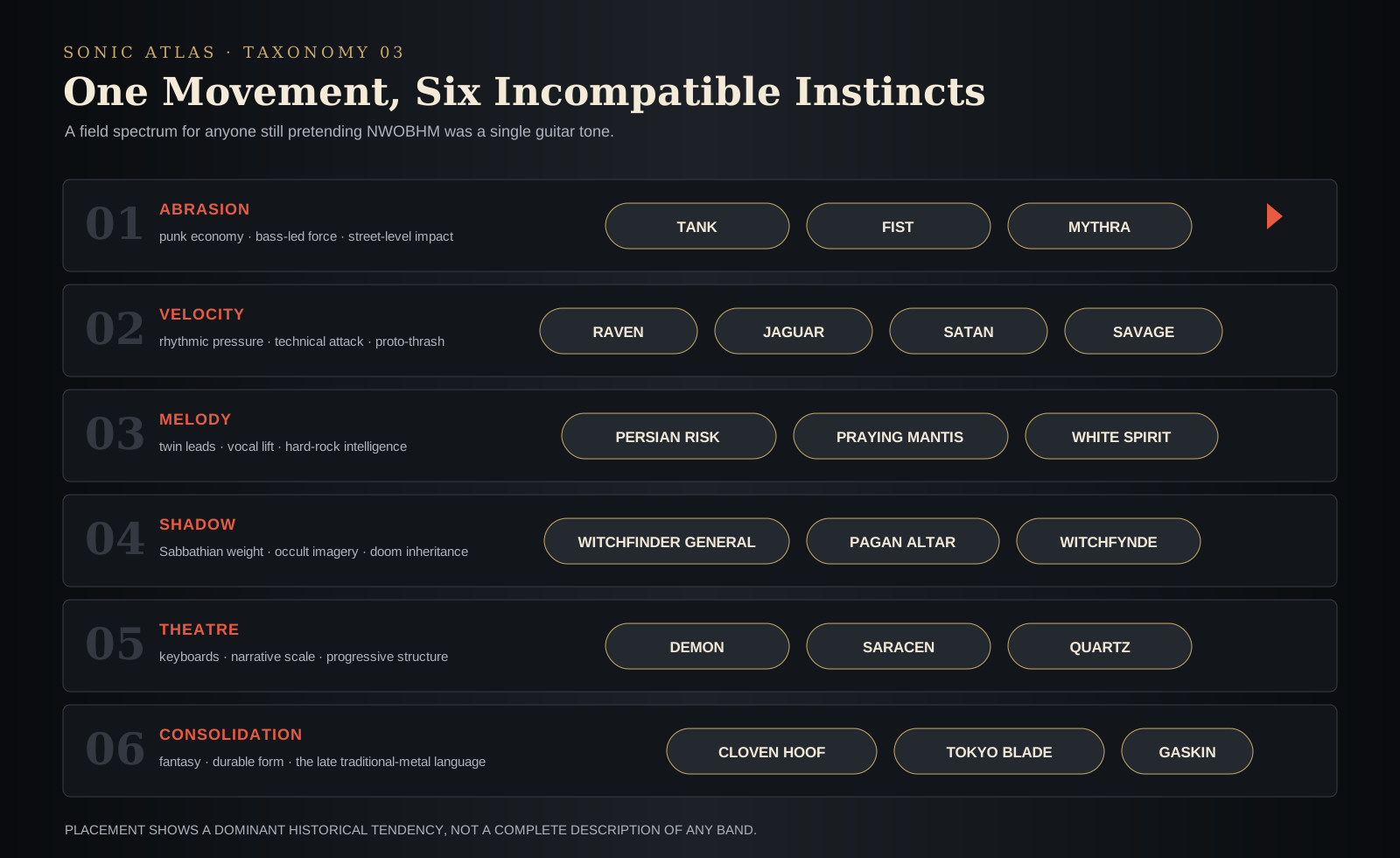
Figure 3 — The Style Spectrum: This resists the fiction of a single NWOBHM sound. Placement indicates a band's most historically useful tendency, not an attempt to imprison its complete catalogue in one box.
The Abrasion Engine: Tank, Fist, and Mythra
Tank should be the first stop after the canonical records. Formed by former Damned bassist Algy Ward, the trio brought punk economy and Motörhead velocity into NWOBHM without becoming a mere Motörhead photocopy. The essential document is Filth Hounds of Hades (1982), produced by “Fast” Eddie Clarke. Its bass is not supportive furniture; it is a blunt instrument occupying the center of the arrangement. The songs move with the graceless purpose of machinery that has lost its safety guard.
Tank matters because the band clarifies the route from hard rock into speed and thrash without pretending that precision arrived first. The attack is physical, the structures concise, the production coarse enough to preserve danger. Begin with “Shellshock,” “Steppin' on a Landmine,” and “Filth Hounds of Hades.” If these sound uncivilized, the record is functioning correctly.
Fist, from South Shields, offered a more classically constructed but still muscular variation. “Name, Rank and Serial Number,” issued by Neat in 1980, is the indispensable artifact: ominous opening, memorable refrain, disciplined riffing, and a mood suspended between street metal and military nightmare. The album Turn the Hell On followed the same year after the band moved to MCA. Fist demonstrate a recurring NWOBHM tragedy: the independent single creates urgency; the major-label album arrives with opportunity, expectation, and no guarantee that the market will wait.
Mythra, also from the North East, compressed the movement's raw promise into the Death & Destiny EP. The appeal is not polish. It is the sensation of a band discovering that acceleration itself can become form. Mythra belong in the ancestry of speed metal because the riffs push forward without yet possessing the clinical down-picking discipline later associated with thrash. Evolution rarely arrives wearing its final uniform.
The Speed Laboratory: Raven, Jaguar, Satan, and Savage
Raven called its approach “athletic rock,” a phrase both faintly ridiculous and entirely accurate. Rock Until You Drop (1981) and Wiped Out (1982) sound hyperactive because they are: high vocals, busy bass, drums struck as if personal honor were at stake, and guitar parts continually threatening to leave the song behind. Raven showed that heaviness could be kinetic rather than ponderous. The American thrash generation noticed.
Jaguar, from Bristol, stripped the idea down further. “Back Street Woman” and “Axe Crazy” announce the thesis; Power Games (1983) sustains it. Jaguar's importance lies in the rhythmic pressure — riffs functioning less as monoliths than as repeated propulsion. The band sits near the junction where NWOBHM ceases to be a national movement and becomes an exportable grammar for speed metal.
Satan supplied the sharper intellect. Court in the Act (1983) is one of the movement's most durable albums because its aggression is organized by intricate guitar writing rather than disguised by noise. The twin leads slice, answer, and recombine; the riffs change direction without dissolving the song; Brian Ross sings with dramatic force but does not smother the machinery. Anyone interested in how NWOBHM feeds thrash, power metal, and later technical traditional metal should study “Trial by Fire” and “Blades of Steel.” Study is the correct verb. Merely “checking them out” sounds suspiciously undergraduate.
Savage, from Mansfield, provides another direct bridge. “Let It Loose” circulated before the band's full-length Loose 'n Lethal appeared in 1983, and its combination of speed, weight, and chantable economy traveled farther than Savage's sales figures. The group demonstrates the difference between commercial scale and historical transmission: a song need not conquer a market if it reaches precisely the right rehearsal room.
The Melodic Intelligence: Persian Risk, Praying Mantis, and White Spirit
Persian Risk began in Cardiff in 1979 and included guitarist Phil Campbell before his long tenure with Motörhead. Their strongest early singles — “Calling for You,” “Ridin' High,” and “Too Different” — occupy the elegant middle ground between street-level metal and melodic hard rock. Carl Sentance brings clarity and reach without sanding away the guitars; the choruses aspire without becoming cosmetics.
The cruel timing of Persian Risk's history is instructive. Their debut album Rise Up did not appear until 1986, after the movement's media window had closed and the market had reorganized around thrash below and polished hard rock above. The band did not lack ability. It lacked synchrony. Popular history regularly misidentifies this as the same thing.
Praying Mantis placed twin-guitar harmony and vocal melody at the center. Time Tells No Lies (1981) is refined without becoming timid, closer to the melodic wing of the movement than to its punk-scorched edge. The group matters to the eventual power-metal and melodic-metal traditions because it understood that speed was only one way to create lift; harmony could do it too.
White Spirit, from Hartlepool, leaned openly toward the Deep Purple inheritance, complete with prominent keyboards. Their 1980 self-titled album is the corrective for anyone who imagines NWOBHM as a mass eviction of the 1970s. Janick Gers would later join Iron Maiden, but White Spirit's greater historical use is conceptual: the new wave did not abolish hard rock's organ, virtuosity, or flamboyance. It recontextualized them within a younger circuit.
The Shadow Wing: Witchfinder General, Pagan Altar, and Witchfynde
Witchfinder General treated speed as optional. From Stourbridge, the band placed Sabbath-derived riffs, morbid atmosphere, and provincial heaviness inside the NWOBHM economy. Death Penalty (1982) and Friends of Hell (1983) are foundational documents for doom metal's later traditionalist revival. The grooves lumber, but they are not inert; the guitar tone has air and grain rather than modern low-frequency obesity. Heaviness is produced by tension and placement, not by asking a plug-in to simulate geological activity.
Pagan Altar were even more spectral. Their early material circulated with almost monastic obscurity, and the album recorded in the period did not receive a conventional contemporary release. Yet the band's mixture of occult storytelling, mournful melody, and Sabbathian pace later became central to the retrospective canon. Pagan Altar prove that a scene's afterlife can revise its hierarchy. Availability delayed recognition; it did not invalidate the work.
Witchfynde, from Derbyshire, joined occult imagery to leaner traditional metal. Give 'Em Hell (1980) is less doom-bound than its sleeve and titles might suggest, but its atmosphere helped establish the visual and lyrical vocabulary from which later extreme metal would borrow. One should distinguish influence from equivalence: Witchfynde did not sound like Norwegian black metal. It helped normalize some of the symbolic materials that more extreme musicians would weaponize.
The Progressive and Theatrical Flank: Demon, Saracen, and Quartz
Demon, from Leek, Staffordshire, began with the formidable Night of the Demon (1981) and The Unexpected Guest (1982), then expanded toward conceptual and progressive territory. Their importance lies in dramatic sequencing, keyboards, atmosphere, and a willingness to let albums behave as more than containers for club-tested songs. Demon is a plausible bridge from theatrical British hard rock to progressive metal, though the bridge is lined with tombstones and operated by an unusually literate caretaker.
Saracen made the progressive inheritance explicit on Heroes, Saints & Fools (1981). Keyboards, narrative scope, and patient development place the record at the movement's artier perimeter. It lacks Maiden's global force but illuminates the same underlying proposition: metal could accommodate extended form without surrendering riff authority.
Quartz complicate the chronology. Formed earlier in the 1970s, connected to Birmingham's established heavy-rock world, and produced on their 1977 debut by Tony Iommi, they were not born from the NWOBHM moment. Yet “Satan's Serenade” and Stand Up and Fight (1980) were absorbed into it. Quartz are best understood as connective tissue — a pre-existing regional band whom the new network made newly legible. Historical categories become more useful, not less, when one admits their untidy edges.
The Cult Traditionalists: Cloven Hoof, Tokyo Blade, and Gaskin
Cloven Hoof, from Wolverhampton, arrived near the far edge of the primary window. Their 1984 self-titled album combines theatrical identities, fantasy imagery, muscular riffing, and a melodic sense that points toward later power and traditional metal. The band sounds less like the ignition of NWOBHM than its ideas being consolidated into a durable international style.
Tokyo Blade, originating in Wiltshire, similarly represents the movement in transition. The self-titled debut (1983) and Night of the Blade (1984) sharpen twin-guitar melody into a form well suited to the global traditional-metal underground. They are frequently remembered as “late NWOBHM,” which is chronologically fair but aesthetically incomplete. Their real significance is that the wave was becoming a language no longer dependent upon the wave itself.
Gaskin, from Lincolnshire, deserve attention for End of the World (1981): melodic, compact, occasionally elegant, and blessedly uninterested in choosing between hard-rock hooks and metallic attack. Gaskin occupy the broad center of the movement — the area least useful for sensational genre genealogy but perhaps closest to what many local bands actually sounded like.
The Machines That Made the Movement
The mythology of rock prefers bands because bands can be photographed. Infrastructure is less cooperative. Yet without the infrastructure, the supposed wave is merely a large number of unrelated young men alarming separate publicans.
The Heavy Metal Soundhouse, associated with DJ Neal Kay at the Bandwagon in Kingsbury, offered bands a feedback system before the term acquired its modern corporate unpleasantness. Demos entered Kay's playlists; audience response entered his chart; the chart gave unknown groups evidence of demand. Iron Maiden's The Soundhouse Tapes named the mechanism directly.
Sounds supplied narrative coherence. Geoff Barton's coverage did not invent the bands, but journalism made dispersed activity visible as a national event. Once named, the movement could be argued over, marketed, imitated, and rejected. Naming does not merely describe a scene. It alters the scene's behavior.
The Friday Rock Show, hosted by Tommy Vance on BBC Radio 1, provided scarce national broadcast space for heavy music. Independent labels converted attention into objects: seven-inch singles, EPs, compilations, and albums that could circulate beyond a band's hometown. Neat Records, based around Impulse Studios in Wallsend, was especially important to the North East nexus; Heavy Metal Records and Ebony Records widened the route; compilations such as Metal for Muthas, Lead Weight, New Electric Warriors, and Roksnax acted as paper maps with grooves.
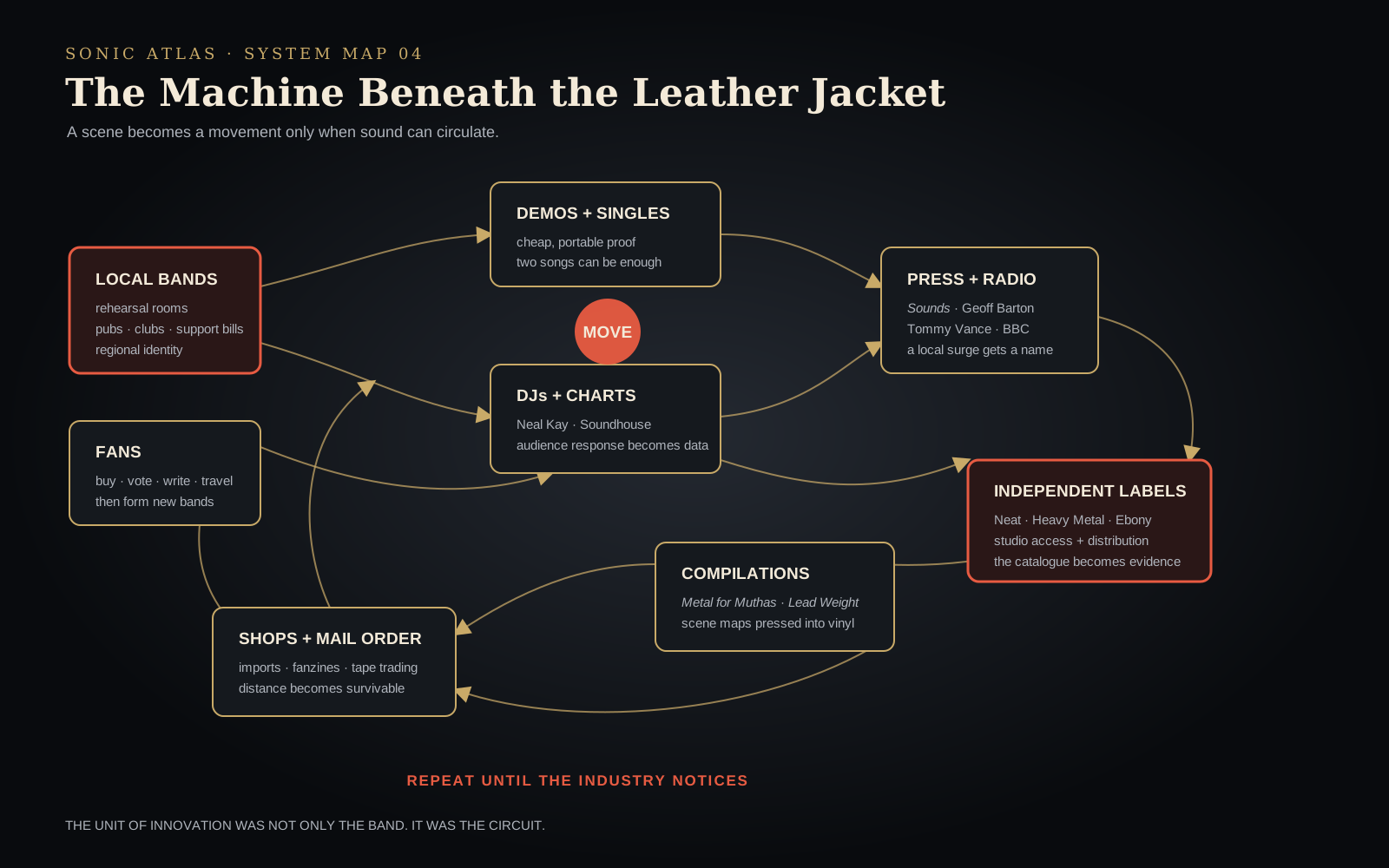
Figure 4 — The Circulation System: The scene operated as a circulation system. No single node “created” NWOBHM; the effect emerged from repeated movement among them.
The seven-inch single was the system's ideal packet size. It was comparatively affordable to record, manufacture, mail, review, stock, and play. An album demanded capital and a catalogue's worth of material. A single demanded two convincing songs and sufficient nerve. That economic distinction shaped the art. Many NWOBHM bands are best understood not through a belated or compromised LP but through one astonishing single in which limited means and total conviction briefly achieved equilibrium.
This is also why pristine contemporary production is the wrong evaluative standard. Some records are narrow, mid-forward, splashy, or under-endowed below the bass guitar. The defects can be real. But the best of them preserve pick attack, ensemble urgency, and the unstable pressure of musicians playing at the edge of their technical control. Audiophile smoothness would be a category error. One does not ask a hand grenade to image politely behind the loudspeakers.
How the Underground Rewrote the Future
The familiar statement that “NWOBHM influenced thrash” is true but insufficiently granular. Different bands transmitted different usable components.
Diamond Head contributed elastic riff architecture and dramatic song forms. Raven, Jaguar, Mythra, Tank, Savage, and Satan supplied various combinations of velocity, abrasion, rhythmic compression, and technical aggression. Venom demonstrated that extremity could become an aesthetic identity rather than an occasional effect. Witchfinder General and Pagan Altar preserved slow, ominous heaviness for future doom traditionalists. Praying Mantis and later Tokyo Blade emphasized the melodic twin-guitar route. Maiden and Saracen validated compositional expansion. Def Leppard demonstrated how thoroughly metal could be engineered for the mass market.
The recipient genres selected from this toolkit. Thrash prioritized speed, palm-muted propulsion, and the DIY network. Power metal elevated melody, gallop, fantasy, and vocal scale. Black metal took Venom's name, transgression, imagery, and willful extremity, then constructed something far colder and more ideologically severe. Doom returned to the Sabbathian branch kept alive within the wave. Progressive metal expanded narrative form, instrumental dialogue, and sectional composition. The later traditional-metal revival treated the entire period as a recoverable design language.
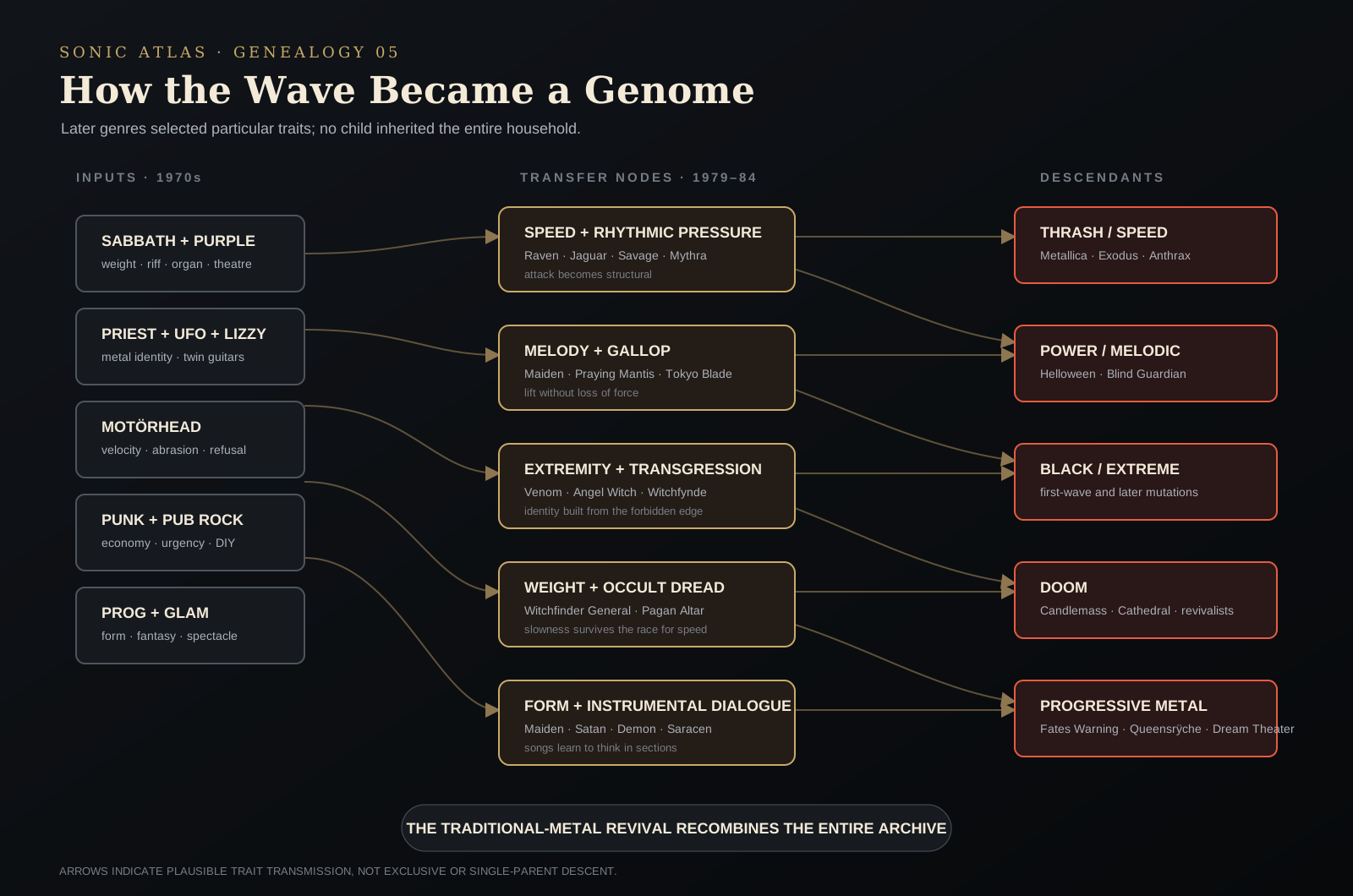
Figure 5 — The Inheritance: Influence is shown as transmission of techniques and attitudes, not as a claim that any later genre has a single parent.
The Bay Area connection deserves particular attention. Metallica's covers of Diamond Head's “Am I Evil?” and Blitzkrieg's “Blitzkrieg” were not casual antiquarian gestures. Lars Ulrich's fandom, tape trading, and later co-curation with Geoff Barton of NWOBHM '79 Revisited reveal how the British underground became source code for a Californian one. This is especially pertinent from a South Bay perspective: the sound that later detonated across the Bay Area did not descend solely from arena metal. It arrived partly through imported singles, duplicated tapes, specialist shops, and the obsessive attention of listeners who heard future tense in records the British market had already begun to abandon.
Why So Many Good Bands Remained Small
Retrospectives often convert commercial outcome into aesthetic verdict. This is history written by accountants wearing vintage tour shirts.
The movement's narrow window punished hesitation. A band that formed in 1979, financed a single in 1981, changed personnel in 1982, and finally released an album in 1984 had crossed several markets without necessarily changing a note. By then Maiden were an international institution, Def Leppard had transformed production expectations, thrash had claimed the underground's appetite for extremity, and MTV had made visual capital nearly as important as musical force.
Independent labels could provide access but not always sustained development. Major labels could sign a band without understanding it, then demand a hit, alter the production, delay the release, or move on. Lineup instability was endemic because musicians still needed income, equipment failed, management was frequently improvised, and the distance between a celebrated demo and a viable career remained enormous.
There was also simple oversupply. Once the press named a wave, hundreds of bands could be marketed under it. The category created visibility and congestion simultaneously. A brilliant single might earn a review, a chart position at the Soundhouse, and a support slot; it could not guarantee distribution in America or a second album. NWOBHM's abundance is central to its fascination and to its casualty rate.
The cult bands therefore should not be treated as failed versions of Iron Maiden. Most restaurants are not failed versions of the Savoy; some are simply excellent rooms the guidebook neglected. Fist, Persian Risk, Satan, and Tank each solved different musical problems. Their smaller scale allows us to see the solutions without the glare of empire.
A Listening Route Beneath the Obvious
The previous Sonic Atlas guide ended with five foundational albums. Keep them. This route begins immediately afterward and descends in stages, because indiscriminate obscurity is not connoisseurship. It is merely poor filing with an attitude.
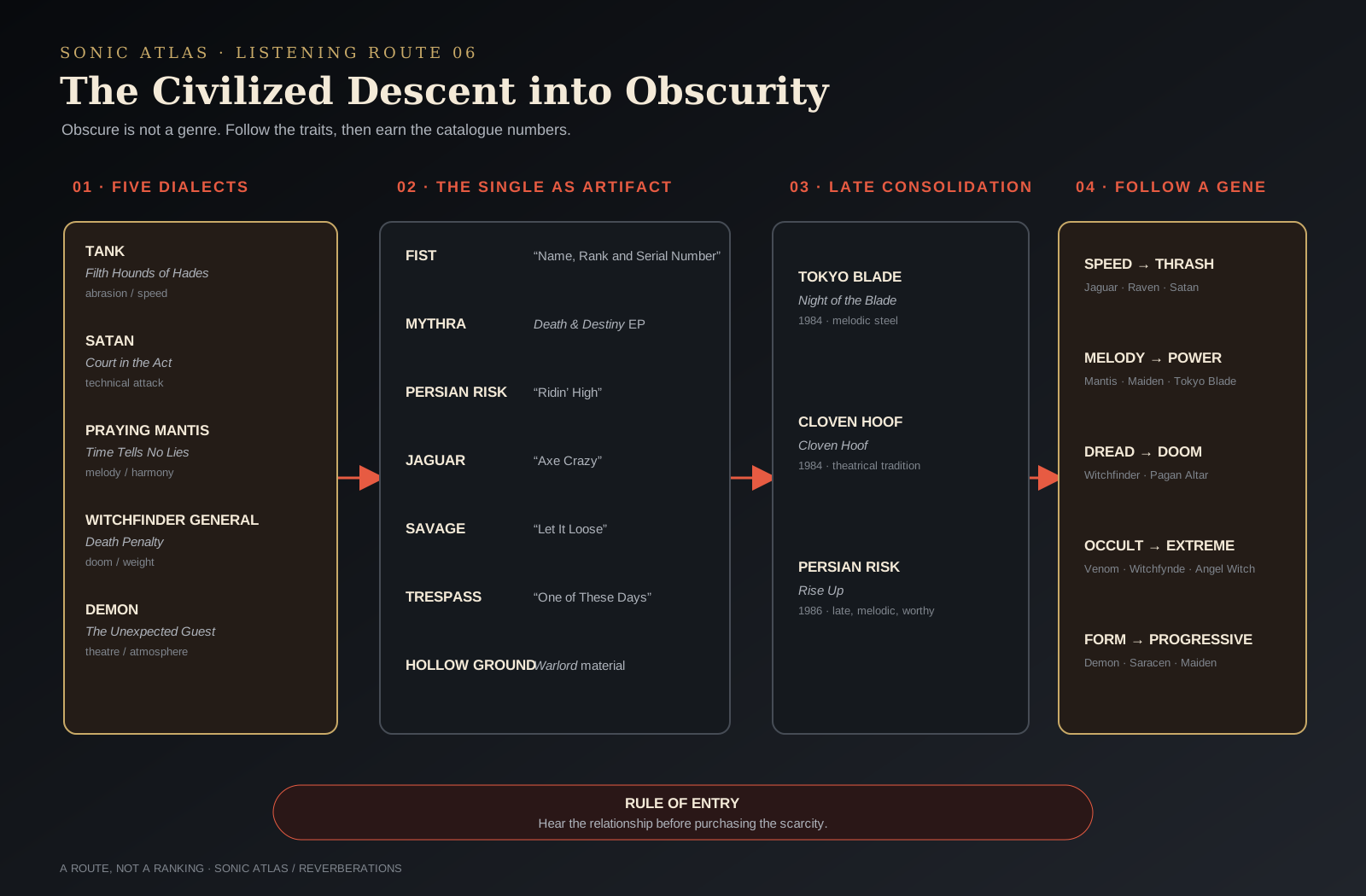
Figure 6 — The Listening Route: Follow one lane at a time. The objective is to hear relationships, not to complete a checklist with the joyless efficiency of a compliance department.
Stage 1: Learn the Underground's Main Dialects
- Tank — Filth Hounds of Hades (1982): punk abrasion, Motörhead-adjacent drive, and the physical grammar of speed.
- Satan — Court in the Act (1983): intricate twin guitars and proto-thrash intelligence.
- Praying Mantis — Time Tells No Lies (1981): the melodic and harmonized wing.
- Witchfinder General — Death Penalty (1982): the doom continuum.
- Demon — The Unexpected Guest (1982): atmosphere, theatre, and progressive reach.
These five establish that NWOBHM was never a single continuum from “less heavy” to “more heavy.” It was multidimensional from the beginning.
Stage 2: Move From Albums to Artifacts
Now abandon the modern assumption that the album is always the privileged unit.
- Fist — “Name, Rank and Serial Number”
- Mythra — Death & Destiny EP
- Persian Risk — “Ridin' High”
- Jaguar — “Axe Crazy”
- Savage — “Let It Loose”
- Trespass — “One of These Days”
- Hollow Ground — Warlord material
This is the movement at its most characteristic: compact, local, urgent, and only partially domesticated by professional production.
Stage 3: Explore the Late Consolidation
- Tokyo Blade — Night of the Blade (1984)
- Cloven Hoof — Cloven Hoof (1984)
- Persian Risk — Rise Up (1986)
These records lie beyond the strictest peak-period boundary, but they demonstrate what happened when the wave's melodic and traditional vocabulary survived after the media event had expired.
Stage 4: Follow One Gene Outward
Choose the element that most interested you and trace it into the next decade:
- From Satan, Jaguar, Savage, and Raven, proceed to Metallica, Exodus, Anthrax, and the speed-metal underground.
- From Praying Mantis, Maiden, and Tokyo Blade, proceed to Helloween, Blind Guardian, Queensrÿche, and Fates Warning.
- From Witchfinder General and Pagan Altar, proceed to Saint Vitus, Candlemass, Cathedral, and the traditional doom revival.
- From Venom, Witchfynde, and Angel Witch, proceed cautiously into the first-wave black-metal and occult-metal lineages.
- From Demon, Saracen, and Maiden, proceed to the progressive-metal architecture that eventually supports Fates Warning, Queensrÿche, Dream Theater, and beyond.
The point is not that NWOBHM single-handedly invented every later metal form. It is that the movement assembled, intensified, and distributed a set of musical genes at precisely the moment an international underground was ready to recombine them.
How to Buy and Hear This Music Without Behaving Foolishly
Original NWOBHM singles can be scarce, expensive, condition-sensitive, and surrounded by the peculiar fumes of collector mythology. The correct first purchase is not automatically the earliest object. It is the edition that lets you hear the music with credible mastering, intact dynamics, and tolerable surfaces at a price that does not require an explanatory meeting with one's spouse.
For exploration, well-curated label anthologies and band compilations are rational. Neat Records collections provide a direct route into the North East ecosystem. Multi-artist sets can recreate the scene's original single-driven diversity more honestly than a shelf of canonized albums. When buying reissues, inspect the source, mastering credits, pressing plant, and reviews of the specific edition rather than genuflecting before “180 gram” as though vinyl mass were an audio engineer.
On a revealing system, do not expect uniform demonstration-disc sonics. Listen instead for the attributes that survived limited budgets: the leading edge of the guitars, the relationship between bass and kick drum, the coherence of twin leads, the way a chorus releases accumulated rhythmic pressure, and whether the mastering preserves the jump from rehearsal-room tension into collective impact. A slightly lean recording with intact attack can be far more convincing than a thick remaster that has compressed the life out of the snare.
The early records often benefit from sensible volume. Not exhibitionist volume; sensible volume. Their tonal balance and energy were built for clubs, headphones, modest British systems, and the social pleasure of being told by an adjacent adult to turn it down. At whisper level, Tank can sound merely underfunded. At the point where the amplifier begins to supply scale, the logic becomes evident.
The Final Correction
NWOBHM is often described as a bridge between the founding heavy bands of the 1970s and the specialized metal genres of the 1980s. A bridge, however, is passive. It waits to be crossed.
This movement behaved more like a switching yard. Sabbath, Purple, Priest, UFO, Thin Lizzy, Motörhead, punk, prog, glam, and pub rock arrived on separate lines. For four feverish years, young British bands uncoupled those influences, rearranged them, accelerated some, darkened others, polished a few, and dispatched the resulting cargo toward California, New York, Germany, Scandinavia, and the next four decades of metal.
Maiden, Saxon, and Def Leppard became the grand terminals. Tank, Persian Risk, Fist, Mythra, Satan, Jaguar, Savage, Witchfinder General, Praying Mantis, Demon, and the rest performed much of the switching.
The beginner's mistake is to hear the small bands as footnotes to the stars. The more accurate — and, let us admit it, better educated — view is that the stars represent only three successful outcomes from a far larger experiment. NWOBHM's true monument is not The Number of the Beast, magnificent though it remains. It is the network: a short-lived, locally powered, gloriously uneven machine that taught heavy metal how to reproduce faster than the industry could contain it.
The first guide gave you the entrance. This is the map below ground. Do try not to spend the entire visit in the gift shop.
Selected Sources and Further Excavation
- Sonic Atlas — A Beginner's Guide to NWOBHM, the introductory article this atlas extends.
- Malc Macmillan, The N.W.O.B.H.M. Encyclopedia (Iron Pages, 2001), an extensive band-by-band reference.
- John Tucker, Suzie Smiled… The New Wave of British Heavy Metal (Independent Music Press, 2006).
- John Tucker, Neat & Tidy: The Story of Neat Records (Iron Pages, 2015).
- Ian Christe, Sound of the Beast: The Complete Headbanging History of Heavy Metal (HarperCollins, 2003).
- Deena Weinstein, Heavy Metal: The Music and Its Culture, revised edition (Da Capo Press, 2000).
- New Wave of British Heavy Metal '79 Revisited (Caroline, 1990), compiled by Lars Ulrich and Geoff Barton; its sequencing is itself a concise argument for the movement's underground canon.
- Le Monde — review and historical précis of Heavy Metal Kingdom, on the movement's 1979–83 window, punk/metal convergence, Neal Kay, Sounds, and Diamond Head's downstream influence.
Historical note: NWOBHM membership has always been contested. Dates, regional labels, and stylistic placements in the maps are intentionally representative rather than exhaustive. The ambiguity is not a flaw in the model; it is evidence that the “movement” was a media-enabled network rather than a formally bounded genre.
Keep Reading
A Beginner's Guide to NWOBHM
The New Wave of British Heavy Metal launched Iron Maiden, Def Leppard, and Saxon — and planted the seeds for thrash, power, and progressive metal. Here's where to start.
Before Prince: The Strange Prehistory of Purple Rain
America sang about purple rain in 1972. Did Prince borrow the phrase? A closer listen separates the historical evidence from a much more interesting musical mythology — the inconvenient difference between an antecedent and an explanation.
Best Riot Fire Down Under Vinyl Pressing: The Kevin Gray Audio Fidelity Cut
A ruined first pressing, an extraordinary singer, and the 2011 Audio Fidelity reissue (AFZTL 1511) mastered by Kevin Gray that restored a personal cornerstone of American heavy metal. On Guy Speranza's songwriting, the essential pair of 'Swords and Tequila' and 'Outlaw,' and why the album is canonical with the evidence left attached.
What Have We Been Listening to in July?
Two heavy metal stalwarts command our attention alongside an unexpected detour into the smooth waters of Yacht Rock — from Armored Saint and Metal Church to Ned Doheny and early Doobie Brothers.