
Best Riot Fire Down Under Vinyl Pressing: The Kevin Gray Audio Fidelity Cut
A ruined first pressing, an extraordinary singer, and the 2011 reissue that restored a personal cornerstone of American heavy metal.
Sonic Atlas Verdict
Our pressing of choice: Audio Fidelity Target Series, 2011 — AFZTL 1511, mastered by Kevin Gray.
The reason: this cut delivers the goods on music we have carried since its original release — above all “Swords and Tequila” and “Outlaw.”
The scope: a firsthand recommendation of the copy we own, supported by release research. Our damaged original cannot serve as a present-day comparison copy; this is not an exhaustive pressing shootout.

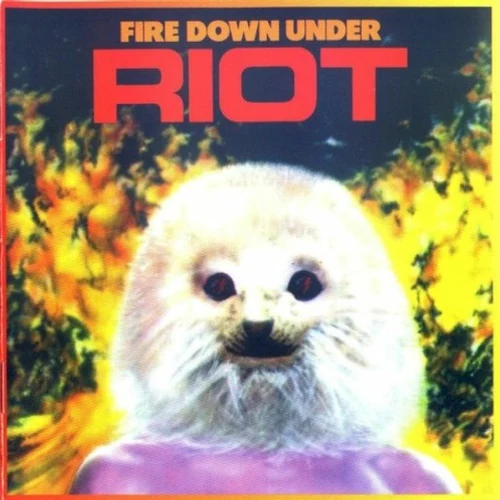
RiotFire Down Under (1981)
A small piece of paper, a rather large loss
We bought a first pressing of Riot's Fire Down Under in our youth, when the album was new and the relationship between disposable income and records was, shall we say, administratively strained. That copy should have accompanied us through the decades. Instead a minor manufacturing defect intervened — a small piece of paper embedded in the polyvinyl chloride. We fussed with it. The record was ruined.
There is no heroic restoration narrative here: a small imperfection became a permanent casualty, and an album we loved acquired an unfortunate footnote. Anyone who has damaged a cherished record knows the peculiar disproportion involved — the object is replaceable in principle; the copy you bought at that age, at that moment, is not.
Not all was lost. Eventually we came upon the 2011 Audio Fidelity pressing, mastered by Kevin Gray, and this cut genuinely delivers the goods — “Swords and Tequila” and “Outlaw” given the glory their stature deserves on a copy we can wholeheartedly recommend. That is the origin of this verdict: it begins with ownership and listening rather than a reflexive genuflection before the words first pressing. Chronology remains an excellent way to arrange a discography; its qualifications as a mastering engineer are less impressive.
What, precisely, is on the turntable?
The record is Audio Fidelity's 2011 Target Series LP, AFZTL 1511, playing at 33⅓ rpm. Our photograph supplies unusually helpful evidence: the label explicitly prints “Mastered by KEVIN GRAY,” the catalog number, and the 1981/2011 dates. The side-one identifier is AFZTL 1511-A — a label inscription, note, not a transcription of the runout.
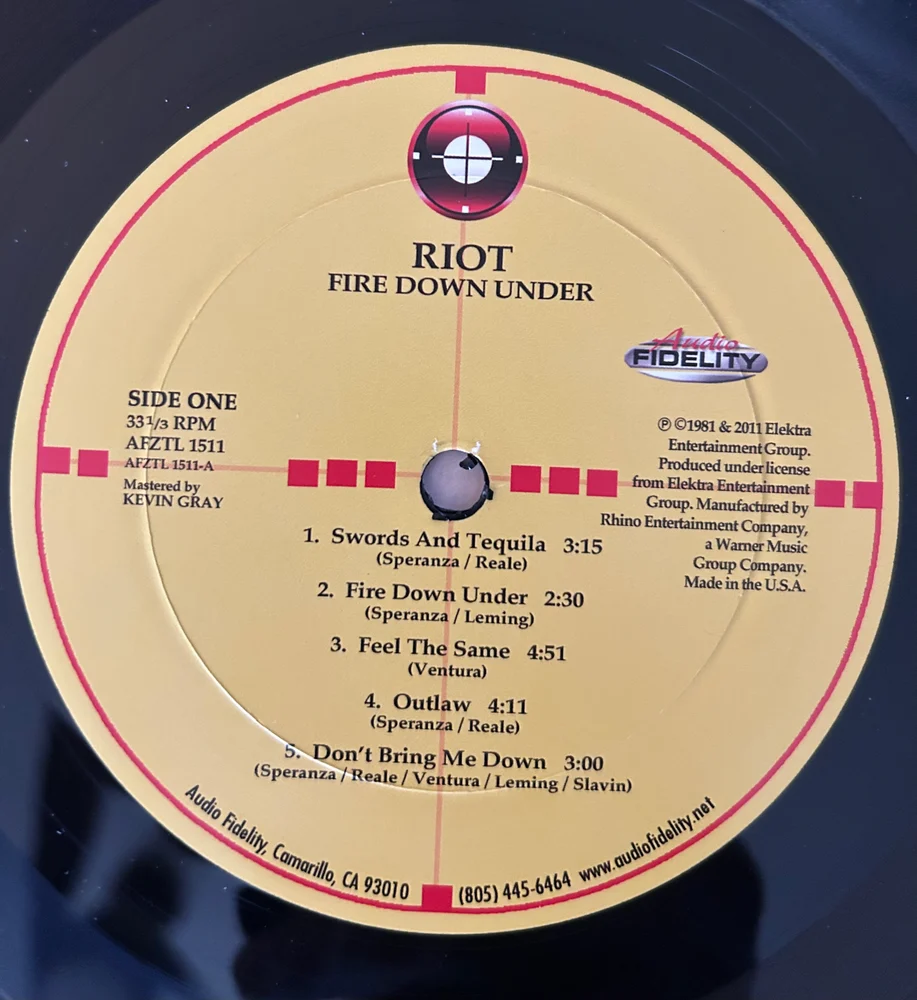
Our copy. Photograph reproduced without retouching. The evidence for the mastering attribution is printed on the record itself.
Elusive Disc's release listing additionally identifies Gray's facility as Cohearent Audio and the plant as Quality Record Pressings.[1] Those are published edition details; the photograph independently establishes only the label credit. The distinction matters, because a surprising amount of audiophile discourse consists of one confirmed fact wearing three unconfirmed accessories. We claim no independently verified all-analog chain, no particular tape generation, no specific set of mastering moves — and the Audio Fidelity name does not automatically make this a 180-gram edition, Target having been a more affordable line of conventional vinyl distinct from the company's premium formats.[2] The musical verdict requires none of those embellishments.
The album that required a negotiation before it could become a classic
Released in 1981, Fire Down Under was Riot's third studio album and the last with original vocalist Guy Speranza. Recorded at Greene Street in New York, produced by Steve Loeb and Billy Arnell with Rod Hui engineering, it placed Speranza alongside guitarists Mark Reale and Rick Ventura, bassist Kip Leming, and drummer Sandy Slavin.[3] The making appears to have been more harmonious than the releasing: in Peter Makowski's retrospective, Ventura remembers unusual chemistry and shared authorship.[4]
Capitol declined the album — too heavy or commercially unsuitable, runs the familiar explanation, though Slavin's account points instead to an internal dispute over an omitted song favored by an A&R representative. The competing recollections deserve to remain competing recollections. After a fan campaign and contractual wrangling, Elektra released it, and it reached No. 49 on the Billboard 200.[3] This was no undiscovered artifact waiting decades for notice; its reputation rests on something more durable than commercial martyrdom — songs that survive being removed from the legend around them. The historical position is fertile, too: the vocabulary belongs to hard rock, the urgency points toward the metal decade taking shape around it, and it need not choose between a tune and an attack.
“Swords and Tequila”: the riff is the invitation
The correct title is “Swords and Tequila” — plural swords, singular invitation to poor judgment. The credit belongs to Speranza and Reale, as the photographed label confirms. Its strength is the relationship between the instrumental identity and the vocal identity. A lesser song puts a serviceable vocal over an excellent riff and hopes nobody notices the unequal division of labor. Here the singing gives the track a second reason to remain in memory: the riff brings you to the door; Speranza makes the place worth staying in.
There is no ceremonial overture before the song announces itself, and the vocal is no mere corridor between guitar features; the central idea stays legible, and the track is recalled as a song rather than a list of impressive incidents. This is why the opener matters to a pressing verdict: its job is to excite, not to become a tasteful exhibit of isolated details. Our enthusiasm for the Gray edition begins with the pleasure of hearing this song afforded its full due — not with a speculative account of which frequency band he adjusted.
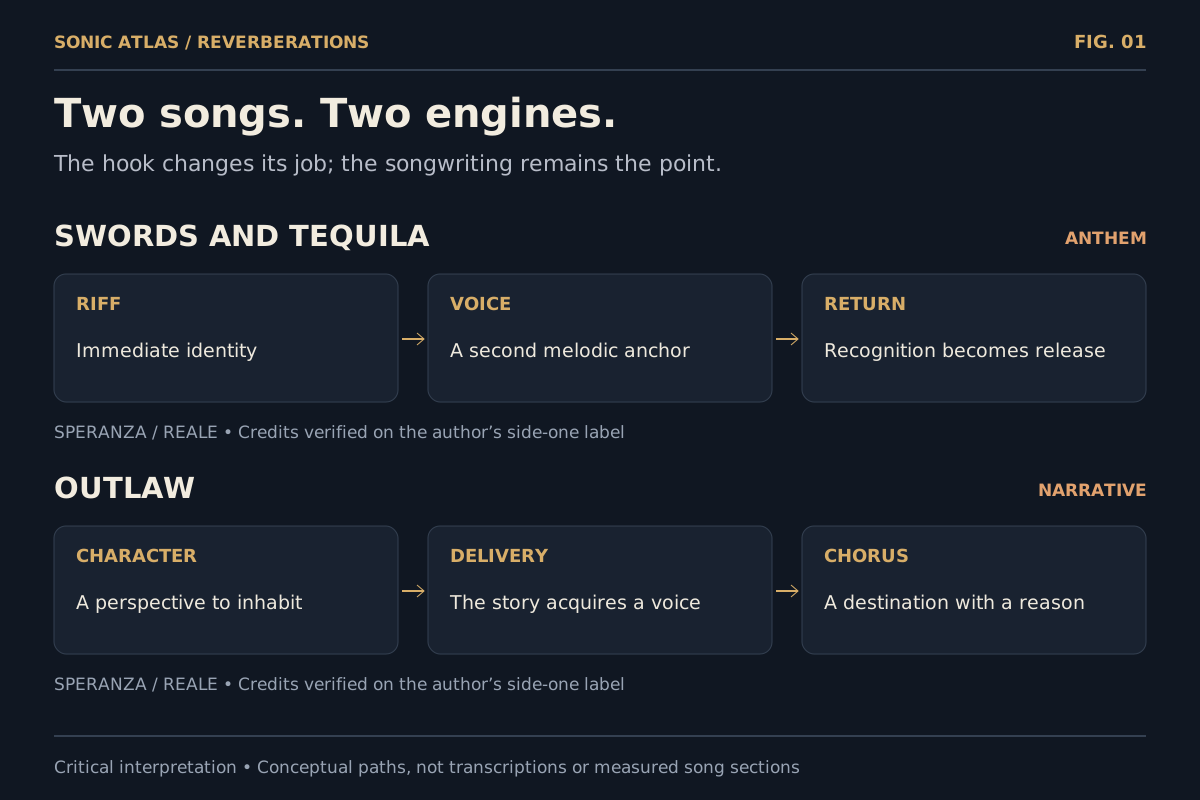
Figure 1. Two songwriting arguments, not measured song structures. Both compositions are credited to Speranza / Reale on our label.
“Outlaw”: a character, not merely a chorus
“Outlaw,” also credited to Speranza and Reale, demonstrates why this album is more than an exercise in momentum. Its narrative gives the singer a role to inhabit, which changes our relationship with the voice: we are following a character, not simply waiting for the title to come around again. A song about an outlaw must persuade us that its protagonist has a life outside the chorus, and Speranza gives the performance that human scale — vivid without inflating into theatrical costume drama.
The lesson is that memorability arises not solely from repetition but from perspective: a strong melodic destination satisfies more when the verses have given it a reason to exist, and “Outlaw” has that sense of destination. For us it and “Swords and Tequila” form the record's essential pair — one the public anthem, the other the storyteller — not interchangeable highlights, and that difference is part of the album's greatness.
Guy Speranza: the singer is also an author
Speranza deserves more than the standard tribute to an underrated vocalist — a phrase that too often avoids the explanation. Here it is: he makes the songs feel inhabited, and his involvement extends into their construction. He shares writing credits on four of side one's five selections, including the title track with Leming; “Feel the Same,” credited to Ventura, makes the counterpoint, since his task also included interpreting someone else's composition as persuasively as his own.
The useful distinction is between vocal display and vocal consequence: a display calls attention to what the singer can do; consequence concerns what happens to the song because this particular singer is doing it. Speranza belongs emphatically to the latter. His delivery also lets the record keep a human face — exuberance, personality, a dramatic premise made approachable — so its emotional world need not be reduced to aggression merely because the guitars arrive with conviction. Another singer might negotiate the notes; the harder assignment is reproducing the relationship between the voice, the material, and the listener.
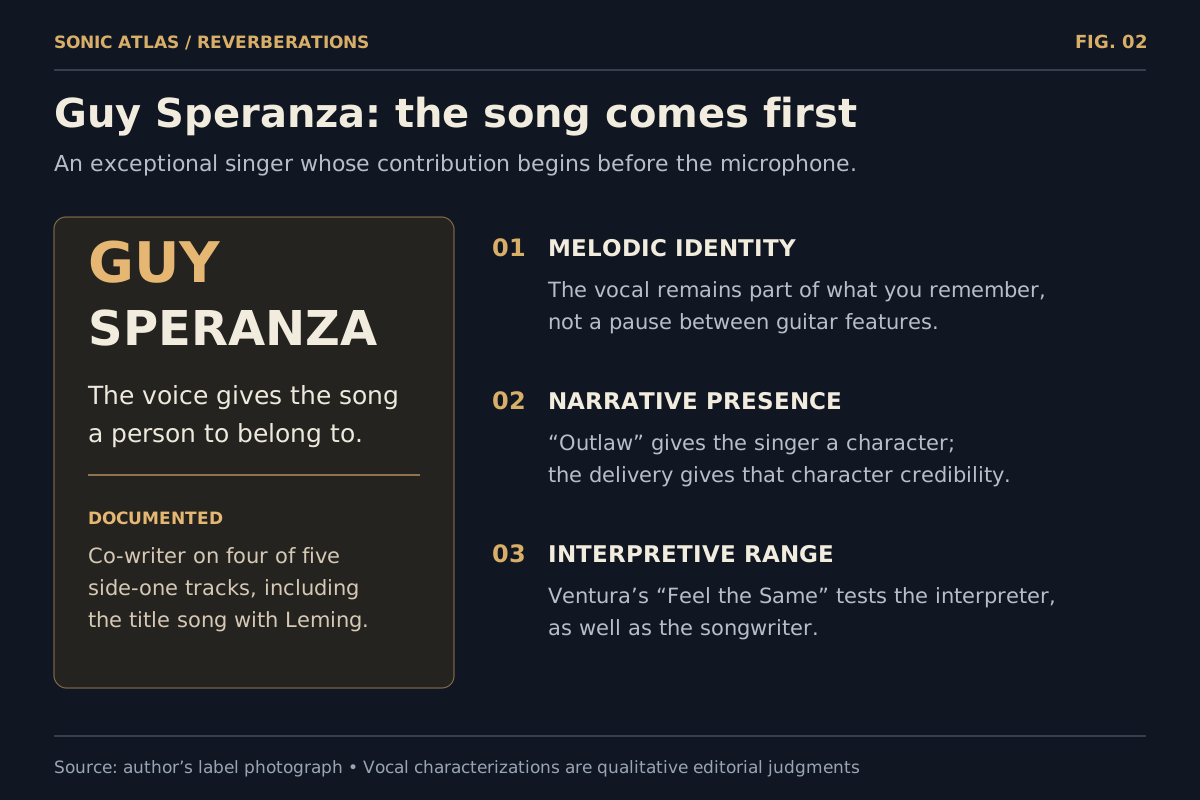
Figure 2. A critical portrait of Speranza's role. The writing credits are documentary; the interpretive descriptions are this essay's argument, not vocal measurements.
Why the album survives beyond its two famous songs
The temptation with Fire Down Under is to praise the opener, salute “Outlaw,” and let the rest vanish into the phrase strong supporting material. That does the sequencing an injustice. The title track supplies concentrated urgency; “Feel the Same” changes the expressive temperature; “Altar of the King” broadens the dramatic setting; “Flashbacks,” with its collage-like conclusion, departs from the straightforward song sequence.[5] These changes let the album accumulate identity without demanding that every track make the same argument at the same volume.
The achievement is contrast with continuity: the consistency comes from the musicians and their sensibility, the variety from what they ask that sensibility to accomplish. This is also where songwriting earns priority over genre bookkeeping. One can debate the boundary between hard rock and heavy metal indefinitely; the record gets on with making that boundary musically useful, letting speed, melody, and dramatic imagination coexist without any one becoming a compulsory uniform.
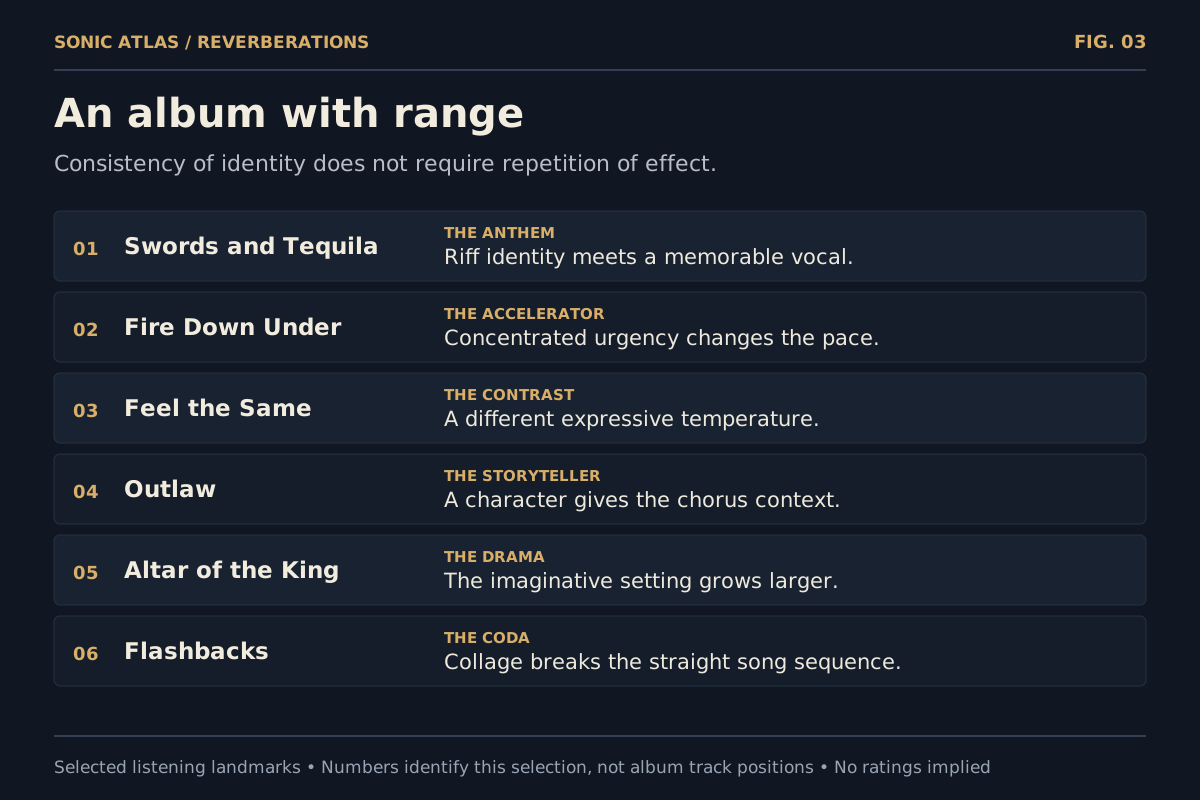
Figure 3. Selected listening landmarks. The descriptions are qualitative; the layout does not imply measured tempo, loudness, or a complete track listing.
Canonical, with the evidence left attached
The word canonical should mean more than “a record we remember fondly.” It implies continuing recognition — work that later listeners and writers return to when explaining what a tradition achieved. There is credible evidence of that standing: Makowski's history reports Steve Harris and Lars Ulrich's admiration for “Swords and Tequila”;[4] Jeremy Morse placed the album in Last Rites' Exploring Metal Classics series in 2016;[6] Todd Manning's fortieth-anniversary assessment for PopMatters in 2021 argued for its enduring place atop Riot's catalog.[5] These are identifiable endorsements, not an invented unanimous verdict.
Influence requires more care. Admiration from musicians in Iron Maiden and Metallica is significant, but it does not establish that a particular later composition was derived from a Riot song; similar riffs, shared vocabulary, and a critic's proposed resemblance are different kinds of evidence, not to be quietly promoted into documented borrowing. Our broader reading is that Fire Down Under belongs among the records that make the transition into eighties metal intelligible — melody essential, attack intensifying, concise songwriting carrying the weight — an interpretation of its position, not a claim that every later band acknowledged it as a blueprint. The canonical claim is already strong enough: the songs endured, serious listeners kept returning, and musicians with far larger audiences recognized their worth.
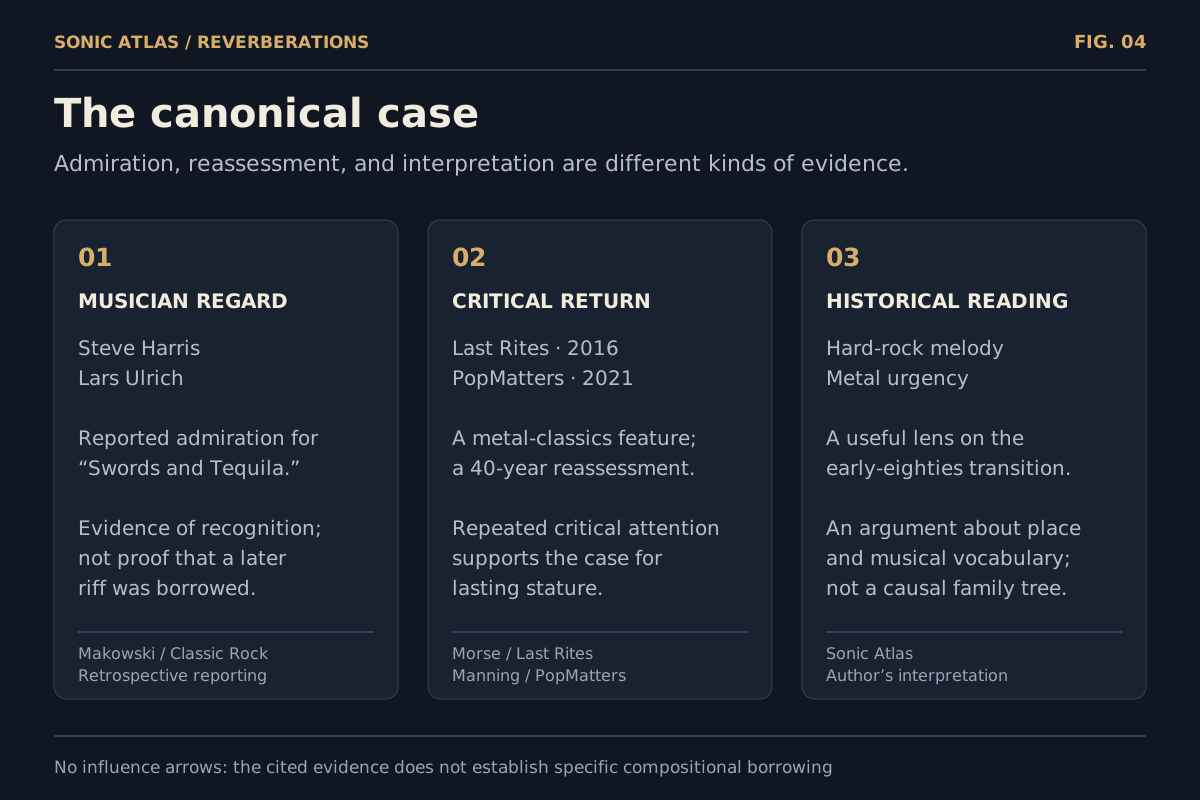
Figure 4. Different forms of recognition, explicitly separated. Sources: Makowski / Classic Rock, Morse / Last Rites, Manning / PopMatters; the historical synthesis is the author's interpretation.
The best-pressing question, answered at the correct scale
Our recommendation is the 2011 Kevin Gray-mastered Audio Fidelity AFZTL 1511. For this listener it is the copy that restored a cherished album to its proper place. That verdict should not be misread as a laboratory result: we cannot make a level-matched comparison with the original we ruined, and we have not assembled every territory, recut, and subsequent reissue. Remembering how much we loved the first pressing is not the same as retaining a reliable sonic reference across decades.
For someone seeking this edition, the useful identifiers are concrete — Audio Fidelity, Target Series, AFZTL 1511, the Kevin Gray credit. Ask for photographs of the actual labels and runouts, and assess the condition of the individual record; a celebrated mastering cannot exempt a used copy from wear, as our original provided an expensive early lesson. What we can say without qualification is that this pressing delivers the music in a way that satisfies us profoundly. The recommendation is personal but not vague: it names the record, the mastering credit, and the songs at the center of the judgment. The first copy was lost; the allegiance was not — and Kevin Gray's Audio Fidelity edition gave that allegiance an excellent record to come home to.
Sources and edition notes
- Elusive Disc — Riot: Fire Down Under LP. Edition listing crediting Kevin Gray at Cohearent Audio and Quality Record Pressings. Used for release specifications, not as an independent listening test.
- Blabbermouth — Riot's Fire Down Under Being Reissued This Month (Oct 10, 2011). Contemporary reporting of the Target Series announcement and its market position.
- Fire Down Under — album reference entry. Album, studio, production, and chart details. No original-cut runout claim is made.
- Peter Makowski — The story of Riot, Classic Rock / Louder. Participant recollections of songwriting and the label dispute; reported admiration from Harris and Ulrich. Conflicting motives are attributed rather than settled.
- Todd Manning — How Does Riot's Fire Down Under Hold Up at 40?, PopMatters (Mar 24, 2021). Retrospective reception; proposed influence parallels are not treated as established causal links.
- Jeremy Morse — Exploring Metal Classics: Riot — Fire Down Under, Last Rites (Jul 26, 2016). Evidence of retrospective critical standing.
Primary copy evidence: the author's supplied label photograph and personal account. No spectral plots, dynamic-range values, controlled comparison results, or unreported listening-session details are represented. Cover image reproduced for identification and criticism; artwork remains the property of its respective rights holders.
Keep Reading
Uriah Heep's Abominog on Vinyl: A Quieter Background, the Same Lean Argument
The 2015 180-gram Abominog reissue (BMGRM094LP) was bought to rescue a lean 1982 original's bottom end. It delivered exceptionally quiet surfaces and a nearly identical tonal balance instead — a case study in why pressing excellence and musical rehabilitation are separate findings.
Beyond Maiden: A Beginner's Atlas of the NWOBHM Underground
The first NWOBHM guide introduced the monuments. This one maps the machinery beneath them: Tank, Persian Risk, Fist, Satan, Jaguar, Mythra, Witchfinder General, and the gloriously unstable British metal underground that taught the next generation how to move faster.
Best Pink Floyd Meddle Vinyl Pressing: UK Original vs. MoFi vs. 2016
Which Meddle pressing sounds best? We compare the UK Harvest original, Japanese EMI, Mobile Fidelity half-speed, and the excellent 2016 remaster — with firsthand listening notes.
Best Supertramp Breakfast in America Vinyl Pressing: Original vs. MoFi vs. 2026 Half-Speed
Did the 2026 Abbey Road half-speed master finally produce the definitive affordable version? We compare four mastering lineages spanning 47 years.