
Uriah Heep's Abominog on Vinyl: A Quieter Background, the Same Lean Argument
On the distinction between pressing excellence and musical rehabilitation, which the heavier-vinyl fraternity occasionally neglects to make.
Abstract: The Monster Has Not Gained Weight
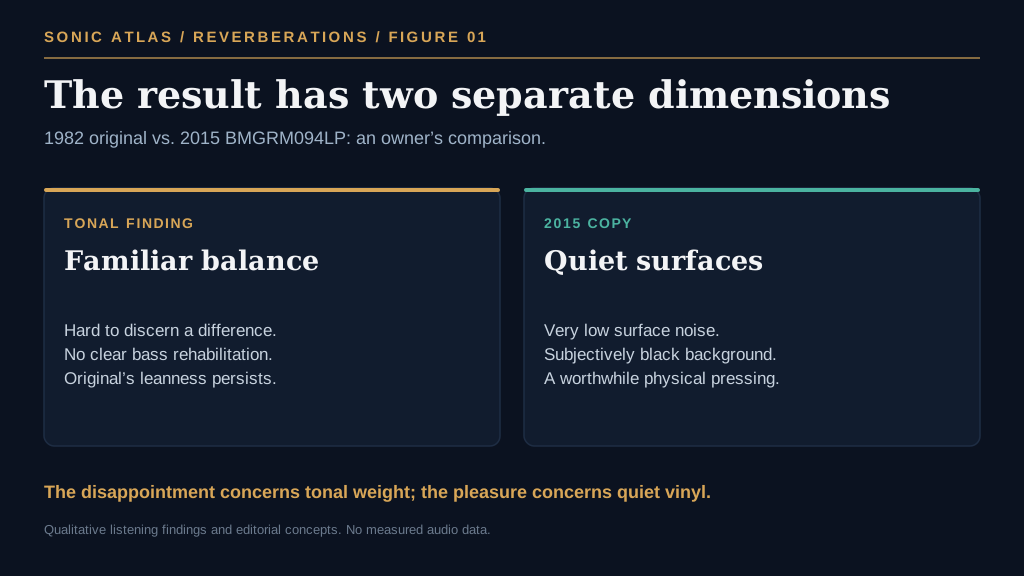
The 2015, 180-gram reissue of Uriah Heep's Abominog, catalog number BMGRM094LP, arrived with a modest assignment: supply some of the low-frequency substance conspicuously absent from our 1982 original. It fulfilled a different one. Its surfaces are exceptionally quiet, its background convincingly black, and its tonal presentation remarkably difficult to distinguish from the earlier record. The anticipated bass rehabilitation never announced itself. The monster acquired a cleaner habitat without acquiring a more substantial skeleton.
This is neither a scandal nor a reason to call the purchase worthless. It is a corrective to the assumption that a later pressing, heavier vinyl, and three intervening decades must collectively constitute progress. Here the achievement is a quiet physical copy; the hoped-for transformation of a lean foundation remains absent from the evidence. Those are separate findings, however inconvenient their separation may be to the sticker department.
I. The Hypothesis and Its Inconvenient Result
Our complaint about the original was specific: it lacked bottom end. Not the familiar demand that every rock record behave like a nightclub ventilation system, but a question of proportion — a hard-rock album can have energy, attack, and conviction while still leaving the listener wishing the lower register carried more of the argument. The reissue was therefore a reasonable experiment, not an invitation to worship a manufacturing date. A different edition might offer a different balance; that possibility justified listening. It did not justify predicting deeper bass before the needle dropped.
It did not arrive. The audible difference between our copies is hard to discern, while the 2015 pressing's low surface noise is unmistakably welcome. The conclusion is correspondingly narrow: we did not hear the tonal correction we had hoped for. The listening chair provides evidence; it does not confer jurisdiction over the entire pressing population, and we will not expand one disappointment into a universal verdict on every original and reissue in existence.
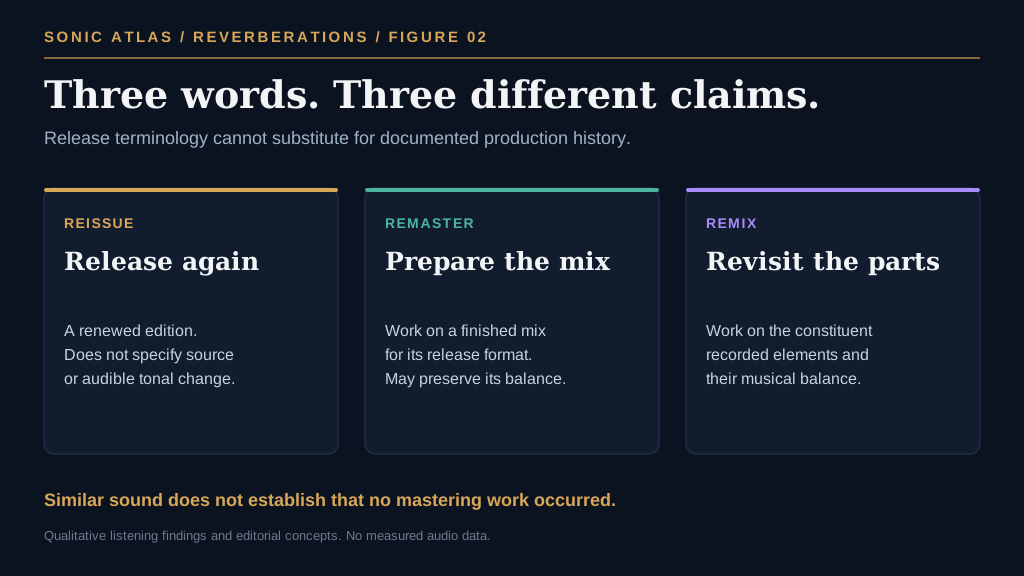
A word on provenance, since record commerce lets three terms mingle freely. A reissue is a renewed release; a remaster prepares a finished mix for distribution; a remix revisits the balance of the recorded elements. This did not sound like a remix or remaster — but similar sound cannot prove no mastering work occurred. An engineer may preserve a familiar balance deliberately. So BMGRM094LP is described here simply as a reissue whose audible presentation closely resembles our original, its exact source and mastering chain unestablished. An empty provenance field is preferable to a beautifully typeset fiction.
II. What the Black Background Actually Buys
The pleasure of this pressing is its quietness. A “black background” is shorthand for the absence of distracting surface noise beneath and between musical events — not a laboratory measurement, but exactly what made the new copy satisfying even as the tonal improvement failed to appear. Surface noise competes with attention: an intrusive tick interrupts a phrase, persistent crackle draws awareness to the medium. Quiet surfaces let the listener follow the record with less interference, and can make softer information easier to notice. None of this requires the signal to have been rebalanced.
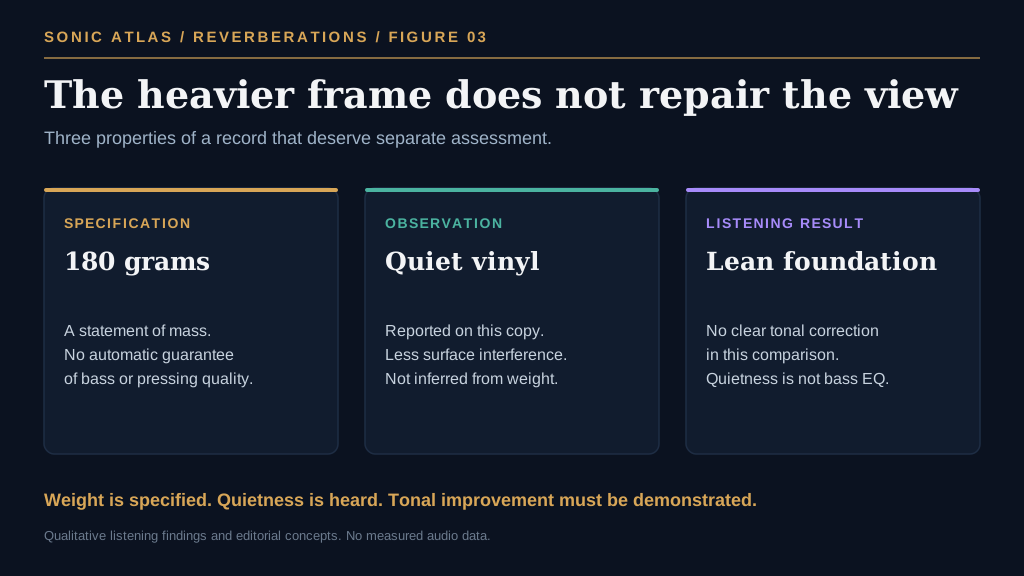
What quietness cannot do is manufacture bass weight that is missing from the balance. Silence underneath a lean recording is still a lean recording. Confusing these categories produces the familiar review in which reduced crackle becomes deeper bass, greater dynamics, and superior artistry by the fourth paragraph. Nor is tonal weight the same as loudness: raising the volume only yields a louder lean balance. Useful bass weight is about the lower register supporting the music in proportion — quantity alone can obscure pitch and soften rhythm. This comparison supplied no evidence of that proportion improving.
Which disposes of the 180-gram argument without its packaging. The mass of a record tells us its mass. It does not identify the source, certify pressing quality, or guarantee a frequency balance, and heavier vinyl earns no automatic credit for flatness or a black background — those must be checked on the actual copy. Here quietness is a listening observation, not a deduction from the weight specification. The distinction sounds embarrassingly elementary until one reads enough promotional prose to see how often the elementary has been escorted out of the building.
III. The Record Itself, and Where the Leanness Lives
A pressing verdict should not forget there is music under discussion. On release, Abominog sounded several years ahead of its time; in reflection it was simply very well-written hard rock for 1982 — which is no small compliment, and ages far better than novelty would have. The sleeve is the finest piece of cover art we own: the slavering, chrome-fanged monster is lurid, confident, and completely unforgettable, the sort of image that justifies the twelve-inch format on its own. And “That's the Way That It Is” has been recorded by others, but Heep's reading of it is, by itself, worth the price of the album. We first knew this record on cassette in our youth, with a different running order; we prefer the LP's sequence, and have ever since.
The leanness itself is a more interesting question than the reissue resolves. The similarity between editions tempts the inference that the lean character originates upstream of the vinyl cutting — plausible, but not proved; recording, mix, source, and mastering could each contribute, and two similar-sounding copies do not locate the cause. What we will say is that we do not think the engineering is the culprit. Ashley Howe was generally a competent producer: Head First and Equator did not suffer from an absence of low end so much as from a decline in the songwriting. The bottom end on Abominog is a characteristic to live with, not obviously a fault to assign.
The playback context, for what it locates rather than what it proves: a VPI Scout and Benz Micro Wood SM into a Conrad-Johnson ET6SE, amplified by a Rogue Audio Atlas Magnum III through Tekton Lore speakers. That identifies the setting in which the comparison mattered to us; it is not a stack of credentials meant to bully a different listener into agreement. More revealing than the equipment is the motive: we already owned the music and wanted a different relationship to its foundation. That is how a pressing comparison becomes meaningful — a clear dissatisfaction and a specific proposed remedy — rather than an indiscriminate appetite for newer objects.
IV. The Verdict: Preservation Without Rehabilitation
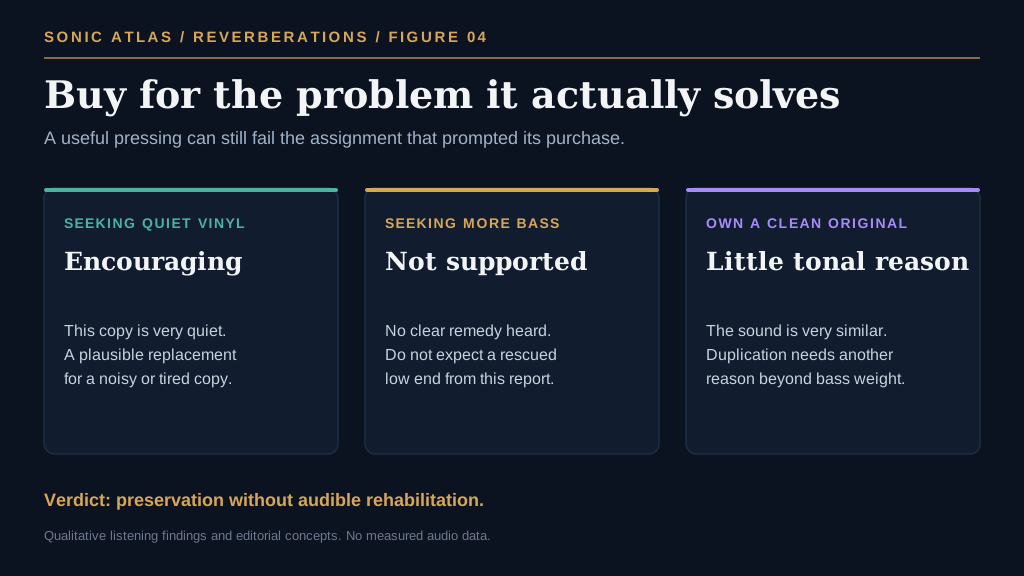
The verdict depends on the problem a buyer wants to solve. For a noisy or tired copy, our 2015 pressing is an encouraging example of quiet vinyl. For the lean bottom end of our 1982 original, it offers no clear remedy, and the owner of a clean original has little tonal reason to duplicate the album. For someone imagining a transformed Abominog, it advises restraint — with the caution that one quiet copy promises nothing about the next. Expectations, unlike surface noise, do not conveniently disappear when the stylus settles into the groove.
The album remains the album we knew in our listening room: its lower foundation still less substantial than we would prefer, its new vinyl pleasantly reluctant to intrude. BMGRM094LP does not need a fictitious mastering rescue to justify its quiet surfaces, and those surfaces do not need to be mistaken for tonal repair. The reissue offers a cleaner window onto Abominog; the view beyond it looks much the same. A heavier frame has not, regrettably, improved the architecture — though with artwork and songs like these, the architecture was worth framing regardless.
Release identity reference: Musik-Sammler — Abominog, 2015, BMGRM094LP, 180-gram reissue. The date, catalog number, and vinyl weight are supported by that collector listing; the listening verdict is the owner's. No blind test, level matching, dynamic-range measurement, mastering engineer, source format, or universal pressing verdict is claimed. The illustrations are editorial concepts, not measured audio data.
Keep Reading
Best Riot Fire Down Under Vinyl Pressing: The Kevin Gray Audio Fidelity Cut
A ruined first pressing, an extraordinary singer, and the 2011 Audio Fidelity reissue (AFZTL 1511) mastered by Kevin Gray that restored a personal cornerstone of American heavy metal. On Guy Speranza's songwriting, the essential pair of 'Swords and Tequila' and 'Outlaw,' and why the album is canonical with the evidence left attached.
Best Pink Floyd Meddle Vinyl Pressing: UK Original vs. MoFi vs. 2016
Which Meddle pressing sounds best? We compare the UK Harvest original, Japanese EMI, Mobile Fidelity half-speed, and the excellent 2016 remaster — with firsthand listening notes.
Best Supertramp Breakfast in America Vinyl Pressing: Original vs. MoFi vs. 2026 Half-Speed
Did the 2026 Abbey Road half-speed master finally produce the definitive affordable version? We compare four mastering lineages spanning 47 years.
Best Rush Permanent Waves Vinyl Pressing: Which Version Sounds Best?
Over 200 versions on Discogs. The MASTERDISK HW inscription is the collector's signal — but can a modern Sean Magee remaster actually improve upon it? We compare originals, MoFi, and Abbey Road cuts.