
Best Pink Floyd Meddle Vinyl Pressing: Original UK vs. MoFi vs. 2016 Remaster
Do you need an expensive early UK pressing or audiophile edition to hear Meddle at its best — or is the 2016 pressing already close enough to definitive?
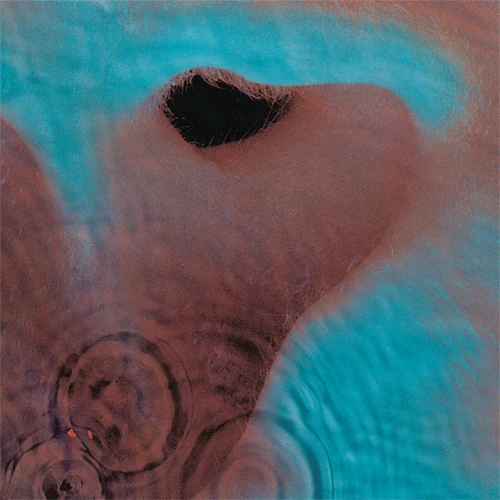
Pink FloydMeddle (1971)
Sonic Atlas Verdict
Best overall value (and the one we own): 2016 Pink Floyd Records 180g reissue (PFRLP6) — silent surfaces, faithful mastering, and very little sonic compromise for about $25–40.
Best historical pressing: Early UK Harvest original (SHVL 795, low stampers) — the benchmark presentation, if you accept the condition gamble and price.
Best audiophile collectible: Mobile Fidelity half-speed (MFSL 1-190) — an important alternate mastering, out of print.
Best for quiet vinyl: Japanese EMI/Odeon pressing — manufacturing precision and typically silent surfaces.
While The Dark Side of the Moon, Wish You Were Here and The Wall receive the majority of pressing-comparison attention, Meddle may be the better Pink Floyd album for judging pressing quality. It combines quiet atmospheric passages demanding an exceptional noise floor, deep bass requiring true low-frequency extension, large dynamic contrasts, spatial effects that test soundstage accuracy, delicate acoustic instrumentation, and heavily processed electric sounds — all culminating in the 23-minute "Echoes," which is one of the most demanding tests of vinyl reproduction in the catalog.
The central question: do you need an expensive early UK pressing or audiophile edition to hear this album at its best, or is the readily available 2016 pressing already close enough to definitive? Our answer, from direct listening, is that the 2016 Pink Floyd Records reissue (PFRLP6) gets you most of the way to definitive for a fraction of the cost — the detail below explains why, and where the vintage and audiophile editions still earn their keep.
Why Meddle Is Such a Good Test Record
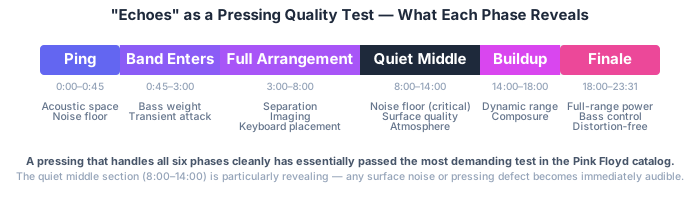
Each track on Meddle reveals different pressing qualities:
- "One of These Days" — Bass definition, low-frequency extension, transient attack, channel separation. The dual-bass guitar figure must remain controlled as the track builds to full intensity without congestion.
- "A Pillow of Winds" — Delicacy, acoustic texture, vocal smoothness, ambient information. Any harshness or pressing noise becomes immediately apparent against the quiet backdrop.
- "Fearless" — Midrange tonality, guitar texture, separation of layered instrumentation. The Liverpool football crowd at the end tests how naturally a pressing handles complex, dense sound.
- "Echoes" — The ultimate test. Soundstage width and depth, extremely quiet passages, noise floor, spatial cues, dynamics, bass weight, instrument localization, and the ability to preserve atmosphere without becoming murky. A pressing that handles all 23 minutes cleanly has essentially passed the most demanding vinyl test in the Pink Floyd catalog.
The Pressings Worth Knowing
1971 UK Harvest Original
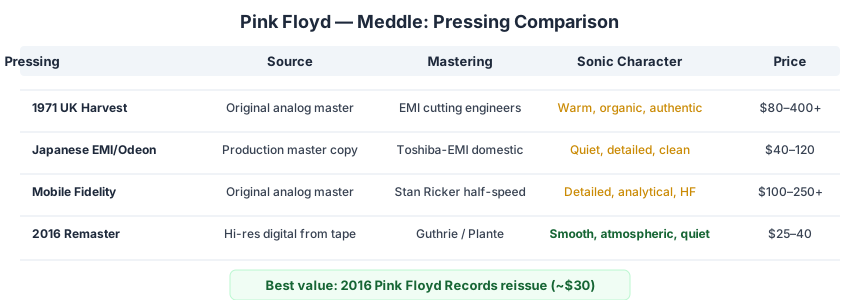
The historical reference pressing. Released on Harvest SHVL 795, cut at EMI's Abbey Road facility, pressed at Hayes. Early matrix variants — particularly copies with low stamper numbers (the collector's ideal being matrices close to 1U/1U) — are treated as the benchmark for authentic presentation.
Collector consensus describes these as having a warmth and organic quality that later pressings can struggle to replicate — the natural result of a first-generation cut from fresh master tapes on then-current equipment. The spatial characteristics of "Echoes" are frequently cited as particularly convincing on good early UK copies.
The downsides are practical: truly clean copies are expensive ($150–400+ for early stampers in NM condition), 55-year-old vinyl inevitably has some surface wear in many cases, and early Harvest pressings were not immune to manufacturing inconsistencies. Buying blind carries risk.
Best for: The collector seeking the historically significant original presentation, who accepts the condition gamble and pricing.
Japanese EMI/Odeon Pressing
Japanese pressings from the Toshiba-EMI era have an established reputation for exceptionally quiet vinyl and high manufacturing precision. Meddle copies (various catalog numbers including EOP-80375 and later EMS-80324) are valued by collectors who prioritize surface silence.
The tonal presentation may differ from UK copies — some listeners report slightly greater upper-frequency emphasis, which can read as either "more detailed" or "brighter" depending on system and preference. The source was likely a production master supplied to Toshiba-EMI rather than the original Abbey Road tape, which may account for subtle differences.
Best for: Collectors who value pressing quality, low surface noise, and manufacturing consistency.
Price: $40–120 on the secondary market.
Mobile Fidelity Sound Lab (MFSL 1-190)
The MoFi Meddle was half-speed mastered from the original analog master tape and pressed in Japan on virgin vinyl (1984). It became an audiophile reference point and retains strong collector demand.
The half-speed technique extracts high-frequency detail that standard real-time cuts may not fully resolve. Collector opinions are generally positive but not unanimous — some report the MoFi offers a wider, more detailed window into the recording, while others feel it presents a subtly different tonal balance from the UK original (slightly less bass weight, more upper-midrange presence). It represents an interpretation as much as a reproduction.
Best for: Collectors specifically interested in classic audiophile editions and alternate mastering perspectives.
Price: $100–250+ (out of print, secondary market only).
2016 Pink Floyd Records Reissue
This is the pressing in the Sonic Atlas archive, and the one we can speak to from direct listening experience.
The 2016 campaign was overseen by James Guthrie and Joel Plante, working from high-resolution digital transfers of the original analog master tapes. The source is not AAA — but as we've argued elsewhere, mastering decisions matter more than simplistic analog-versus-digital labels.
What strikes us most about this pressing is the background silence. Between notes, between phrases, during the quiet middle section of "Echoes" — there is nothing. No surface hiss, no pressing artifacts, no groove noise. The vinyl itself disappears.
The presentation is smooth and liquid without being soft. "A Pillow of Winds" and "St. Tropez" are particularly impressive — the acoustic guitar has texture and presence, the vocals are natural and sibilance-free, and the room ambience decays naturally into silence rather than into pressing noise.
On "Echoes": the opening ping appears in a believable acoustic space. Bass weight arrives convincingly when the band enters. Wright's keyboards sit naturally in the soundstage. Gilmour's guitar has texture without edge. Mason's transients are controlled without being dulled. The quiet middle section — the most demanding noise-floor test — reveals that this pressing is genuinely silent. The buildup back into the final passage maintains composure without compression artifacts.
The top end is controlled without being rolled off. There is no harshness anywhere. The soundstage is wide and stable. Instrument separation is convincing throughout.
Best for: Almost everyone who wants an excellent-playing copy without collector pricing.
Price: $25–40 new.
Original Analog vs. Modern Remaster: Does the Source Matter?
Listeners often assume that an original analog pressing automatically sounds superior and that a digital remaster is automatically inferior. Meddle provides a useful counterexample.
Consider what a buyer of a "superior" 1971 original is actually getting: a 55-year-old piece of PVC that has been played, stored, and handled for over five decades. The master tape was fresh in 1971, but the pressing itself has aged. Surface noise accumulates. Groove wear is invisible but audible. Storage conditions matter. And early 1970s UK pressing quality, while often excellent, was not uniformly pristine.
Meanwhile, the 2016 pressing was cut from a high-resolution transfer of that same tape (captured while the tape was still in playable condition), mastered by engineers intimately familiar with the catalog, and pressed on modern equipment with contemporary quality control. The vinyl is new. The surfaces are silent. The mastering reflects decades of accumulated expertise with this specific music.
None of this means the 2016 is objectively "better" than a pristine UK original — that comparison we have not made firsthand. But it does mean the assumption that older = better and digital = worse deserves scrutiny, especially when the practical alternative is a worn $200 original versus a mint $30 modern pressing. For more on this topic, see AAA vs. Digital Source.
How to Identify a Good Meddle Pressing
Check the dead wax under angled light. Key identifiers:
- Harvest label + SHVL 795 + early matrices — UK original. Lower stamper numbers generally indicate earlier pressing runs.
- Toshiba-EMI/Odeon identifiers + Japanese text on label — Japanese pressing.
- MFSL 1-190 + Mobile Fidelity branding — MoFi half-speed edition.
- Pink Floyd Records label + PFRLP6 — 2016 reissue.
Always check the dead wax rather than relying solely on the jacket — condition can outweigh theoretical mastering superiority, and a clean modern pressing will easily outperform a worn original. For a full guide, see How to Read the Dead Wax.
Does 180-Gram Vinyl Matter Here?
The 2016 pressing is 180g. That is not why it sounds good. It sounds good because Guthrie and Plante made excellent mastering decisions, the pressing plant delivered clean surfaces, and the source transfer captured the tape faithfully. The weight is a packaging detail, not a sonic feature. See Does 180-Gram Vinyl Sound Better? for the full argument.
Which Meddle Pressing Should You Buy?
Best historical pressing
Early UK Harvest (SHVL 795, low stampers) — original presentation and collector significance.
Best audiophile collectible
Mobile Fidelity (MFSL 1-190) — important alternate mastering with established collector reputation.
Best quiet-vinyl alternative
Japanese EMI/Odeon pressing — manufacturing quality and typically silent surfaces.
Best overall value / recommendation
2016 Pink Floyd Records reissue — excellent mastering, quiet pressing, easy availability, reasonable cost, and very little sonic compromise.
The Sonic Atlas Verdict
We do not believe a collector needs to spend several hundred dollars on Meddle to understand what makes the recording special. A pristine UK original may ultimately provide the most historically authentic presentation, and a MoFi offers an interesting audiophile interpretation — but the 2016 pressing succeeds on the qualities that matter most: atmosphere, dynamics, low noise, dimensionality, tonal balance, and musical involvement.
That recommendation comes from listening, not from specifications. We own this pressing. We have played it repeatedly. "Echoes" holds up across its entire 23 minutes without fatigue, without distraction, without the pressing calling attention to itself. The vinyl disappears and the music remains.
The best pressing is not necessarily the rarest pressing. It is the pressing that preserves the character of the recording — and makes you want to turn the record over and play "Echoes" again.
Related Reading
Keep Reading
Best Pink Floyd The Wall Vinyl Pressing: Which Version Actually Sounds Best?
Same album. Same music. Dramatically different sound. We compare original US and UK copies, the 2011 Doug Sax remaster, the 2016 Grundman reissue, and more — with a clear verdict.
Best Rush Permanent Waves Vinyl Pressing: Which Version Sounds Best?
Over 200 versions on Discogs. The MASTERDISK HW inscription is the collector's signal — but can a modern Sean Magee remaster actually improve upon it? We compare originals, MoFi, and Abbey Road cuts.
Best Supertramp Breakfast in America Vinyl Pressing: Original vs. MoFi vs. 2026 Half-Speed
Did the 2026 Abbey Road half-speed master finally produce the definitive affordable version? We compare four mastering lineages spanning 47 years.
Best Supertramp Crime of the Century Vinyl Pressing: Which Version Sounds Best?
One of the finest analog demonstration records ever made — but which pressing delivers? We compare the producer-endorsed UK original, Speakers Corner, MoFi UHQR, and the new Abbey Road half-speed master.