
25 Best-Sounding Vinyl Records We Own: An Audiophile's Real-World Ranking
Every album on this list is actually owned, played, and evaluated through the same analog playback system. This is not a list assembled from other audiophile lists.
Why This List Is Different
Search for "best sounding vinyl records" and you will find the same predictable group of albums recycled across dozens of websites. Dark Side of the Moon. Kind of Blue. Aja. Random Access Memories. The lists are assembled from other lists, rarely from sustained listening experience on a single resolving system.
This is different.
Every record here is part of our own collection and has been evaluated through the same analog playback system — a modified VPI Scout turntable with a Benz Micro Wood SM cartridge feeding a Conrad-Johnson ET6SE phono stage and tube amplification. The objective is not to identify the 25 greatest albums ever made. It is to identify the 25 records in our collection that most convincingly demonstrate what high-quality vinyl playback can do.
Evaluation Methodology
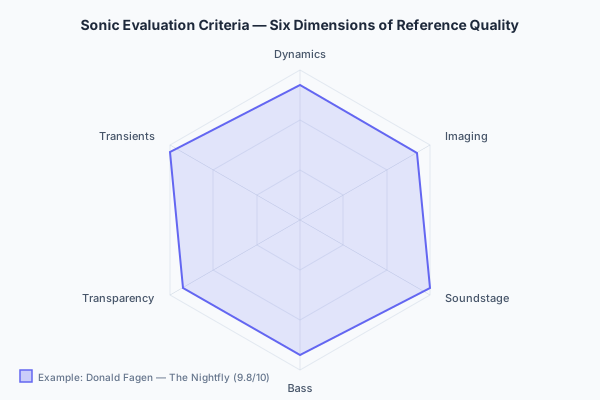
Each album is evaluated across several sonic attributes:
- Dynamics — How effectively the recording moves between quiet and loud passages without sounding compressed or constrained
- Transient Response — The speed and realism of attacks: drums, cymbals, piano strikes, guitar picking, percussion
- Imaging — The ability to locate individual performers and instruments precisely within the stereo field
- Soundstage — Width, depth, height, dimensionality, and the sense of acoustic space extending beyond the speakers
- Bass Quality — Extension, articulation, pitch definition, impact, and control — not simply quantity
- Tonal Balance — Whether the recording presents convincing bass, midrange, and treble without excessive brightness, thickness, or coloration
- Transparency — The ability to hear reverberation, room ambience, instrument decay, subtle textures, and production details
Points are deducted for audible deficiencies including sibilance, glare, congestion, excessive compression, distorted vocals, poor inner-groove performance, weak mastering, or excessive surface noise attributable to the pressing.
This is a sonic ranking rather than a musical ranking. An album we love may rank below a less personally important record if the latter is demonstrably superior as an audio recording. Likewise, obscure or unexpected albums are allowed to outrank recognized audiophile classics. That tension is part of what gives the list credibility.
The Ranking at a Glance
The full write-up for each record follows. Scores are out of 10, averaged across the seven attributes above.
| # | Album | Artist | Year | Score |
|---|---|---|---|---|
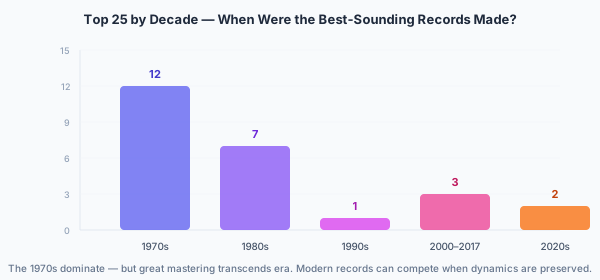
| 1 | The Nightfly | Donald Fagen | 1982 | 9.8 |
| 2 | Aja | Steely Dan | 1977 | 9.7 |
| 3 | Crime of the Century | Supertramp | 1974 | 9.6 |
| 4 | I Robot | The Alan Parsons Project | 1977 | 9.5 |
| 5 | The Seeds of Love | Tears for Fears | 1989 | 9.4 |
| 6 | Gaucho | Steely Dan | 1980 | 9.3 |
| 7 | Animals (2018 Remix) | Pink Floyd | 2022 | 9.2 |
| 8 | Breakfast in America | Supertramp | 1979 | 9.1 |
| 9 | Toto IV | Toto | 1982 | 9.0 |
| 10 | One Eighty | Ambrosia | 1980 | 8.9 |
| 11 | Year of the Cat | Al Stewart | 1976 | 8.8 |
| 12 | Hard Candy | Ned Doheny | 1976 | 8.7 |
| 13 | The Dark Side of the Moon | Pink Floyd | 1973 | 8.6 |
| 14 | Hand. Cannot. Erase. | Steven Wilson | 2015 | 8.5 |
| 15 | Rumours | Fleetwood Mac | 1977 | 8.4 |
| 16 | The Harmony Codex | Steven Wilson | 2023 | 8.3 |
| 17 | To the Bone (45 RPM) | Steven Wilson | 2017 | 8.2 |
| 18 | Damnation | Opeth | 2003 | 8.1 |
| 19 | Silk Degrees | Boz Scaggs | 1976 | 8.0 |
| 20 | Bobby Caldwell | Bobby Caldwell | 1978 | 7.9 |
| 21 | Night and Day | Joe Jackson | 1982 | 7.8 |
| 22 | Moonmadness | Camel | 1976 | 7.7 |
| 23 | Wind & Wuthering | Genesis | 1976 | 7.6 |
| 24 | Bill LaBounty | Bill LaBounty | 1982 | 7.5 |
| 25 | Synchronicity | The Police | 1983 | 7.4 |
#1 — Donald Fagen — The Nightfly
Year: 1982 · Genre: Jazz-Pop, Sophisti-Pop · Overall Sonic Score: 9.8/10

The Nightfly is a digital recording released on analog vinyl, and its inclusion at number one reinforces the Sonic Atlas position that great vinyl playback is ultimately about mastering and execution — not analog purity alone. The image precision is surgical. Every instrument occupies a distinct physical position within an exceptionally deep and wide soundstage. Bass is articulate and extended without bloat. Transients — particularly the drum programming and keyboard attacks — arrive with startling accuracy. The perceived noise floor is vanishingly low for a vinyl pressing. Fagen's vocal sits in a stable, precisely defined space that never wanders or smears.
What to Listen For: Vocal placement stability · bass articulation on "I.G.Y." · cymbal decay · keyboard transient precision
Demonstration Track: "I.G.Y."
Scores: Dynamics: 9/10 · Imaging: 10/10 · Soundstage: 10/10 · Transients: 10/10 · Bass: 9/10 · Transparency: 10/10
Pressing Notes: The copy evaluated for this article is from our personal collection; detailed matrix and mastering information will be added after verification.
#2 — Steely Dan — Aja
Year: 1977 · Genre: Jazz-Rock, Pop · Overall Sonic Score: 9.7/10
Aja represents extraordinary studio precision applied to sophisticated jazz-rock arrangements. The drum reproduction — particularly Steve Gadd's legendary performance on the title track — is reference-caliber. Image placement is exact without sounding clinical. The tonal balance is remarkably even across the frequency spectrum. Layered arrangements that would collapse into congestion on lesser recordings remain fully intelligible here. Instrumental textures feel natural and three-dimensional rather than flat or processed. For how it stacks up against its glossier successor, see our listening comparison, Aja vs. Gaucho: Which Steely Dan Album Sounds Better?
What to Listen For: Steve Gadd's drum kit positioning · guitar and keyboard separation · bass definition · harmonic layering that remains transparent
Demonstration Track: "Aja"
Scores: Dynamics: 9/10 · Imaging: 10/10 · Soundstage: 9/10 · Transients: 10/10 · Bass: 9/10 · Transparency: 10/10
Pressing Notes: The copy evaluated for this article is from our personal collection; detailed matrix and mastering information will be added after verification.
#3 — Supertramp — Crime of the Century
Year: 1974 · Genre: Progressive Rock · Overall Sonic Score: 9.6/10
One of the strongest traditional analog-era demonstration records in the collection. The dynamic range is tremendous — quiet passages that barely register above silence erupt into full-scale orchestral and band explosions without a trace of compression. Piano reproduction is startlingly realistic. The soundstage extends deep behind the speakers with clearly defined layers. Atmospheric detail — reverb tails, room reflections, the decay of Hodgson's harmonica — hangs in space with remarkable clarity. The quiet-to-loud contrasts on "School" remain one of the most dramatic dynamic events available on vinyl. For edition-by-edition detail, see our Crime of the Century pressing comparison.
What to Listen For: Piano attack realism · dynamic range on "School" · harmonica decay · orchestral depth layering
Demonstration Track: "School"
Scores: Dynamics: 10/10 · Imaging: 9/10 · Soundstage: 10/10 · Transients: 10/10 · Bass: 9/10 · Transparency: 9/10
Pressing Notes: The copy evaluated for this article is from our personal collection; detailed matrix and mastering information will be added after verification.
#4 — The Alan Parsons Project — I Robot
Year: 1977 · Genre: Progressive Rock, Art Rock · Overall Sonic Score: 9.5/10

An exceptionally deep soundstage combined with powerful but controlled bass defines this record's sonic character. Atmospheric layering creates a sense of three-dimensional space that few recordings from any era can match. Synthesizer textures are rendered with full harmonic complexity rather than being reduced to flat, two-dimensional patches. Studio-created spatial effects pan and recede convincingly. Wide dynamic contrasts between intimate verses and full-band passages demonstrate Alan Parsons' mastery of the recording medium.
The copy evaluated here is the 1977 US Arista pressing (AL 7002), pressed at PRC Richmond, with matrices A-S-1 / B-S-1 — an unassuming early pressing of the kind easily overlooked because it carries no audiophile logo on the jacket. What stands out is not merely a quiet piece of vinyl but the mastering itself: a near-total black background that lets low-level spatial information survive, depth rather than exaggerated width, and separation that never carves artificial space around instruments or spotlights them. The tonal character holds steady from track to track, and it is refined without the added sheen of a modern “audiophile spectacular” cut. Crucially, it resolves enough that each layer is individually accessible while still cohering as music — you hear through Parsons' multitrack technique rather than being made to admire it. On our Benz Micro Wood SM loaded at 500 Ω into the Conrad-Johnson, the loading opens the cartridge up without pushing it toward etched transients, so the pressing's depth and layering are especially obvious. On the evidence of this copy, an MFSL or another prestige early pressing would be a comparison rather than an upgrade.
What to Listen For: Soundstage depth · bass extension and control · synthesizer texture · spatial effects panning
Demonstration Track: “I Wouldn't Want to Be Like You”
Scores: Dynamics: 9/10 · Imaging: 9/10 · Soundstage: 10/10 · Transients: 9/10 · Bass: 10/10 · Transparency: 9/10
Pressing Notes: 1977 US Arista AL 7002 · PRC Richmond · runout matrices A-S-1 / B-S-1.
#5 — Tears for Fears — The Seeds of Love
Year: 1989 · Genre: Art Pop, Progressive Pop · Overall Sonic Score: 9.4/10
One of the article's strongest examples of a highly complex production that remains remarkably transparent. The production scale is enormous — orchestral layers, multi-tracked vocals, dense percussion, keyboards, and guitars coexist without the mix collapsing into congestion. Vocals are dimensional and precisely placed. Percussion hits with genuine physical impact. Microdetail is exceptional: you can hear individual room ambiences, reverb characteristics, and production decisions that would be masked on a lesser recording. Density without sonic collapse — the rarest achievement in recorded music.
What to Listen For: Vocal dimensionality · percussion transient impact · orchestral layering · low-level production detail
Demonstration Track: "Woman in Chains"
Scores: Dynamics: 9/10 · Imaging: 9/10 · Soundstage: 9/10 · Transients: 10/10 · Bass: 9/10 · Transparency: 10/10
Pressing Notes: The copy evaluated for this article is from our personal collection; detailed matrix and mastering information will be added after verification.
#6 — Steely Dan — Gaucho
Year: 1980 · Genre: Jazz-Pop · Overall Sonic Score: 9.3/10
Where Aja sounds organic and warm, Gaucho presents almost clinical studio precision. The cleanliness is extreme — backgrounds are silent, images are rock-stable, and every element in the mix occupies a precisely defined frequency and spatial range. Bass control is exemplary. Percussion detail is immaculate. The consistency across the entire frequency spectrum is remarkable — no region calls attention to itself. It is a masterclass in studio discipline that rewards analytical listening. We weigh it directly against its predecessor in Aja vs. Gaucho.
What to Listen For: Image stability · bass control on "Babylon Sisters" · percussion micro-detail · frequency-spectrum consistency
Demonstration Track: "Babylon Sisters"
Scores: Dynamics: 8/10 · Imaging: 10/10 · Soundstage: 9/10 · Transients: 9/10 · Bass: 10/10 · Transparency: 10/10
Pressing Notes: The copy evaluated for this article is from our personal collection; detailed matrix and mastering information will be added after verification.
#7 — Pink Floyd — Animals: 2018 Remix
Year: 2022 (remix) · Genre: Progressive Rock · Overall Sonic Score: 9.2/10
The ranking concerns the sonic capabilities of the 2018 remix rather than whether the remix is artistically preferable to the original mix. The separation between instruments is dramatically improved. Bass extension reaches deeper with greater authority. Image placement is precise and stable. Low-frequency events — particularly the synthesizer bass on "Dogs" — arrive with genuine physical weight. Dramatic spatial effects pan convincingly across an enormous soundstage.
What to Listen For: Bass extension · instrument separation · spatial effects on "Dogs" · low-frequency authority
Demonstration Track: "Dogs"
Scores: Dynamics: 9/10 · Imaging: 9/10 · Soundstage: 10/10 · Transients: 9/10 · Bass: 10/10 · Transparency: 9/10
Pressing Notes: The copy evaluated for this article is from our personal collection; detailed matrix and mastering information will be added after verification.
#8 — Supertramp — Breakfast in America
Year: 1979 · Genre: Pop Rock, Progressive Pop · Overall Sonic Score: 9.1/10
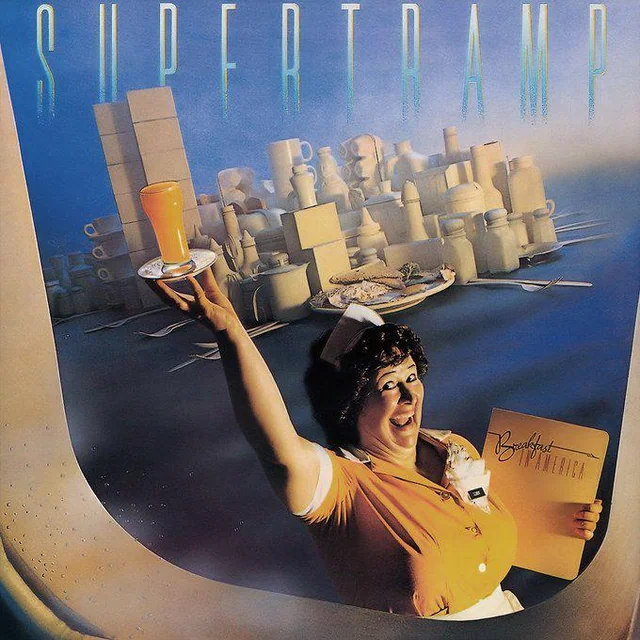
An extremely clean background with a smooth tonal presentation that never fatigues. Stereo separation is excellent — instruments occupy distinct positions with minimal bleed. Vocal clarity is exceptional, and on a properly performing pressing the album resists objectionable sibilance entirely. Controlled high frequencies allow extended listening sessions without glare. The image placement is precise and the overall presentation is polished without sacrificing musical energy. For edition detail, see our Breakfast in America pressing comparison.
What to Listen For: Vocal clarity and sibilance-free reproduction · stereo separation · clean background · controlled treble
Demonstration Track: "The Logical Song"
Scores: Dynamics: 8/10 · Imaging: 9/10 · Soundstage: 9/10 · Transients: 9/10 · Bass: 9/10 · Transparency: 10/10
Pressing Notes: The copy evaluated for this article is from our personal collection; detailed matrix and mastering information will be added after verification.
#9 — Toto — Toto IV
Year: 1982 · Genre: Pop Rock, AOR · Overall Sonic Score: 9.0/10
Jeff Porcaro's drum reproduction alone justifies the inclusion. The transient attack on snare, toms, and cymbals is among the most realistic in the collection. The production is polished to a mirror finish without sacrificing dynamic life. Layered vocals are separated and intelligible. Bass definition is excellent — each note has clear pitch and appropriate weight. The stereo image is highly organized, every element precisely placed as if arranged on a grid.
What to Listen For: Jeff Porcaro's drum transients · bass pitch definition · layered vocal separation · stereo image organization
Demonstration Track: "Rosanna"
Scores: Dynamics: 9/10 · Imaging: 9/10 · Soundstage: 9/10 · Transients: 10/10 · Bass: 9/10 · Transparency: 9/10
Pressing Notes: The copy evaluated for this article is from our personal collection; detailed matrix and mastering information will be added after verification.
#10 — Ambrosia — One Eighty
Year: 1980 · Genre: Soft Rock, West Coast · Overall Sonic Score: 8.9/10
One of the article's unexpected selections. An exceptionally smooth production with vocal layering that floats in a convincing three-dimensional space. Bass articulation is precise and musical. The sophisticated studio arrangement creates a polished West Coast sound with excellent tonal balance — warm but never thick, detailed but never analytical. This record consistently surprises listeners unfamiliar with it. It has no business sounding this good, and yet it does.
What to Listen For: Vocal layering depth · bass articulation · tonal balance · smooth high-frequency presentation
Demonstration Track: "Biggest Part of Me"
Scores: Dynamics: 8/10 · Imaging: 9/10 · Soundstage: 9/10 · Transients: 8/10 · Bass: 9/10 · Transparency: 9/10
Pressing Notes: The copy evaluated for this article is from our personal collection; detailed matrix and mastering information will be added after verification.
#11 — Al Stewart — Year of the Cat
Year: 1976 · Genre: Folk Rock, Soft Rock · Overall Sonic Score: 8.8/10

Alan Parsons produced this record and the sonic signature is unmistakable. Acoustic instruments are rendered with startling realism. Vocal placement is precise and natural. The soundstage is dimensional — instruments exist in a convincing acoustic space rather than feeling pasted onto a flat plane. Instrumental texture is rich and detailed. The ambience around each performance is clearly audible, creating an enveloping sense of presence.
What to Listen For: Acoustic guitar realism · vocal placement · ambient space around instruments · natural instrumental texture
Demonstration Track: "Year of the Cat"
Scores: Dynamics: 8/10 · Imaging: 9/10 · Soundstage: 9/10 · Transients: 9/10 · Bass: 8/10 · Transparency: 9/10
Pressing Notes: The copy evaluated for this article is from our personal collection; detailed matrix and mastering information will be added after verification.
#12 — Ned Doheny — Hard Candy
Year: 1976 · Genre: West Coast Soul, AOR · Overall Sonic Score: 8.7/10
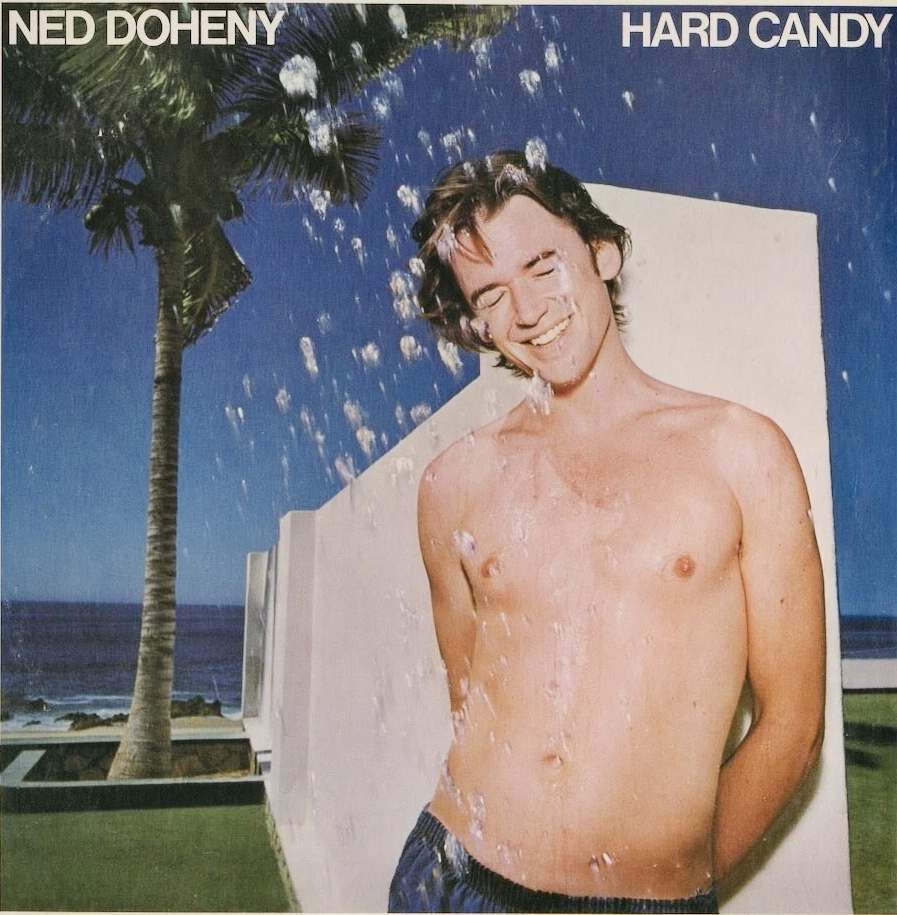
Another selection that differentiates this list from conventional audiophile recommendations. The production is exceptionally clean with a liquid midrange that lets Doheny's voice float effortlessly above the arrangements. Bass quality is superb — tight, musical, and precisely defined. Vocal placement is stable and forward without being aggressive. The rhythmic precision of the session players creates an effortless presentation that belies the sophistication underneath. Everything breathes.
What to Listen For: Liquid midrange quality · bass tightness · vocal placement · rhythmic precision of session musicians
Demonstration Track: "Get It Up for Love"
Scores: Dynamics: 8/10 · Imaging: 9/10 · Soundstage: 8/10 · Transients: 9/10 · Bass: 9/10 · Transparency: 9/10
Pressing Notes: The copy evaluated for this article is from our personal collection; detailed matrix and mastering information will be added after verification.
#13 — Pink Floyd — The Dark Side of the Moon
Year: 1973 · Genre: Progressive Rock · Overall Sonic Score: 8.6/10
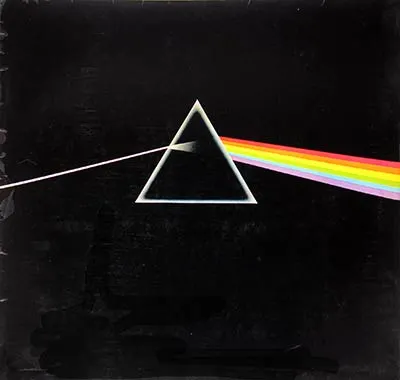
Its inclusion is predictable, but excluding it simply to appear unconventional would be equally artificial. The soundstage depth remains genuinely impressive more than fifty years later. Spatial effects — clocks, cash registers, footsteps, heartbeats — pan and recede with convincing dimensionality. Natural transient behavior gives percussion genuine weight. Bass extension is substantial. Low-level information — background voices, tape hiss used as texture, room ambience — is clearly audible on a resolving system.
What to Listen For: Soundstage depth · spatial effect placement · bass extension on "Time" · low-level ambient detail
Demonstration Track: "Time"
Scores: Dynamics: 9/10 · Imaging: 9/10 · Soundstage: 9/10 · Transients: 8/10 · Bass: 8/10 · Transparency: 8/10
Pressing Notes: The copy evaluated for this article is from our personal collection; detailed matrix and mastering information will be added after verification.
#14 — Steven Wilson — Hand. Cannot. Erase.
Year: 2015 · Genre: Progressive Rock, Art Rock · Overall Sonic Score: 8.5/10

Modern dynamic range done right. Wilson's meticulous approach to mastering delivers depth, transient reproduction, and complex passages that remain fully separated even at high playback levels. Bass control is exceptional — deep synthesizer tones coexist with acoustic bass without frequency masking. Atmospheric detail creates a sense of immersion that rewards close listening. One of the strongest examples that contemporary vinyl releases can compete sonically with golden-era pressings.
What to Listen For: Dynamic range preservation · bass separation · complex passage clarity · atmospheric immersion
Demonstration Track: "Regret #9"
Scores: Dynamics: 9/10 · Imaging: 8/10 · Soundstage: 9/10 · Transients: 9/10 · Bass: 9/10 · Transparency: 8/10
Pressing Notes: The copy evaluated for this article is from our personal collection; detailed matrix and mastering information will be added after verification.
#15 — Fleetwood Mac — Rumours
Year: 1977 · Genre: Pop Rock · Overall Sonic Score: 8.4/10
Vocal layering is the star here — the interplay between Buckingham, Nicks, and McVie is rendered with natural separation and texture. Acoustic guitar has genuine body and resonance. The midrange is warm and inviting without sacrificing detail. Instrument separation is clean throughout. Studio ambience is clearly audible, creating an intimate sense of presence. The tonal balance is exemplary — nothing screams, nothing hides.
What to Listen For: Three-part vocal separation · acoustic guitar body · natural midrange warmth · studio ambience
Demonstration Track: "Dreams"
Scores: Dynamics: 8/10 · Imaging: 9/10 · Soundstage: 8/10 · Transients: 8/10 · Bass: 8/10 · Transparency: 9/10
Pressing Notes: The copy evaluated for this article is from our personal collection; detailed matrix and mastering information will be added after verification.
#16 — Steven Wilson — The Harmony Codex
Year: 2023 · Genre: Art Rock, Electronic · Overall Sonic Score: 8.3/10

An enormous spatial presentation with very deep bass and ambient information that extends well beyond the speaker boundaries. Dimensionality is remarkable — sounds emerge from unexpected positions in the listening space. Electronic textures are precisely rendered with full harmonic content. The production is highly modern yet transfers to vinyl with exceptional fidelity. One of the most spatially impressive records in the collection.
What to Listen For: Spatial depth · deep bass extension · ambient information beyond speakers · electronic texture precision
Demonstration Track: "Economies of Scale"
Scores: Dynamics: 8/10 · Imaging: 8/10 · Soundstage: 10/10 · Transients: 8/10 · Bass: 9/10 · Transparency: 8/10
Pressing Notes: The copy evaluated for this article is from our personal collection; detailed matrix and mastering information will be added after verification.
#17 — Steven Wilson — To the Bone (45 RPM)
Year: 2017 · Genre: Art Pop, Progressive Pop · Overall Sonic Score: 8.2/10

A real-world example of why 45 RPM can offer meaningful sonic advantages when the mastering takes advantage of the format. Transient attack is noticeably sharper than comparable 33⅓ pressings. The mastering is spacious with excellent dynamic headroom. Vocals are clear and precisely located. Low-frequency definition benefits from the increased groove velocity. The 45 RPM format gives this pressing a tangible edge in immediacy and detail retrieval.
What to Listen For: Transient sharpness vs. 33 RPM · vocal clarity · spacious mastering · low-frequency groove-velocity advantage
Demonstration Track: "Permanating"
Scores: Dynamics: 9/10 · Imaging: 8/10 · Soundstage: 8/10 · Transients: 9/10 · Bass: 8/10 · Transparency: 8/10
Pressing Notes: The copy evaluated for this article is from our personal collection; detailed matrix and mastering information will be added after verification.
#18 — Opeth — Damnation
Year: 2003 · Genre: Progressive Rock, Art Rock · Overall Sonic Score: 8.1/10
Acoustic texture rendered with remarkable fidelity. Vocal ambience is natural and enveloping — Åkerfeldt's voice exists within a clearly defined reverberant space. Drum tone is warm and realistic. Reverberation tails are long and clearly audible. Natural dynamics allow the music to breathe without compression artifacts. The overall production is exceptionally atmospheric, creating an immersive listening experience that rewards quiet, focused attention.
What to Listen For: Vocal reverb space · acoustic guitar texture · drum tone naturalness · reverberation decay
Demonstration Track: "Windowpane"
Scores: Dynamics: 8/10 · Imaging: 8/10 · Soundstage: 9/10 · Transients: 8/10 · Bass: 8/10 · Transparency: 8/10
Pressing Notes: The copy evaluated for this article is from our personal collection; detailed matrix and mastering information will be added after verification.
#19 — Boz Scaggs — Silk Degrees
Year: 1976 · Genre: Soft Rock, Blue-Eyed Soul · Overall Sonic Score: 8.0/10

Natural tonal balance with rhythm-section reproduction that is both smooth and detailed. The midrange is rich without becoming thick or congested. Bass is controlled and musical — each note has clear pitch definition. Studio polish enhances rather than obscures the performances. Vocal clarity is excellent, with Scaggs' voice sitting naturally in the mix without artificial forwardness or recession.
What to Listen For: Rhythm section detail · midrange smoothness · bass pitch definition · vocal naturalness
Demonstration Track: "Lowdown"
Scores: Dynamics: 8/10 · Imaging: 8/10 · Soundstage: 8/10 · Transients: 8/10 · Bass: 8/10 · Transparency: 8/10
Pressing Notes: The copy evaluated for this article is from our personal collection; detailed matrix and mastering information will be added after verification.
#20 — Bobby Caldwell — Bobby Caldwell
Year: 1978 · Genre: Blue-Eyed Soul, Soul-Jazz, AOR · Overall Sonic Score: 7.9/10

Another selection that separates this list from the recycled audiophile canon — and one that deserves to sit well up the list rather than languish near the bottom. Bobby Caldwell's self-titled 1978 debut — cut at TK Studios in Hialeah, Florida, and best known for the signature single "What You Won't Do for Love" — is a masterclass in warm, uptown soul-jazz production. Caldwell played most of the instruments himself, and the record has the intimate, unforced presentation of an artist working close to the console. The Fender Rhodes has genuine body and bloom; Mike Lewis' horn and string charts sit in a believable acoustic layer behind the vocal rather than pasted on top; and the rhythm section — with George "Chocolate" Perry on bass — is round, tuneful, and deep without ever turning to mud. Caldwell's voice is placed forward and stable, silky rather than sibilant. It is not a fireworks record; it is a tonal-balance and midrange record, and on a resolving system it is quietly addictive.
What to Listen For: Fender Rhodes body and decay · vocal warmth without sibilance · horn-and-string layering behind the voice · round, tuneful bass on "What You Won't Do for Love"
Demonstration Track: "What You Won't Do for Love"
Scores: Dynamics: 7/10 · Imaging: 8/10 · Soundstage: 8/10 · Transients: 7/10 · Bass: 8/10 · Transparency: 8/10
Pressing Notes: The copy evaluated for this article is from our personal collection (Clouds/TK Records, 1978); detailed matrix and mastering information will be added after verification.
#21 — Joe Jackson — Night and Day
Year: 1982 · Genre: New Wave, Jazz-Pop · Overall Sonic Score: 7.8/10

Percussion and piano dominate the sonic landscape with extraordinary rhythmic precision. Stereo separation is wide and clearly defined. Bass is taut and propulsive. Spatial cues — particularly room reflections around the piano — are clearly audible. The stripped-down arrangements leave nowhere for sonic deficiencies to hide, and this pressing reveals none. Clean, fast, and rhythmically immediate.
What to Listen For: Piano transient attack · percussion clarity · bass tautness · room spatial cues
Demonstration Track: "Steppin' Out"
Scores: Dynamics: 8/10 · Imaging: 8/10 · Soundstage: 7/10 · Transients: 9/10 · Bass: 8/10 · Transparency: 8/10
Pressing Notes: The copy evaluated for this article is from our personal collection; detailed matrix and mastering information will be added after verification.
#22 — Camel — Moonmadness
Year: 1976 · Genre: Progressive Rock · Overall Sonic Score: 7.7/10
This is not a spectacular "demo record" in the conventional sense. Its strength is refinement and atmosphere. Air surrounds each instrument. A liquid quality connects passages with effortless flow. Texture — particularly flute, keyboards, and Latimer's guitar tone — is rendered with delicate fidelity. The atmospheric soundstage creates an enveloping sense of space. Natural instrumental decay hangs in the air. Midrange beauty is the defining characteristic.
What to Listen For: Air around instruments · flute texture · guitar tone liquidity · natural decay and atmosphere
Demonstration Track: "Song Within a Song"
Scores: Dynamics: 7/10 · Imaging: 8/10 · Soundstage: 8/10 · Transients: 7/10 · Bass: 7/10 · Transparency: 9/10
Pressing Notes: The copy evaluated for this article is from our personal collection; detailed matrix and mastering information will be added after verification.
#23 — Genesis — Wind & Wuthering
Year: 1976 · Genre: Progressive Rock · Overall Sonic Score: 7.6/10
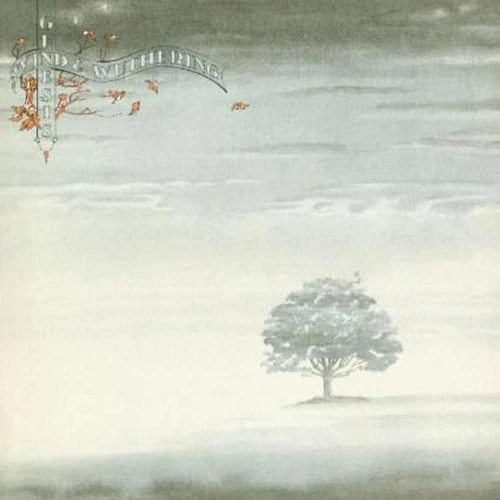
Keyboard depth is the standout quality — Banks's layers of Mellotron, piano, and synthesizer exist in clearly distinct spatial planes. Atmosphere pervades the recording. Layered instrumentation remains intelligible even during the most complex passages. Acoustic texture — particularly the 12-string guitar work — is rendered with convincing body and resonance. Soundstage depth is excellent. The rich tonal palette rewards extended exploration.
What to Listen For: Keyboard spatial layering · 12-string guitar body · atmospheric depth · complex-passage intelligibility
Demonstration Track: "Blood on the Rooftops"
Scores: Dynamics: 7/10 · Imaging: 8/10 · Soundstage: 8/10 · Transients: 7/10 · Bass: 7/10 · Transparency: 8/10
Pressing Notes: The copy evaluated for this article is from our personal collection; detailed matrix and mastering information will be added after verification.
#24 — Bill LaBounty — Bill LaBounty
Year: 1982 · Genre: West Coast, Soft Rock · Overall Sonic Score: 7.5/10
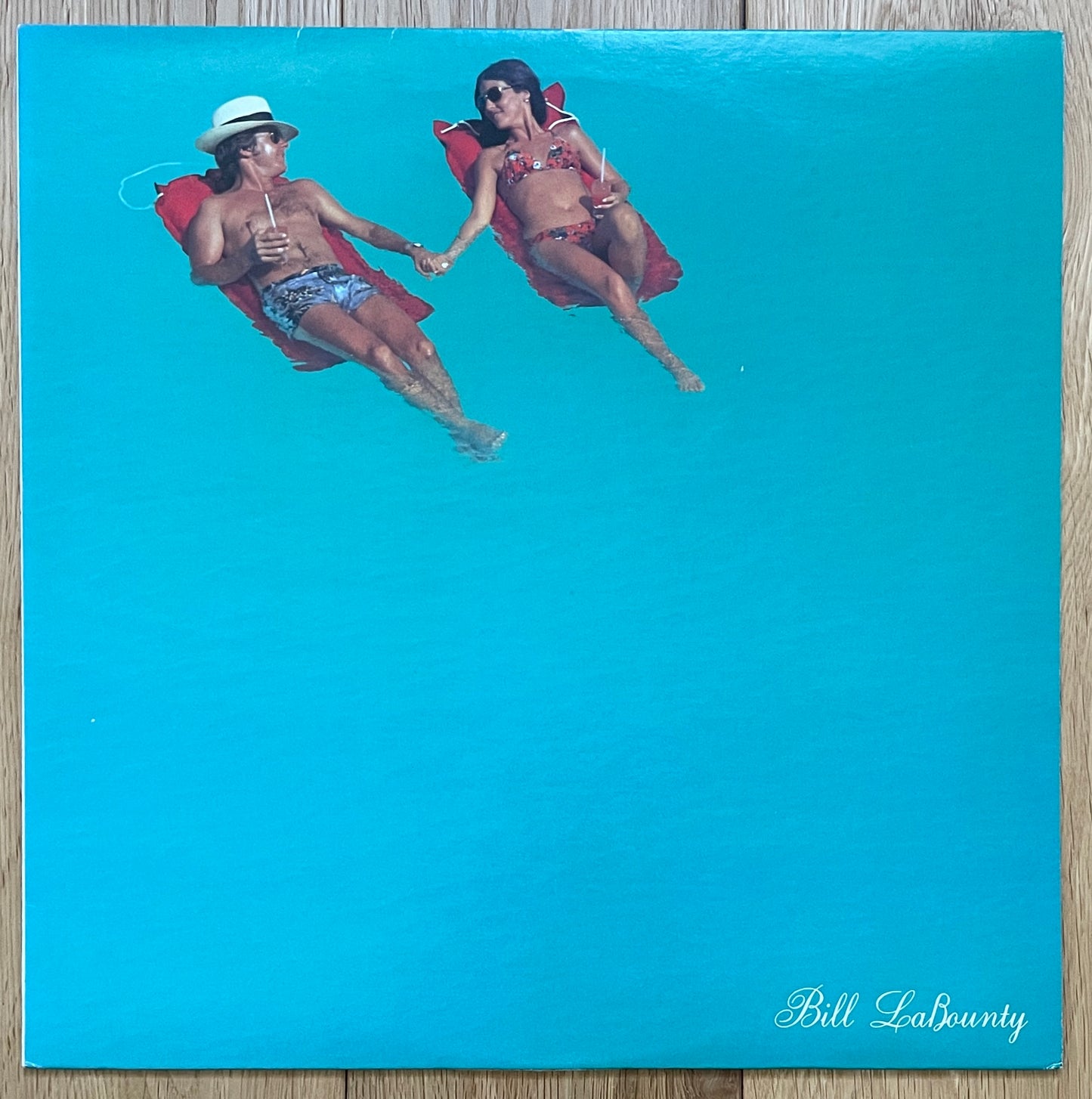
This is precisely the sort of record that belongs on this list: largely absent from the usual audiophile canon, yet startlingly accomplished when heard on a resolving system. Bill LaBounty's 1982 self-titled album has the effortless sophistication associated with the best late-1970s and early-1980s West Coast studio recordings, but without the excessive polish that can drain such records of life. The presentation is warm, open and remarkably natural.
What distinguishes the album is its sense of space and ease. Instruments occupy discrete positions without being artificially outlined, while vocals emerge from a quiet, dimensional background. Bass is full and tuneful rather than merely prominent, and the midrange possesses the kind of unforced tonal density that makes piano, electric keyboards and voice sound convincingly physical. Transients arrive cleanly but never become etched.
The Japanese pressing evaluated here is particularly impressive: exceptionally quiet vinyl allows low-level ambience, instrumental decay and the spaces between musicians to remain intact. Nothing announces itself as an audiophile effect. Instead, the recording simply becomes increasingly convincing as the system becomes more revealing.
That may be its greatest achievement. Bill LaBounty does not sound engineered to impress. It sounds engineered well enough that eventually you stop noticing the engineering.
What to Listen For: Vocal dimensionality · instrumental separation without artificial edge definition · warm, articulate bass · keyboard body and decay · exceptionally quiet backgrounds
Demonstration Track: "Livin' It Up"
Scores: Dynamics: 7/10 · Imaging: 8/10 · Soundstage: 8/10 · Transients: 7/10 · Bass: 8/10 · Transparency: 8/10
Pressing Notes: Japanese pressing. Dead wax: Side 1 — P-11134-1 / 312Z SO followed by an unidentified mark; Side 2 — P-11134-2 / Z-V-3. The copy evaluated here is exceptionally quiet, allowing the recording's low-level ambience, instrumental decay and spatial information to emerge from an unusually black background. This pressing favors dimensionality and tonal ease over exaggerated detail — a particularly sympathetic presentation of LaBounty's sophisticated West Coast production.
#25 — The Police — Synchronicity
Year: 1983 · Genre: New Wave, Rock · Overall Sonic Score: 7.4/10

Stewart Copeland's percussion reproduction is the defining attribute. The transient response is extremely fast — hi-hat articulation, snare crack, and cymbal splash arrive with genuine speed and physical presence. The stereo presentation is open and spacious. Image definition is sharp. Bass articulation from Sting's playing is clean and propulsive. Instrumental space between the trio's parts allows each musician to occupy distinct sonic territory.
What to Listen For: Copeland's hi-hat and cymbal transients · stereo openness · bass articulation · instrument separation within the trio
Demonstration Track: "Wrapped Around Your Finger"
Scores: Dynamics: 8/10 · Imaging: 8/10 · Soundstage: 8/10 · Transients: 9/10 · Bass: 8/10 · Transparency: 7/10
Pressing Notes: The copy evaluated for this article is from our personal collection; detailed matrix and mastering information will be added after verification.
Notable Omissions
Several excellent recordings did not make the final Top 25. A few examples reinforce the selection methodology:
Peter Gabriel — So: Exceptionally produced with tremendous dynamics and spatial information, but audible vocal sibilance embedded in portions of the recording prevents it from reaching the standard required for this list. This demonstrates that the rankings are based on actual listening rather than conventional audiophile reputation.
UFO — Strangers in the Night: One of our favorite hard-rock recordings and an extraordinary live document, but musical greatness and raw live energy are different criteria from absolute reference-level fidelity.
Genesis — A Trick of the Tail: Beautiful recording with excellent atmosphere, but lacks the visceral dynamic impact and bass authority of the records that made the final cut.
King Crimson — Red: Reference-quality sound does not have to be smooth or polite, and Red is thrilling proof — explosive drum dynamics, raw guitar texture, and substantial bass weight that stays coherent even at the "Starless" climax when lesser recordings would collapse. It is one of the most physically impactful records in the collection. What keeps it just outside the Top 25 is refinement rather than force: imaging, soundstage width, and transparency sit a step below the reference tier, so the visceral energy that makes it so exciting is also what caps its absolute fidelity score. A record we return to constantly — judged here on sonics alone.
The Recording Is Only Half the Equation
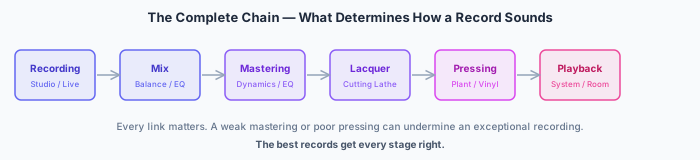
A great recording can still sound mediocre on an inferior pressing. Conversely, a carefully mastered reissue can sometimes reveal qualities obscured by an earlier release.
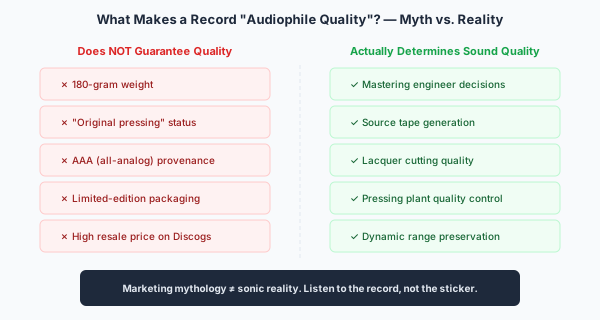
The factors that determine how a vinyl record actually sounds extend well beyond the original studio performance:
- Mastering engineer — The decisions made at the cutting lathe define the vinyl's sonic ceiling
- Lacquer cutting — The physical act of inscribing the groove determines transient accuracy and frequency response
- Source material — Whether cut from original master tapes, safety copies, or digital transfers
- Pressing plant — Quality control varies dramatically between facilities
- Vinyl formulation — Material purity affects surface noise and groove fidelity
- Groove spacing — More space per groove means less inner-groove distortion
- Record condition — Even a reference pressing degrades with poor handling
For guidance on identifying specific pressings, see our articles on reading the dead wax, the original pressing myth, 180-gram vinyl, 45 RPM versus 33⅓ RPM, and vinyl pressing quality in 2026.
Conclusion
There is no single characteristic that makes a record audiophile quality. Not 180-gram weight. Not AAA provenance. Not original pressing status. Not 45 RPM. Not expensive packaging. Not limited-edition status.
What matters is the complete chain: recording → mix → mastering → lacquer → pressing → playback system.
The highest compliment we can give any record on this list is that, when everything is right, we stop listening to the equipment. The speakers disappear, the mechanical act of playing a record disappears, and what remains is a convincing musical event occupying the room.
That is what the best-sounding vinyl records actually do.
Keep Reading
Why Do Different Vinyl Pressings Sound Different? Mastering, Matrix Numbers & Pressing Plants Explained
Two records can contain the same album and still sound conspicuously different. Learn why mastering, lacquer cutting, metalwork, and pressing plants all leave an audible fingerprint on vinyl.
Best Audiophile Vinyl Reissue Labels in 2026: Who Actually Makes the Best-Sounding Records?
We don't rank the packaging. We rank the records. A tier-based evaluation of Analogue Productions, Mobile Fidelity, Speakers Corner, Tone Poet, Impex, Intervention, and more — judged by mastering, pressing, and real-world listening.
AAA Vinyl vs. Digitally Sourced Vinyl: Does All-Analog Really Sound Better?
AAA is desirable — but AAA is not a guarantee. And a digital step is not an automatic disqualification. Here's why mastering remains the dominant variable.
Does 45 RPM Vinyl Sound Better Than 33 RPM?
If weight doesn't matter much, what physical property of a record actually can improve sound? Speed does — but not automatically. A physics-based explanation.