
Vinyl Mastering Engineers: How to Recognize the Best Cuts in the Dead Wax
Two copies of the same album. Same label. Same catalog number. Same weight. One sounds dramatically better. The answer is often two initials scratched into the lacquer.
The Most Important Name You Never See on the Cover
The mastering engineer's name rarely appears on the front of an album jacket. It is not listed on streaming services. It does not appear in most music journalism. And yet this single individual — operating a cutting lathe in a specialized facility — makes decisions that fundamentally determine how a vinyl record sounds.
The same master tape, sent to two different mastering engineers, will produce two different sounding records. Different EQ decisions. Different dynamic range. Different groove spacing. Different sibilance management. Different bass handling. The mastering matters more than the format, and the engineer is the mastering.
For collectors, this creates a practical opportunity: if you learn to recognize the initials that mastering engineers inscribe into the dead wax, you gain one of the strongest predictive signals available before dropping the needle.
A mastering engineer's signature is not a guarantee of great sound. But it is one of the strongest clues a record buyer has.
What Does a Vinyl Mastering Engineer Actually Do?
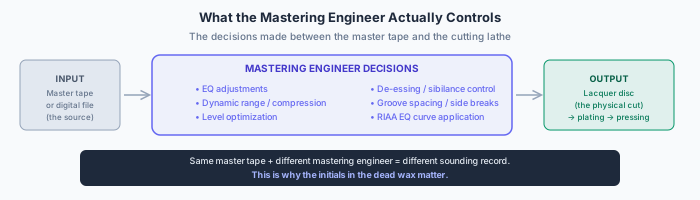
The vinyl mastering engineer receives a finished mix — either on tape or as a high-resolution digital file — and prepares it for the physical act of cutting a lacquer disc. This involves:
- EQ adjustment — Compensating for the RIAA curve, managing bass energy that could cause groove overcutting, controlling high frequencies that could create sibilance
- Dynamic range decisions — How much compression (if any) to apply, how to handle transient peaks, whether to preserve or reduce the dynamic range of the source
- Level optimization — Balancing loudness against groove spacing, inner-groove distortion risk, and playing time per side
- Side breaks — Deciding where to split the program across sides, affecting groove density and therefore playback quality toward each side's end
- Groove geometry — Pitch (groove spacing) and depth decisions that determine signal-to-noise ratio, stereo separation, and susceptibility to tracking errors
- The physical cut — Operating the lathe to inscribe the modulated groove into the lacquer disc, which becomes the mother for all subsequent pressings
Every one of these decisions is audible. A conservative, transparent approach preserves dynamics but may sacrifice loudness. An aggressive approach maximizes impact but risks distortion. A careless approach produces a record that sounds flat, dull, or harsh regardless of how good the source material is.
The best engineers find the balance point — and their initials in the runout groove are the evidence that someone with decades of experience made deliberate choices about how your record should sound.
The Initials Reference
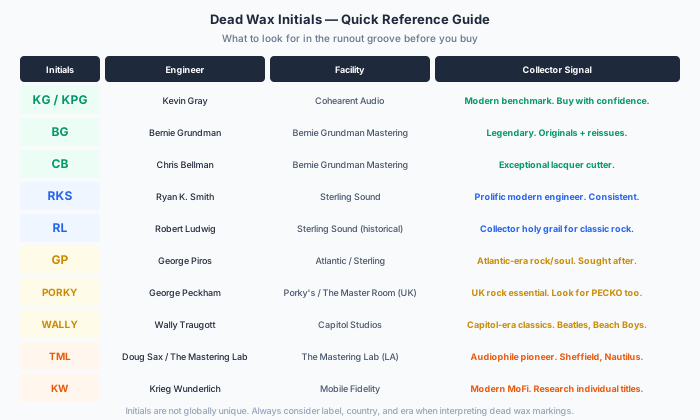
KG / KPG — Kevin Gray
Facility: Cohearent Audio (formerly AcousTech Mastering) · Active: 1980s–present · Known for: Analogue Productions, Blue Note Tone Poet, Music Matters Jazz, Verve Acoustic Sounds, Speakers Corner, and hundreds more
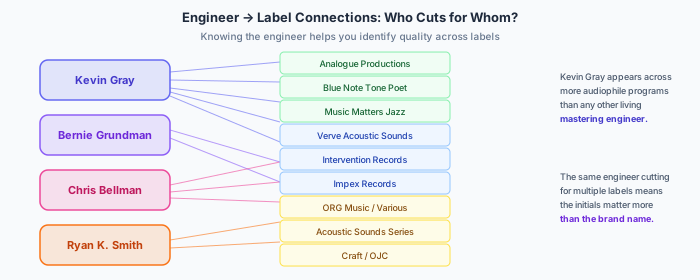
Kevin Gray is the most prolific audiophile vinyl mastering engineer working today. His initials appear in the dead wax of more premium reissue programs than any other single engineer. The Analogue Productions catalog, the entire Tone Poet series, the legendary Music Matters Jazz program, and substantial portions of the Verve Acoustic Sounds and Speakers Corner catalogs all bear his mark.
Gray's approach is characterized by transparency and respect for the source. His cuts tend toward natural tonal balance rather than enhancement — the goal is to let the master tape speak rather than imposing a sonic signature. Bass is extended but controlled. Treble is open without brightness. Dynamics are preserved. The noise floor is consistently low.
What to look for: "KG" or "KPG" hand-etched in the runout groove. On Tone Poet releases, typically accompanied by Optimal Media pressing marks. On AP titles, accompanied by QRP plant codes.
Collector confidence: Very high. A KG cut from good source material is among the safest purchases in audiophile vinyl.
BG — Bernie Grundman
Facility: Bernie Grundman Mastering, Hollywood · Active: 1970s–present · Known for: Original pressings (Steely Dan, Michael Jackson, Prince) plus modern reissues for Intervention, Impex, and others
Bernie Grundman occupies a unique position: he mastered many of the original pressings that collectors now pay hundreds of dollars for, and he continues to master new reissues of those same recordings decades later. His credits include the original cuts of Thriller, Aja, The Nightfly, and Purple Rain — records that appear on best-sounding vinyl lists worldwide.
Grundman's sonic signature is refined, musical, and unhurried. His cuts tend toward warmth and weight without sacrificing detail. There is a smoothness to his lacquers that is immediately recognizable once you've heard enough of them — particularly in vocal reproduction and midrange density.
What to look for: "BG" in the dead wax. On original pressings from the 1970s–1980s, often accompanied by A&M or Warner matrix numbers. On modern reissues, associated with Intervention Records and Impex titles pressed at RTI.
Collector confidence: Very high. Both for original pressings and modern reissues.
CB — Chris Bellman
Facility: Bernie Grundman Mastering, Hollywood · Active: 1980s–present · Known for: Major reissue programs, classic rock recuts, Impex, ORG Music
Chris Bellman works at Bernie Grundman's facility and shares that studio's commitment to musical, transparent mastering. His cuts are particularly well-regarded for classic rock and pop — genres where the balance between impact and refinement is critical. Bellman handles many of the titles that require powerful low-frequency reproduction without sacrificing midrange clarity.
What to look for: "CB" in the dead wax. Frequently found on Impex releases, ORG Music titles, and various audiophile reissues pressed at RTI.
Collector confidence: High. Consistently excellent lacquer work.
RKS — Ryan K. Smith
Facility: Sterling Sound, New York · Active: 2010s–present · Known for: Acoustic Sounds Series, Verve titles, prolific modern audiophile work
Ryan K. Smith has become one of the most active mastering engineers in the current audiophile vinyl market. His work appears across the Verve/UMG Acoustic Sounds Series, various Craft Recordings titles, and numerous other reissue programs. Smith's cuts are detailed and open, with good dynamics and controlled treble. He represents the next generation of dedicated vinyl mastering — engineers who grew up with digital but understand the specific requirements of the lacquer format.
What to look for: "RKS" in the dead wax. Commonly found on Acoustic Sounds Series jazz titles and various Universal reissues.
Collector confidence: High. Consistently strong results across a large and growing catalog.
RL — Robert Ludwig
Facility: Sterling Sound (historical); Gateway Mastering · Active: 1960s–present · Known for: Original pressings of Led Zeppelin, Jimi Hendrix, Rolling Stones, and countless classic-rock landmarks
For classic-rock collectors, "RL" in the dead wax is the holy grail. Robert Ludwig's original cuts from the late 1960s and 1970s are legendary — his mastering of Led Zeppelin II was famously recalled by Atlantic because it was "too loud" (the replacement cut, by a different engineer, is widely considered inferior). An RL pressing of a classic-rock title routinely commands significant premiums on the secondary market.
Ludwig's approach was bold, dynamic, and unafraid of level. His cuts hit hard. They have weight, presence, and physicality that conservative mastering often lacks. For rock music — where impact matters — his work set standards that subsequent engineers have spent decades trying to match.
What to look for: "RL" etched or stamped in the dead wax. Most valuable on first pressings from Atlantic, Polydor, and other major-label rock releases from the late 1960s through the 1970s.
Collector confidence: Extremely high for original pressings. An RL cut of a major classic-rock title is almost always the version to own — if the pressing is in good condition.
GP — George Piros
Facility: Sterling Sound / Atlantic · Active: 1970s–1990s · Known for: Atlantic-era rock, soul, and R&B pressings
George Piros cut many of the original Atlantic Records pressings that collectors now prize. His work spans Led Zeppelin, Yes, Genesis, ABBA, and dozens of R&B and soul titles. A GP-cut Atlantic pressing from the 1970s is a strong quality signal — these tend toward natural dynamics and open, uncompressed sound.
What to look for: "GP" in the dead wax of Atlantic, Atco, and related label pressings from the 1970s and 1980s.
Collector confidence: High for the Atlantic era. These pressings reward hunting.
PORKY / PECKO — George Peckham
Facility: Porky's Prime Cuts / The Master Room, London · Active: 1970s–2000s · Known for: UK pressings of major rock titles — Pink Floyd, Led Zeppelin, The Who, Queen, and hundreds more
George Peckham was a legendary UK mastering engineer whose playful dead-wax inscriptions ("A Porky Prime Cut," "Pecko!") became collector calling cards. His work is found on UK first pressings of many canonical rock albums. Peckham's cuts tend toward warmth and weight, with strong bass and natural midrange — characteristics that complement UK pressing plants' generally excellent vinyl formulations.
What to look for: "PORKY," "PECKO," or "A PORKY PRIME CUT" scratched into UK pressings. Sometimes abbreviated or varied — Peckham enjoyed leaving personalized messages.
Collector confidence: High for UK rock. A Porky cut of a major 1970s rock title is typically among the best-sounding versions available.
WALLY — Wally Traugott
Facility: Capitol Studios, Hollywood · Active: 1960s–2000s · Known for: Capitol-era Beatles, Beach Boys, Pink Floyd (US), and the broader Capitol/EMI catalog
Wally Traugott's name is inseparable from Capitol Records' vinyl output across several decades. His cuts of Beatles, Beach Boys, and Capitol-era Pink Floyd pressings are sought by collectors. Traugott's approach was workmanlike and reliable — not flashy, but consistently musical and well-balanced.
What to look for: "WALLY" or "WT" in the dead wax of Capitol pressings. Particularly relevant for US Beatles and Beach Boys collectors.
Collector confidence: Good for the Capitol catalog. His cuts represent the label's quality standard across decades.
TML — The Mastering Lab / Doug Sax
Facility: The Mastering Lab, Los Angeles · Active: 1967–2015 · Known for: Sheffield Lab direct-to-disc, audiophile pressings, Pink Floyd, Ray Charles, and pioneering high-fidelity mastering
Doug Sax founded The Mastering Lab in 1967 and became one of the earliest engineers to explicitly pursue audiophile-quality vinyl mastering. His facility handled the legendary Sheffield Lab direct-to-disc recordings and mastered titles across rock, jazz, and classical for labels that prioritized fidelity. TML markings in the dead wax indicate a facility that was purpose-built for sonic excellence.
What to look for: "TML" or Mastering Lab identifiers in the dead wax. Most relevant for audiophile-oriented pressings from the 1970s through the 2000s.
Collector confidence: High. TML pressings are consistently well-mastered.
KW — Krieg Wunderlich
Facility: Mobile Fidelity Sound Lab · Active: 2000s–present · Known for: Modern MoFi catalog
Krieg Wunderlich is Mobile Fidelity's primary mastering engineer and has been responsible for the bulk of their output in the modern era. His work is competent and often excellent — though as noted in our reissue labels article, MoFi titles require individual evaluation rather than blind confidence. Wunderlich's best work delivers transparency and detail; his less successful titles can sound polite rather than dynamic.
What to look for: "KW" or MoFi-specific markings in the dead wax. Pressed at RTI (standard) or QRP (One-Step/UHQR).
Collector confidence: Moderate to high. Research individual titles rather than purchasing blind.
A Note on Initials: Context Matters
Initials are not globally unique. "KG" could theoretically identify different engineers depending on geography and era. "BG" at a German plant is not Bernie Grundman. "RL" on a 2020s pressing is not Robert Ludwig's 1970s Sterling work.
Always interpret dead-wax initials in context:
- Label and catalog number — Which label commissioned the mastering?
- Country of pressing — US, UK, German, and Japanese pressings use different facilities
- Era — An "RL" on a 1971 Atlantic pressing means something very different from "RL" on a 2024 reissue
- Accompanying codes — Plant codes, stamper numbers, and matrix information provide additional context
For a complete guide to interpreting all dead-wax markings, see our article: How to Read the Dead Wax.
Does a Famous Engineer Guarantee a Great Pressing?
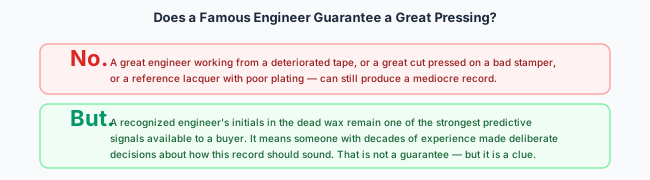
No. And understanding why is critical.
A mastering engineer can only work with what arrives at the lathe. If the source tape has deteriorated, the best engineer in the world cannot recover information that no longer exists. If the plating process introduces defects after the lacquer is cut, the engineer bears no responsibility. If the pressing plant produces a noisy, off-center disc from a perfect stamper, the mastering was not the problem.
The complete chain matters:
- Source tape condition — Deterioration, oxide shedding, or generational loss limits the ceiling
- Mastering decisions — The engineer's skill and intent (this article's focus)
- Plating quality — Converting the lacquer into metal stampers without introducing noise
- Stamper generation — Earlier stampers typically outperform later ones
- Pressing plant QC — Quality varies enormously between plants
- Vinyl formulation — Material purity affects surface noise
- Your playback system — A reference pressing on a mediocre turntable will not reveal its qualities
But here is the practical reality: in most cases, the mastering engineer's decisions are the single largest variable determining how a record sounds. Source tapes are usually adequate. Pressing plants are usually competent. The mastering is where the most consequential sonic decisions happen.
That is why the initials matter.
How to Use This Knowledge
A practical workflow for the informed buyer:
- Before purchasing: Check Discogs for dead-wax photos or descriptions. Look for recognized initials. Cross-reference with our pressing identification guide.
- At the record store: Flip the record over. Inspect the runout groove under good light. Recognized initials tip the balance toward purchasing.
- After purchasing: Document what you find. Over time, you'll develop a personal database of which engineers' work aligns with your preferences.
- When comparing pressings: If two copies of the same album exist at similar prices — one with KG/BG/CB/RL in the dead wax and one without — buy the one with recognized initials.
This is not audiophile mythology. This is forensic evidence of who made decisions about your record's sound. Learn to read it, and your collection will improve measurably.
Conclusion
The mastering engineer is the invisible hand that shapes how every vinyl record sounds. The same album mastered by different engineers — or by the same engineer at different points in their career, from different source tapes, under different time constraints — can sound dramatically different.
The initials in the dead wax are not marketing. They are not packaging. They are not mythology. They are a factual record of who operated the lathe when your record was born.
Kevin Gray. Bernie Grundman. Chris Bellman. Ryan K. Smith. Robert Ludwig. George Piros. George Peckham. Wally Traugott. Doug Sax. Krieg Wunderlich.
These are the names that matter more than the label on the jacket. Learn them. Look for them. Your ears will confirm why.
Keep Reading
How to Read the Dead Wax: The Secret History Written in Your Record's Runout
Every vinyl record carries a forensic document in its runout groove. Learn to decode mastering engineer initials, pressing plant codes, stamper generations, and matrix numbers.
Why Do Different Vinyl Pressings Sound Different? Mastering, Matrix Numbers & Pressing Plants Explained
Two records can contain the same album and still sound conspicuously different. Learn why mastering, lacquer cutting, metalwork, and pressing plants all leave an audible fingerprint on vinyl.
Best Led Zeppelin III Vinyl Pressing: Which Version Sounds Best?
UK plum first pressing, US Specialty Records, Classic Records 200g, and the 2014 Page remaster compared. Matrix numbers, plant codes, and buying recommendations.
Best Vinyl Pressing: How to Find the Best-Sounding Version of Any Album
Original pressing, remaster, reissue or audiophile edition? Learn how to use matrix numbers, mastering credits, pressing plants and Discogs to find the best-sounding vinyl pressing before you buy.