
Why Does My Record Sound Sibilant?
A causal analysis of vocal sibilance, groove geometry, and phonograph playback error — and a structured method for determining where the problem actually originates.
1. Introduction: The Problem of a Shared Symptom
Few artifacts disrupt analog playback as immediately as a distorted “S.” A sustained note may remain stable, drums may retain their impact, and the stereo image may appear convincing — only for a vocal consonant to spread into a coarse burst of energy that seems detached from the singer. The effect may resemble excessive brightness, but the two phenomena are not identical. Brightness is a broad tonal characteristic. Sibilant distortion is usually localized, transient, and nonlinear: a short high-frequency event emerges with a splashed, spitty, or tearing character that was not necessarily present in the source.
The diagnostic difficulty is that the human voice itself is sibilant. Fricative consonants are produced by forcing air through a narrow constriction in the vocal tract, generating turbulent energy concentrated predominantly in the upper midrange and treble. Microphone type, placement, equalization, compression, and the singer's technique may intensify that energy before the signal ever reaches a cutting lathe. A record may therefore reproduce strong sibilance accurately. Conversely, a comparatively well-controlled vocal may acquire distortion because the playback stylus cannot trace the groove modulation faithfully.
The research question is thus not simply, “Why is this record sibilant?” It is more precisely stated:
At what stage in the recording-to-reproduction chain did the objectionable sibilant energy originate, and what comparative evidence distinguishes that stage from the others?
The thesis advanced here is that reliable diagnosis requires the separation of signal content from reproduction error. Sibilance is content; sibilant distortion is an alteration of content. They can coexist, but they should not be treated as interchangeable.
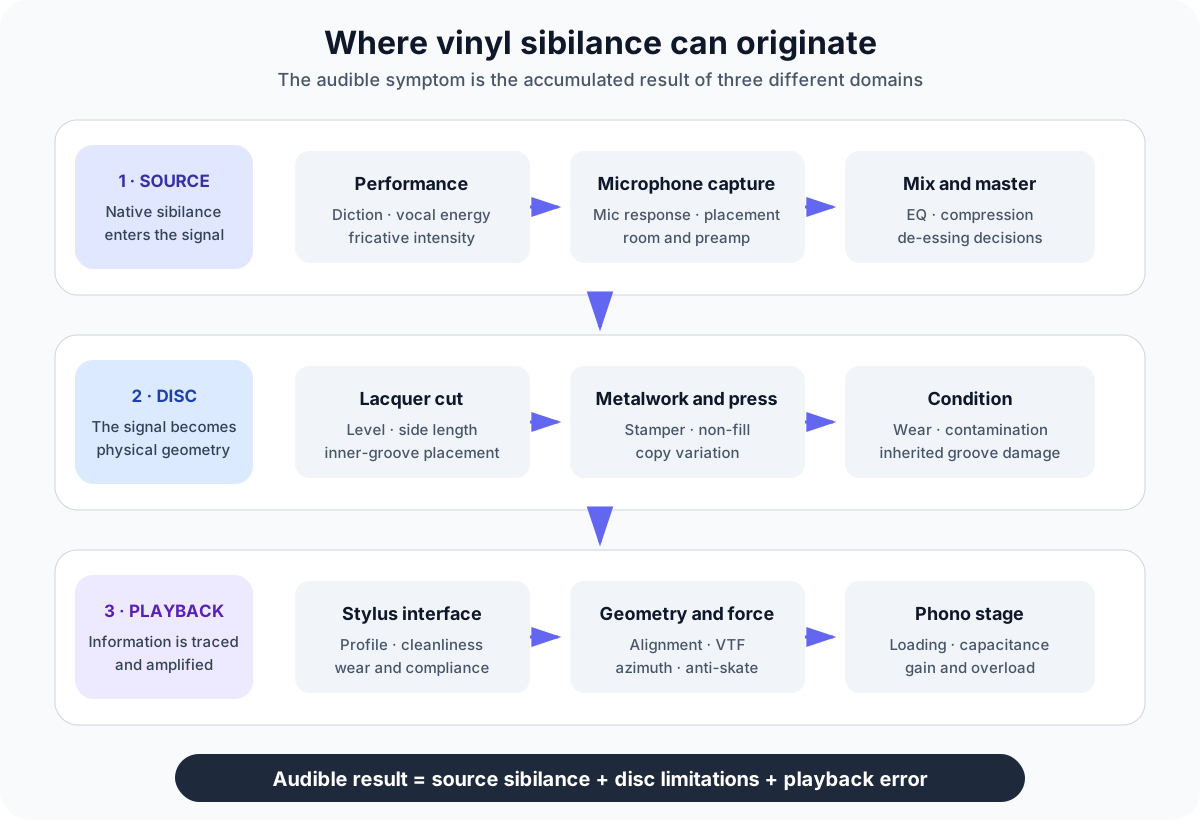
Figure 1. Sibilance is a cumulative phenomenon. Native high-frequency energy may be modified during disc production and altered again during playback.
2. Terminological and Conceptual Foundations
Native or Recorded Sibilance
Native sibilance is already encoded in the source used to produce the record. Its causes may include the performer's diction, close microphone placement, a microphone with an elevated presence response, aggressive equalization, heavy compression, or insufficient de-essing during mixing and mastering. If the same consonant exhibits substantially the same character on a reputable digital release, on multiple vinyl pressings, and through different playback systems, the parsimonious explanation is that the sibilance belongs primarily to the recording.
Native sibilance can be prominent or aesthetically unpleasant without being technically defective. A revealing playback system may expose it more clearly than a system with rolled-off treble or greater masking distortion. Accuracy does not guarantee comfort.
Sibilant Distortion
Sibilant distortion is additional nonlinear energy created when a complex high-frequency modulation is cut or traced imperfectly. Instead of reproducing the consonant as a coherent burst of noise, the system may produce breakup, lateral splashing, channel-specific fuzz, or a grainy halo. In severe cases, the phonetic content becomes less intelligible even as the event becomes more conspicuous.
This distinction matters because equalization cannot repair a mechanical tracing failure. Reducing treble may make the failure less irritating, but it does not restore the information that the stylus failed to follow. Similarly, increasing tracking force indiscriminately cannot correct groove damage already inscribed by a worn or mistracking stylus.
Sibilance as a Causal Chain
An error at any stage may survive every stage that follows. Several smaller errors can also accumulate.
3. Why Vinyl Is Particularly Vulnerable
High-Frequency Groove Modulation
A phonograph record stores sound as microscopic variation in a continuous groove. High frequencies require the groove direction to change rapidly. Strong vocal sibilants are especially demanding because they combine substantial amplitude, broad spectral content, and rapid transient behavior.
The RIAA recording characteristic attenuates low frequencies and applies high-frequency pre-emphasis during cutting; the phono preamplifier applies the complementary curve during playback. The net theoretical response is flat. Nevertheless, the physical high-frequency modulation cut into the lacquer remains demanding to trace. Excessive sibilance is often treated before cutting through selective de-essing because a playback cartridge may be unable to follow severe sibilant modulation without distortion.
The Inner-Groove Problem
At a constant rotational speed, angular velocity remains fixed while linear groove velocity declines as the stylus moves toward the label. Linear velocity is described by:

where v is linear velocity, r is groove radius, and N is rotational speed in revolutions per minute.
At 33⅓ rpm, a groove at a radius of approximately 146mm passes the stylus at roughly 0.51 m/s. At a radius of 60mm, velocity falls to approximately 0.21 m/s. The same high-frequency event must therefore be represented within much less linear groove length near the end of the side.
An 8kHz cycle occupies approximately 64μm of groove length at a 146mm radius but only about 26μm at a 60mm radius — increasing the demand placed on the stylus by more than double.
This does not mean that every inner groove must sound distorted. A well-cut record played with a suitable, correctly aligned cartridge can reproduce inner tracks cleanly. It does mean that alignment error, stylus geometry, groove wear, and excessive cutting level become more consequential as linear velocity falls. Sibilance that intensifies consistently during the final minutes of several record sides is strong evidence of a tracing or alignment problem.
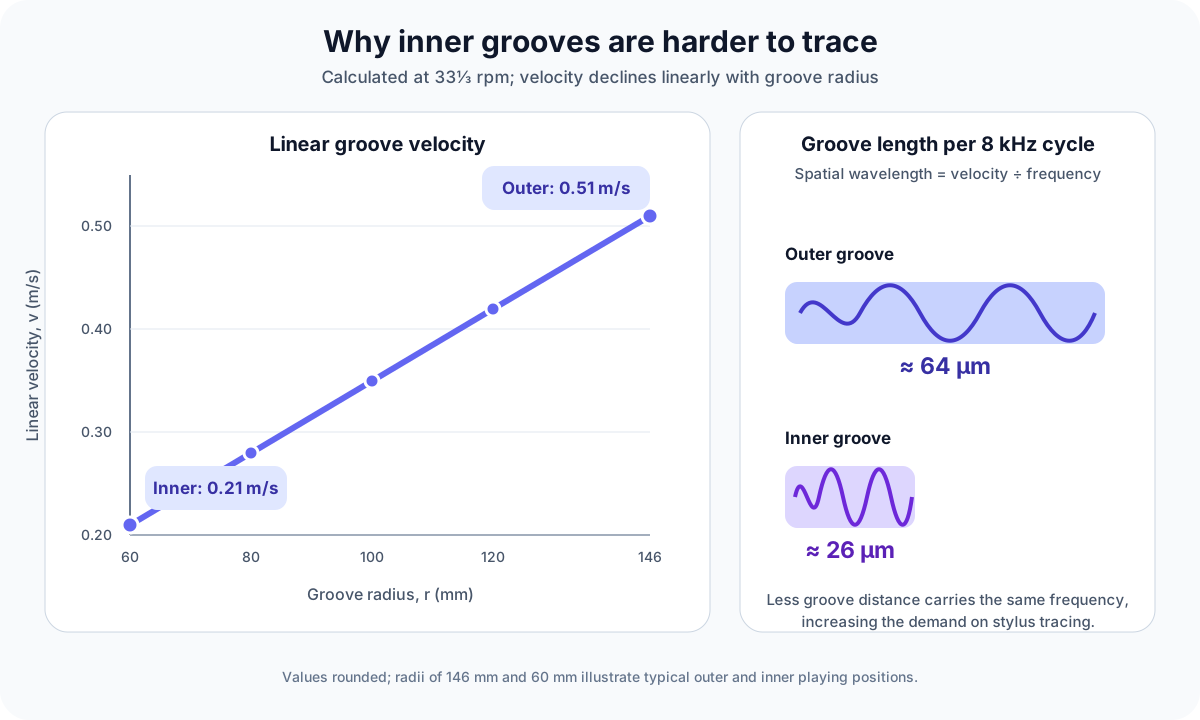
Figure 2. At 33⅓ rpm, linear velocity falls with groove radius. An 8kHz cycle occupies approximately 64μm at 146mm radius but only about 26μm at 60mm radius.
Stylus Profile and Tracing Accuracy
Stylus profiles differ in their ability to follow short-wavelength groove modulations. A spherical stylus has a relatively broad scanning radius and may be less capable of tracing demanding high-frequency information, particularly toward the inner groove. Elliptical, line-contact, MicroLine, Shibata, and related profiles generally present a narrower scanning dimension while extending contact area vertically along the groove wall.
Profile alone, however, is not destiny. A sophisticated stylus that is poorly aligned may perform worse than a simpler stylus operating within appropriate conditions. Advanced profiles also tend to reveal small errors in overhang, offset angle, azimuth, and stylus rake angle more clearly.
4. Mechanical Sources of Sibilant Distortion
Cartridge Alignment
Pivoted tonearms describe an arc across the record and are perfectly tangent to the groove at only two null points under conventional alignment geometries. Everywhere else, some tracking-angle error remains. An alignment error may present as generalized high-frequency roughness, increased distortion toward the inner grooves, or asymmetrical behavior between channels.
Alignment should be verified with a protractor appropriate to the effective length and geometry of the tonearm. Merely making the cartridge body appear straight in the headshell is insufficient; the stylus cantilever, not the decorative exterior of the cartridge, is the relevant reference.
Vertical Tracking Force
Tracking force must remain within the cartridge manufacturer's specified range. Too little force may prevent the stylus from maintaining stable contact with both groove walls during demanding modulation. The result can be mistracking precisely where the musical signal becomes most complex. Contrary to a common intuition, tracking too lightly is not necessarily safer for records: repeated mistracking can concentrate destructive force on a small region of the groove.
Anti-Skate and Channel Asymmetry
Friction between stylus and groove produces an inward skating force in most pivoted tonearms. Anti-skate applies a compensating outward force. Its purpose is to promote balanced contact with the two groove walls, thereby reducing uneven wear and channel-specific distortion.
Diagnostic Clue
A centered but equally distorted consonant suggests a different causal pattern from breakup concentrated in one channel. Anti-skate should be treated as a dynamic compromise — friction varies with groove modulation and position — not as a number that can be made universally exact.
Azimuth and Vertical Geometry
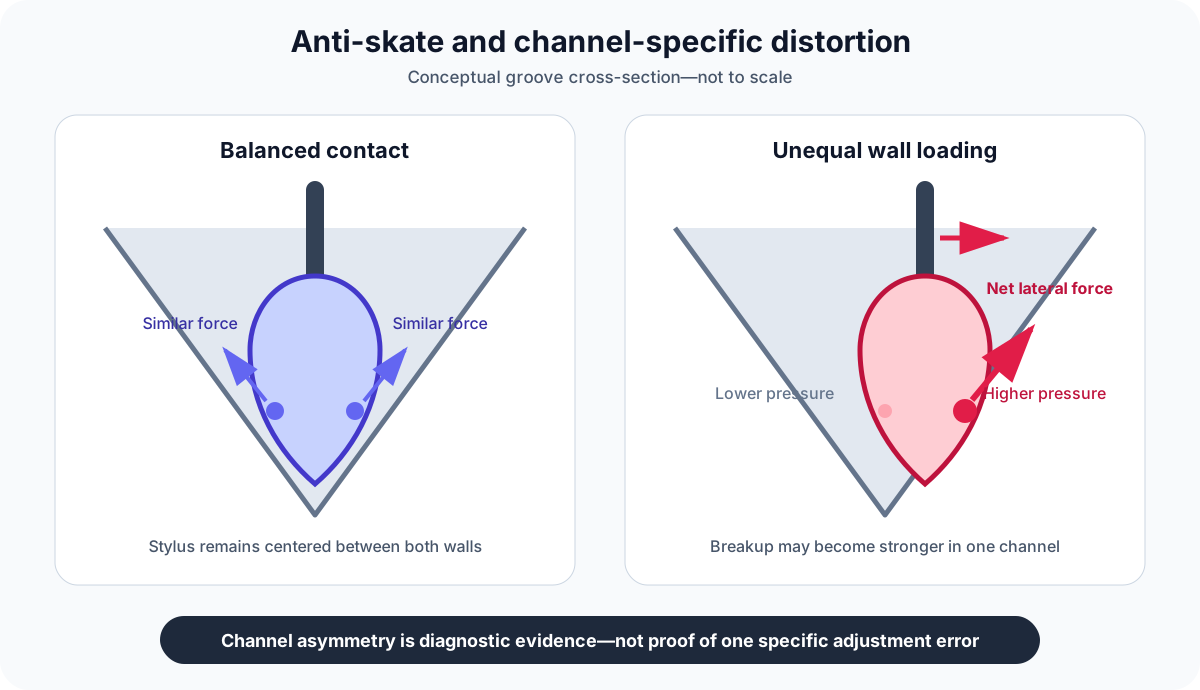
Figure 3. Unequal wall loading may cause distortion to become more conspicuous in one channel. The observation narrows the investigation but does not by itself distinguish anti-skate error, azimuth error, or damage to one groove wall.
Azimuth describes the stylus orientation when viewed from the front. If the stylus is not seated symmetrically between the groove walls, channel separation, balance, and distortion may suffer. Because the cantilever and diamond are not always perfectly square to the cartridge body, visual alignment of the body is only a preliminary measure.
Stylus Contamination and Wear
A deposit attached to the stylus changes its effective geometry and prevents intimate contact with the groove. Because the contact dimensions are microscopic, contamination that appears trivial to the unaided eye may be acoustically significant. Wear is more serious. A worn contact surface may mistrack and permanently damage groove walls. When sibilance gradually worsens across records that were previously clean, stylus age and condition must move high on the list of hypotheses.
5. Sources Located in the Record
Mastering and Lacquer Cutting
The cutting engineer must translate a signal into groove geometry that can be manufactured and replayed by real systems. If an identical burst of distortion occurs at the same instant on multiple clean copies of the same cut, the probability of a cutting or source-master problem rises. Dead-wax information becomes useful here: two nominally identical albums may derive from different lacquers, engineers, plants, or later recuts.
Pressing Defects vs. Cutting Defects
Listeners often attribute any objectionable vinyl sound to a “bad pressing,” but pressing and cutting are distinct operations. Persistent sibilance at exactly the same musical event across many copies is more likely to originate upstream in the source or cut than in random pressing variation.
Groove Wear and Inherited Damage
A used record may preserve damage created by an earlier playback system. Because sibilants are among the hardest events to trace, they may be among the first to exhibit permanent damage. Cleaning can remove contamination, but it cannot reconstruct missing groove geometry. If one used copy distorts while another copy of the same matrix plays cleanly on the same system, groove damage becomes the leading explanation.
6. Electrical Loading and the Perception of Sibilance
Cartridge loading changes the interaction among the cartridge generator, cable, and phono input. Loading does not correct a geometrical alignment error or repair mistracking. It may, however, change how conspicuous existing sibilant energy becomes. A loading condition that preserves more upper-frequency energy can expose a difficult recording or a marginal tracing condition that a more heavily damped presentation partially obscures.
This mirrors our experience with the Benz Micro Wood SM and Conrad-Johnson ET6SE. At 200Ω, the presentation was controlled and forgiving. Moving to 500Ω initially made certain vocal sibilants seem more apparent. Over time, however, the broader change became clear: the system also gained openness, air, image separation, and transient speed. The correct conclusion was not that 500Ω had created mistracking — rather, the new loading changed the perceptual context in which pre-existing high-frequency information was heard.
Electrical loading should be evaluated only after mechanical setup is known to be sound. Otherwise, tonal adjustment risks concealing a mechanical fault.
7. Case Study: “Comfortably Numb”
Roger Waters' vocal passages in “Comfortably Numb” provide a useful example because the sibilants can sound conspicuous even in otherwise highly regarded playback chains. When such a passage is encountered, the instinctive response may be to adjust the cartridge. That response is premature.
A more disciplined investigation asks five questions:
- Does the event occur at the same word every time? If so, random contamination becomes less likely.
- Does the same vocal character appear on a digital version? If so, at least part of the sibilance belongs to the recording or mastering.
- Does another vinyl pressing reproduce the event differently? A meaningful difference implicates the mastering, cut, condition, or manufacture of the particular copy.
- Does the distortion occur equally in both channels? Strong asymmetry may point toward azimuth, anti-skate, groove-wall damage, or another channel-specific problem.
- Do other records distort at a comparable radius? If not, a global turntable fault is less likely.
Our copy carries the side-two matrix inscription PBL-36184-1 AF. That inscription anchors the observation to a specific physical cut rather than to The Wall as an abstract title. A different pressing should not be assumed to contain identical groove geometry merely because it contains the same performance.
8. A Controlled Diagnostic Protocol
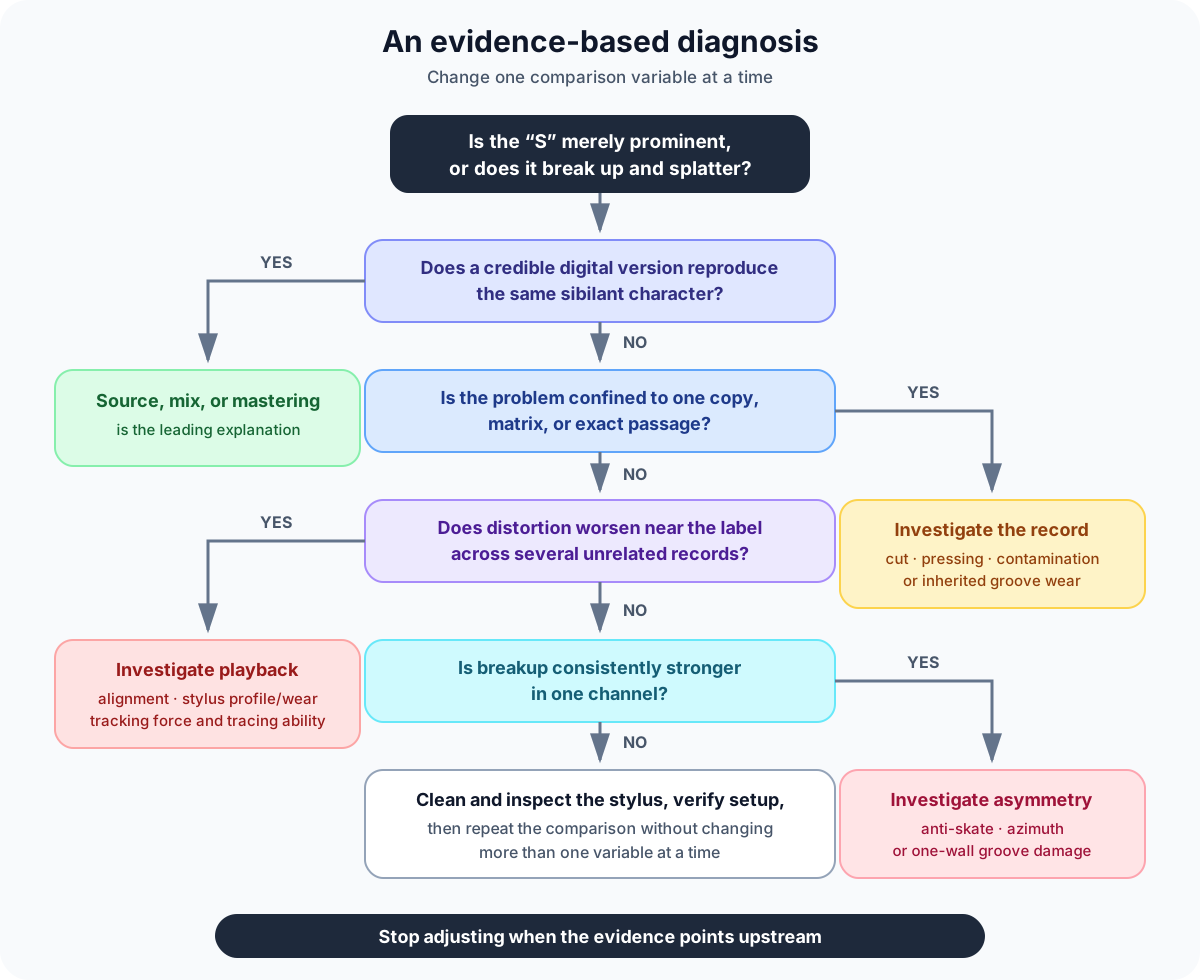
Figure 4. A comparative diagnosis begins with the source and the individual record before proceeding to system-wide mechanical adjustments.
The following sequence minimizes unnecessary adjustment and avoids changing several variables at once:
Step 1: Classify the audible event
Determine whether the sound is merely prominent or actually distorted. Listen for breakup, spitting, channel splash, or loss of intelligibility.
Step 2: Record its location
Note the song, word, time, record side, and approximate groove radius. A problem confined to the last several minutes of multiple sides has different implications from one isolated event.
Step 3: Clean the record and stylus
Remove the simplest confounding variables before altering geometry.
Step 4: Compare channels
Listen for left-right asymmetry. Do not collapse to mono before documenting the difference — the asymmetry is evidence.
Step 5: Compare a digital master
Determine whether the sibilant event predates the vinyl transfer.
Step 6: Compare another record and another pressing
Separate a system-wide pattern from a record-specific pattern.
Step 7: Verify setup in a fixed order
Level → fasteners → stylus condition → alignment → VTF → anti-skate → azimuth. Confirm each before moving to the next.
Step 8: Evaluate loading last
Once tracking is stable, compare approved loading values. Judge not only sibilance but tonal balance, transient definition, and musical coherence.
Step 9: Stop when the evidence points upstream
If the problem remains isolated to one passage or one pressing while reference records reproduce cleanly, further adjustment may degrade the rest of the collection.
9. Discussion
The diagnostic model presented here resists two habits common in analog playback culture. The first is component essentialism: the assumption that one component possesses a stable sonic character that explains every observation. The second is adjustment bias: the belief that every unpleasant sound proves the system requires further tuning.
Both habits ignore the structure of the evidence. If a symptom changes by record, radius, matrix, channel, or source, then the cause must be capable of producing that pattern. A global loading value cannot logically explain a defect isolated to one damaged copy. A single problematic vocal does not establish universal misalignment. Conversely, repeated inner-groove breakup across a broad sample cannot plausibly be blamed on a succession of unrelated mastering failures.
This is why the record collection itself becomes a diagnostic instrument. Familiar recordings provide controlled stimuli of different levels, groove radii, vocal characteristics, and mastering histories. The most revealing system is not the one that makes every record equally pleasant. It is the one whose differences are stable, intelligible, and traceable to evidence.
10. Conclusion
Vinyl sibilance cannot be reduced to a single cause because the audible symptom belongs to an extended chain of production and reproduction. Strong “S” sounds may originate with the singer, microphone, mix, or master. They may become more difficult during lacquer cutting, be compromised by manufacturing, suffer permanent groove damage, or be distorted by an improperly aligned, contaminated, worn, or unsuitable playback stylus. Electrical loading may change their prominence without being their mechanical cause.
The decisive distinction is between sibilance contained in the signal and distortion added to the signal.
That distinction cannot be made reliably through tonal impression alone. It requires comparison: across formats, pressings, groove locations, channels, and known reference records.
The practical lesson is one of restraint. Before changing cartridge alignment to correct one offensive consonant, determine whether the system reproduces other difficult records cleanly. Before condemning a pressing, compare its matrix and condition with another copy. Before selecting a darker loading value, verify that it is not merely concealing mistracking. Sometimes the turntable is wrong. Sometimes the groove is damaged. Sometimes the cutting engineer faced an impossible passage. And sometimes a transparent system is reproducing exactly what was recorded — including the parts we would prefer not to hear.
Keep Reading
Why Does Vinyl Sound Worse Near the End of a Side?
Inner-groove distortion is not one phenomenon. Learn how to separate inherent format limitations from correctable setup problems — and when the record itself is to blame.
Diagnosing Vinyl Problems — A Complete Guide
A hub linking every article on vinyl playback issues: sibilance, inner-groove distortion, turntable setup, cartridge loading, and pressing quality.
What Really Happens When You Change Moving-Coil Cartridge Loading?
What does phono cartridge loading actually change? A real-world comparison of 200Ω and 500Ω using a Benz Micro Wood SM moving-coil cartridge into a Conrad-Johnson ET6SE.
Why Does Vinyl Crackle? How to Diagnose Pops, Clicks and Surface Noise
The character of the noise tells you what's causing it — and whether you can fix it. A diagnostic guide to every type of vinyl surface noise, from fixable dust to permanent groove damage.