
Best Pink Floyd The Wall Vinyl Pressing: Which Version Actually Sounds Best?
Same album. Same music. Dramatically different sound depending on which pressing you own. We compare originals, reissues, and remasters to identify the versions worth owning.
Sonic Atlas Verdict
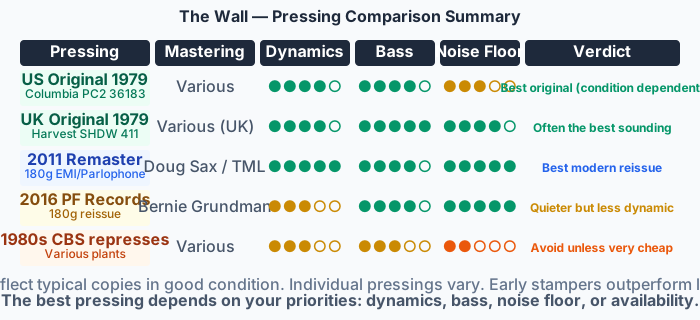
Best overall: UK original (Harvest SHDW 411) — early stamper in clean condition
Best modern reissue: 2011 180g remaster (Doug Sax / The Mastering Lab)
Best affordable: Clean US original (Columbia PC2 36183) — Santa Maria pressing
Best if you prioritize quiet vinyl: 2016 Pink Floyd Records reissue (Bernie Grundman)
Avoid / overpriced: Later 1980s CBS represses, generic 180g reissues with no mastering credit

Pink FloydThe Wall (1979)
Why The Wall Is Complicated
The Wall is not a simple album to press well. It is a double LP with ambitious production — quiet passages, explosive dynamics, orchestral layers, sound effects, dialogue, and dense multi-tracked arrangements that push the limits of what vinyl can reproduce cleanly. The inner grooves of each side are particularly demanding, and the sheer quantity of music across four sides means groove spacing is tighter than on a single LP.
This makes The Wall unusually sensitive to mastering and pressing quality. A careless pressing reveals its compromises quickly: inner-groove distortion on side endings, congested mixes during the loudest passages, surface noise competing with quiet intros, and sibilance on Roger Waters' vocal consonants.
A great pressing, by contrast, reveals the extraordinary sophistication of Bob Ezrin's production — the spatial depth, the dynamic contrasts, the orchestral detail, and the raw emotional power of the performances.
The difference between a mediocre pressing and a reference pressing of The Wall is not subtle. It is dramatic.
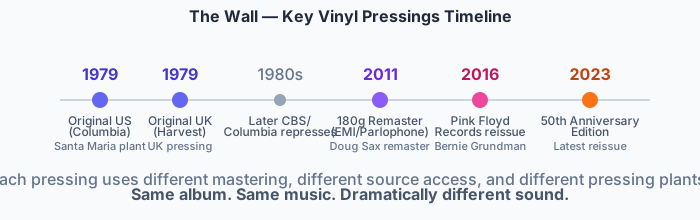
The Pressings
US Original — Columbia PC2 36183 (1979)
Mastering: Various (check dead wax for specifics) · Plant: Columbia Santa Maria, Terre Haute, Pitman · Market price: $20–$80 depending on condition and stamper
The US original is the most commonly encountered pressing and varies significantly depending on which plant produced it and which stamper generation was used. Santa Maria pressings (identifiable by "S" in the matrix) are generally considered the best US copies — they tend toward fuller bass and more open dynamics compared to Terre Haute or Pitman pressings.
Early stampers sound noticeably better than later ones. The album sold millions of copies in the US, meaning later pressings were produced from worn stampers with higher noise floors and reduced high-frequency detail. A first-pressing Santa Maria copy with low stamper numbers is genuinely excellent — dynamic, punchy, and musical. A later repress from worn tooling sounds flat and congested by comparison.
Sonic character: Dynamic, punchy, slightly forward midrange. Bass is present but not as extended as the UK pressing. Treble can be slightly bright on some copies. Surface noise varies enormously by pressing generation.
What to look for in the dead wax: "PC2 36183" matrix with "S" plant identifier (Santa Maria). Lower stamper numbers (1A/1B/1C/1D across four sides) indicate earlier, superior pressings.
UK Original — Harvest SHDW 411 (1979)
Mastering: Various (UK mastering) · Plant: EMI pressing · Market price: $40–$150 depending on condition
The UK original is widely considered the best-sounding vintage pressing of The Wall. British pressing plants in 1979 generally maintained higher quality-control standards than their US counterparts, and the UK mastering tends toward greater bass extension, wider dynamics, and a more natural tonal balance.
The difference is most audible in the bass response — the UK pressing delivers genuine low-frequency weight that the US pressing doesn't fully achieve — and in the noise floor, which is consistently lower on well-preserved UK copies. The orchestral passages on "Comfortably Numb" and "The Trial" reveal greater depth and separation on the UK mastering.
Sonic character: Fuller bass extension, wider dynamics, lower noise floor, more natural tonal balance. The most "complete" sounding vintage pressing. Slightly warmer than the US original without sacrificing detail.
What to look for in the dead wax: Harvest SHDW 411 with EMI pressing marks. A1/B1/C1/D1 matrix designations indicate first stampers. Condition is critical — a noisy UK pressing loses its advantage over a clean US copy.
2011 180g Remaster — EMI/Parlophone
Mastering: Doug Sax / The Mastering Lab · Plant: Optimal Media (Germany) · Market price: $40–$70
This is our pick for the best modern reissue. Doug Sax — founder of The Mastering Lab and one of the most respected mastering engineers in vinyl history — handled this remaster with evident care. The dynamics are fully preserved (no loudness-war compression). The noise floor is extremely low. Bass is extended and controlled. The spatial presentation reveals production detail that earlier pressings obscure.
The 180g weight is not the reason it sounds good — the mastering is. Sax understood vinyl's requirements and made decisions that serve the format rather than fighting it. Inner-groove performance is notably better than the originals, suggesting careful attention to groove spacing and level management toward side endings.
Sonic character: Open, dynamic, extended bass, very quiet vinyl. The most detailed and transparent pressing available. Slightly less "warm" than the UK original but more revealing.
Collector note: This pressing is becoming harder to find as it goes out of print. If you see a clean copy at a reasonable price, purchase it.
2016 Pink Floyd Records Reissue
Mastering: Bernie Grundman · Plant: Optimal Media (Germany) · Market price: $35–$55
Bernie Grundman is a legendary engineer, and his involvement ensures competent mastering. The pressing is quiet, flat, and well-manufactured. However, this version trades some dynamic range for a smoother, more polished presentation. The loudest passages don't hit with the same force as the 2011 Sax remaster or the UK original. The quietest passages are rendered beautifully — perhaps the quietest vinyl of any Wall pressing — but the macro-dynamics that give the album its emotional architecture are slightly compressed.
This is not a bad pressing. It is a good pressing that prioritizes smoothness and low noise over raw dynamic impact. For listeners who value quiet backgrounds and fatigue-free extended listening, it may be preferable. For listeners who want The Wall to hit like it did in 1979, the 2011 or a good original is superior.
Sonic character: Smooth, quiet, polished. Excellent detail retrieval. Slightly reduced macro-dynamics compared to the best alternatives. Bass is controlled but less visceral than the UK original.
1980s CBS Represses — Avoid
As The Wall continued selling through the 1980s, CBS pressed millions of additional copies from increasingly worn stampers at multiple plants. These later pressings are identifiable by higher stamper numbers, thinner vinyl stock, and (often) visibly lower-quality jacket printing.
Sonically, they are markedly inferior: higher noise floors, reduced dynamics, congested mixes, and audible inner-groove distortion on side endings. The bass loses definition. The spatial information collapses. These copies are not worth purchasing unless they cost less than $5 and you need a beater copy for casual listening.
How to identify: Later stamper numbers (3F, 4G, etc.), lighter vinyl weight, "CBS" rather than "Columbia" label design on some copies. If the vinyl looks thin and the jacket feels cheap, it's probably a later repress.
The Methodology: How We Evaluated
Our evaluation follows the same framework used in our Best Vinyl Pressing guide:
- Identify the mastering — Who cut the lacquer? What source did they use? (Mastering engineer guide)
- Check the dead wax — Matrix numbers and initials reveal pressing generation and plant
- Evaluate dynamics — Does the pressing preserve the full dynamic range of the master, or has it been compressed?
- Listen for pressing defects — Surface noise, inner-groove distortion, warps, off-center holes
- Compare against the source — Does the vinyl add anything the digital source doesn't have? Does it lose anything?
Our Recommendation by Budget
- Under $30: Hunt for a clean US original (Columbia PC2 36183) with early stamper numbers and a Santa Maria pressing. These exist in used bins and online for reasonable prices if you're patient.
- $40–$70: The 2011 Doug Sax 180g remaster is the sweet spot. Best available modern pressing with reference-quality mastering and quiet vinyl.
- $60–$150: A clean UK original (Harvest SHDW 411) with early stampers. The best-sounding vintage pressing, but condition is everything — a noisy copy is worse than a clean reissue.
- Any budget: Avoid 1980s CBS represses regardless of price. Life is too short for bad vinyl.
Does the Original Pressing Always Win?
No. And The Wall is a perfect case study in why.
A clean, early-stamper UK original is likely the best-sounding version of this album available on vinyl. But that specific pressing — first stamper, clean condition, properly stored for 45+ years — is increasingly rare and expensive.
A typical US original from a later stamper, with surface wear and a few scuffs, will be outperformed by the 2011 Doug Sax remaster in virtually every sonic dimension. The remaster has lower noise, better dynamics, superior bass extension, and none of the groove-wear artifacts that accumulate over four decades of play.
The original pressing myth — the idea that "first pressing" automatically means "best sounding" — collapses when you factor in condition, stamper generation, and the quality of modern mastering from engineers like Doug Sax and Bernie Grundman working with access to the original tapes.
Buy the best-sounding copy, not the oldest copy.
Conclusion
The Wall deserves a pressing that does justice to its ambition. Bob Ezrin's production is extraordinarily detailed — orchestral textures, spatial effects, dramatic dynamic contrasts, intimate vocals alongside explosive full-band passages. A great pressing reveals all of it. A mediocre pressing flattens it into background noise.
For most listeners in 2026, the 2011 Doug Sax remaster represents the ideal combination of sonic quality, availability, and price. It sounds reference-quality without requiring a $150 investment in a pristine UK original that may or may not arrive in the condition described.
If you already own a clean UK original with early stampers, congratulations — you own what is likely the best-sounding version of this album on vinyl. Treasure it.
If you own a 1980s CBS repress and wonder why The Wall sounds flat and lifeless on your system — now you know why. The album is not the problem. The pressing is.
The right pressing transforms The Wall from a good album into a physical experience. Find it.
Keep Reading
Best Pink Floyd Meddle Vinyl Pressing: UK Original vs. MoFi vs. 2016
Which Meddle pressing sounds best? We compare the UK Harvest original, Japanese EMI, Mobile Fidelity half-speed, and the excellent 2016 remaster — with firsthand listening notes.
Best Rush Permanent Waves Vinyl Pressing: Which Version Sounds Best?
Over 200 versions on Discogs. The MASTERDISK HW inscription is the collector's signal — but can a modern Sean Magee remaster actually improve upon it? We compare originals, MoFi, and Abbey Road cuts.
Best Supertramp Breakfast in America Vinyl Pressing: Original vs. MoFi vs. 2026 Half-Speed
Did the 2026 Abbey Road half-speed master finally produce the definitive affordable version? We compare four mastering lineages spanning 47 years.
Best Supertramp Crime of the Century Vinyl Pressing: Which Version Sounds Best?
One of the finest analog demonstration records ever made — but which pressing delivers? We compare the producer-endorsed UK original, Speakers Corner, MoFi UHQR, and the new Abbey Road half-speed master.