
The Interesting History of April Wine
A Canadian hard rock institution that delivered anthems, arena-filling riffs, and one of the most electrifying live recordings of the early 1980s.
A Band Built for the Road
April Wine formed in Halifax, Nova Scotia in 1969 — a time when Canadian rock bands faced the unenviable task of competing for attention in a market dominated by British and American acts. Under the leadership of guitarist and vocalist Myles Goodwyn, the band spent the better part of a decade grinding through lineup changes and stylistic shifts, evolving from blues-tinged folk rock into a hard-driving arena act. Their early albums — April Wine (1971), Electric Jewels (1973), and Stand Back (1975) — showed promise but struggled to break beyond the Canadian border.
The turning point came in the late 1970s. The Whole World's Goin' Crazy (1976) and First Glance (1978) found the band tightening their sound, writing sharper hooks, and embracing the hard rock energy that would define their peak years. By the time they entered the studio for their next two releases, April Wine had transformed into one of the tightest live acts in North America.
Harder...Faster (1979)
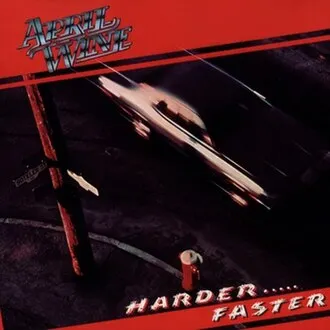
Harder...Faster (1979)
📌 Pinned to the corkboard
Harder...Faster was the album where everything clicked. The production was lean and punchy, the songwriting razor-sharp, and the performances delivered with a confidence that came from years of relentless touring. Our favorite track is a toss-up — and it changes with mood. "Before The Dawn," with Brian Greenway stepping to the microphone in a rare show of democracy from the Goodwyn-led lineup, delivers an emotional vocal performance that predates the power ballad era by several years. It is tender without being saccharine, melodic without losing its edge — a pre-power-ballad ballad, if you will.
But then there is "I Like to Rock" — and what elevates it above the rest of the lot is a stroke of compositional brilliance. Listen closely to the instrumental section and you will hear the bass line weaving together the riffs from the Beatles' "Day Tripper" and the Rolling Stones' "(I Can't Get No) Satisfaction" — two of the most iconic guitar hooks in rock history, seamlessly interpolated into a single groove. The blend works remarkably well, the bass tying the two together into something that feels both familiar and entirely new. It is a knowing wink to rock's lineage while asserting April Wine's own place within it. The track became a Canadian rock anthem and remains the song most associated with the band.
The album went platinum in Canada and cracked the US market in a way that previous releases had not. It established April Wine as a legitimate international hard rock act, not merely a regional success story. We should also acknowledge the inclusion of a King Crimson cover — "21st Century Schizoid Man" — which remains an odd choice for a straightforward hard rock album. It functions primarily as an exercise in musician chops, and frankly feels out of place alongside the hooky anthems surrounding it. That said, it has grown on us over time — a reminder that April Wine were more than capable of stretching beyond their comfort zone, even if the fit was never quite natural.
Nature Of The Beast (1981)
Nature Of The Beast (1981)
🎸 The one that broke through
If Harder...Faster opened the door, Nature Of The Beast kicked it off its hinges. The album produced April Wine's biggest international hit — "Just Between You and Me," a power ballad that reached the US top 20 and proved the band could deliver tenderness alongside thunder. But the album's real strength lies in its harder material: "Sign of the Gypsy Queen" (a cover of the Lorence Hud track) became a live staple, and the overall production captured a band at peak confidence. Nature Of The Beast went platinum in the United States and cemented April Wine's place in the canon of early-1980s hard rock alongside Loverboy, Triumph, and Rush.
King Biscuit Flower Hour — Live From Kansas (1982)
Our first real introduction to April Wine came not from the studio albums but from the Monsters of Rock Castle Donington 1980 festival recording in the archive — specifically, the live rendition of "I Like to Rock." That single performance told us everything we needed to know: simple, immediate-impact, bouncy rhythm songs that were unfailingly catchy with decent vocals. From there, we explored the back catalog in earnest.
It was around that same time that we saw them perform the King Biscuit Flower Hour set on a broadcast TV music show back in the day — one of those fleeting pre-MTV experiments that gave rock fans a window into live performance before music video dominated the landscape. The energy of that broadcast stuck with us.
The King Biscuit recording itself was captured on September 13, 1982, at the Kansas Coliseum in Wichita, Kansas, for broadcast on the legendary King Biscuit Flower Hour — a syndicated live radio program that aired on over 300 US stations from 1973 to 1993. The show documented rock acts at their touring peak, and April Wine's Wichita set is a masterclass in arena-hard-rock execution.
The setlist drew heavily from Harder...Faster and Nature Of The Beast, delivering the hits with a ferocity that studio recordings could only suggest. The energy of the crowd, the interplay between guitarists Myles Goodwyn and Brian Greenway, and the propulsive rhythm section of bassist Steve Lang and drummer Jerry Mercer created a document of a band operating at full velocity. A bonus track from a 1985 King Biscuit session was later appended to the release, offering a glimpse of the slightly more polished — but no less powerful — late-period lineup.
The recording was eventually released commercially in 1999 under both the King Biscuit Flower Hour and Greatest Hits Live titles. For those who missed April Wine in their arena-filling prime, this recording is the closest approximation to standing in that Kansas crowd — and it remains one of the finest live documents in Canadian rock history.
Legacy
April Wine continued recording through the mid-1980s with Power Play (1982), Animal Grace (1984), and Walking Through Fire (1985) before disbanding. They reunited in 1992 and continued in various forms for decades, with Myles Goodwyn remaining the sole constant until his retirement from touring in March 2023. Goodwyn passed away on December 3, 2023, at age 75 — R.I.P. His songwriting, voice, and vision guided April Wine for over 50 years. Their catalog spans more than 20 studio albums, but it is the 1979–1982 window — three albums and one incandescent live recording — that defines their highest achievement.
Keep Reading
The Progressive Rock Family Tree: How Yes, King Crimson, Genesis and the Entire Prog Genome Connect
A personnel-based map of progressive rock, from Yes, King Crimson, Genesis and ELP through Canterbury, U.K., Asia, neo-prog, Porcupine Tree, Dream Theater and the modern progressive ecosystem.
Why UFO's Strangers In The Night Edges Out Thin Lizzy's Live And Dangerous
Both are canonical live hard rock recordings. Both capture bands at their absolute peak. But only one is an honest document of what actually happened on stage.
A Beginner's Guide to NWOBHM
The New Wave of British Heavy Metal launched Iron Maiden, Def Leppard, and Saxon — and planted the seeds for thrash, power, and progressive metal. Here's where to start.
Ned Doheny: The Missing Link in the California Sound
How one of Los Angeles' most sophisticated songwriters helped define West Coast soul — and somehow remained outside the spotlight.