
Remix, Remaster, Recut, Repress: What Actually Changed on Your Record?
A new purchase date is not evidence of a new sonic intervention. Five familiar record-shop terms describe very different activities — and very different prospects for improvement.
I. The sticker has entered the witness box
The modern record buyer is offered an impressive vocabulary of renewal. Albums return remastered, reissued, recut, restored, expanded and, occasionally, apparently sanctified. The sleeve looks familiar; the price has acquired postgraduate qualifications. Somewhere between shrink wrap and checkout, the reasonable question disappears: what, precisely, has changed?
Our 2015 reissue of Uriah Heep’s Abominog, BMGRM094LP, provides an instructive embarrassment. We hoped for more low-frequency substance than our 1982 original supplied. We received exceptionally quiet surfaces and a tonal presentation difficult to distinguish from the earlier copy. The background improved; the anticipated bass rehabilitation did not announce itself.[1]
That distinction is the entrance examination for vinyl forensics. A release can improve as a manufactured object without substantially changing the musical balance. Equally, a remaster can preserve that balance deliberately. Similar sound does not prove identical mastering, any more than a fresh copyright line proves someone located a better tape.
The useful vocabulary describes interventions. It does not award medals.
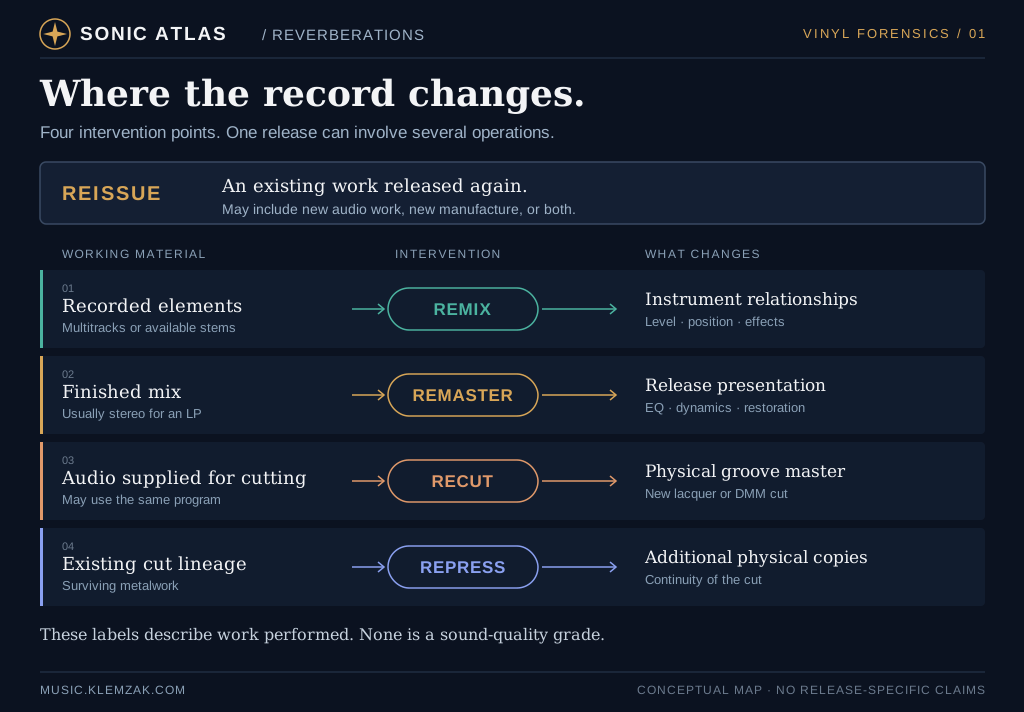
Figure 1. Locate the intervention before predicting the improvement. This is a conceptual production map, not the documented history of a particular pressing.
II. Reissue and repress: commerce meets manufacture
A reissue is an existing work released again. It may introduce different packaging, a different label, another format or an elaborate anniversary justification. The word alone identifies no particular audio treatment. A reissue can contain a remix, a remaster, an unchanged digital master or a cut derived from surviving metalwork. Its essential announcement is availability.[2]
A repress, used precisely, concerns manufacture. Discogs requires its Repress designation to originate from the original master disc. For vinyl, the relevant continuity runs through metal parts descended from an existing cut. More copies are pressed; the cutting engineer need not revisit the source.[2]
This does not require the very same individual stamper to survive indefinitely. Nor does shared ancestry make every copy equally quiet, flat, centered or unworn. The distinction is between retaining the cut’s lineage and creating a new cut, not between possessing and lacking a mystical first-generation blessing.
Retail language is less disciplined. “Repress” sometimes means little more than “back in stock.” Treat that usage as a shipping announcement until the manufacturing history supports something stronger. A warehouse has many virtues; expertise in discography is not compulsory among them.
The terms also refuse to form a quality ladder. A carefully manufactured repress of an excellent cut may be preferable to an ambitious new edition. Renewed availability can be sufficient reason to buy, especially when the alternative is a damaged copy at a collector’s price.
III. Recut: a new groove is a consequential event
A recut creates another physical groove master: a lacquer, or a copper surface in Direct Metal Mastering. DMM’s metal refers to the cutting surface; the term does not, by itself, establish whether the audio source was analog or digital.[3]
The source may remain unchanged while the physical translation differs. Cutting level, groove spacing, side duration and treatment of difficult frequencies affect the task. A fresh cut may solve a practical problem, introduce another, or reproduce the previous approach closely. Its existence establishes work, not progress.[4]
This is also where vocabulary becomes slippery. “Vinyl mastering” can mean preparing the audio, cutting the disc, or a session combining those activities. Precision Record Pressing explicitly warns clients to clarify which service they are buying.[4] Consequently, a cutting signature identifies a relevant participant without automatically identifying every preceding mastering decision.
Runouts deserve scrutiny on both sides. A changed matrix suffix can suggest a different cut, but its meaning depends on the label’s or facility’s numbering system. Additional plating or plant marks need not indicate fresh audio preparation. Decode the system before promoting an unfamiliar digit into a revelation.
A later recut can therefore retain the same processed audio while changing its delivery to the groove. Alternatively, a new cutting session can accompany extensive remastering. The listener needs both parts of that history. Asking only whether the lacquer is new leaves the more consequential question of what fed the lathe unanswered.
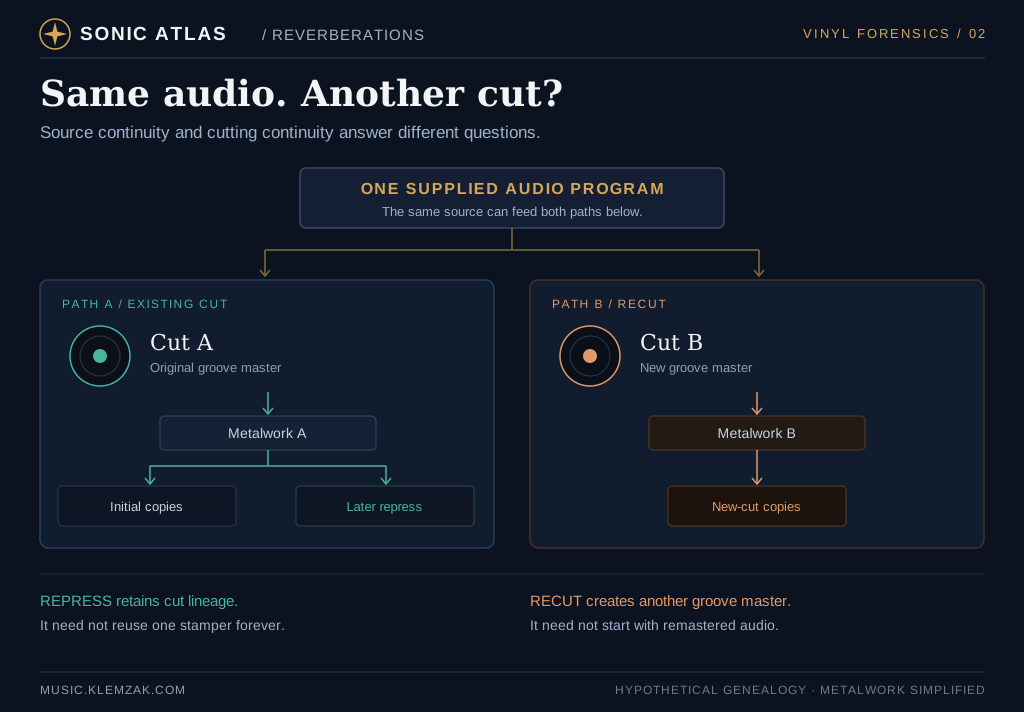
Figure 2. Audio-source continuity and physical-cut continuity answer different questions. The branches are hypothetical; no real matrix numbers or stamper histories are asserted.
IV. Remaster: reconsidering the finished argument
A remaster revisits mastering. In conventional stereo work, the engineer starts with an existing finished mix and prepares another release master, potentially reconsidering source selection, transfer, equalization, dynamics, restoration and sequencing. Abbey Road describes remastering as mastering undertaken again, while emphasizing that it need not imply a defective original.[5]
The limitation is access. With a stereo mix, the instruments already coexist in two channels. Boosting a frequency region may reveal a bass guitar more clearly, but it also affects other information occupying that region. There is no ordinary mastering fader marked “John’s bass, exclusively.”
Stem mastering provides more selective access through supplied groups, such as vocals and instruments. Abbey Road distinguishes this from conventional processing of the complete stereo mix.[6] Source-separation software offers another possibility, but estimated components should not be confused with the original recording tracks.[9] The resources available matter more than the department name.
A remaster can be transformative, restrained or worse. It can recover value from a superior source without announcing itself through theatrical brightness. Conversely, louder presentation can masquerade as newly excavated detail. “Remastered” describes an opportunity for judgment; it supplies none of the judgment itself.
The decisive source question is often whether an earlier, less processed version remains available. Returning to a mix before heavy release limiting may permit a different result. Starting with the already limited release master presents a different task. Both projects might be marketed as remasters, although their room for improvement is conspicuously unequal.
V. Remix: reopening the arrangement’s internal negotiations
A remix returns to separate recorded elements, ideally the original multitracks, and constructs another mix. Relative instrument levels, panning, effects and processing can be reconsidered before the result reaches mastering. In this context, remix does not necessarily mean a dance adaptation; the performances may remain the same while their relationships change.[7]
That access can address a buried vocal or an overpowering instrument more directly. It also permits historical revision. Familiar reverberation, placement and balance contribute to an album’s identity. Greater separation may please us while changing the original’s emotional proportions. Clarity is an achievement; fidelity to an earlier aesthetic is another question.
Steven Wilson’s Three Piece Suite makes the archival limitation concrete. He explains that surviving multitracks from Gentle Giant’s first three albums covered only around half their material; the remaining tracks were missing, presumed lost.[8] The stereo album’s survival did not mean every song remained available for conventional reconstruction.
A remix subsequently requires mastering and, for a newly cut vinyl edition, physical translation into grooves. These terms therefore overlap. They describe activities along a production history, not mutually exclusive species displayed in a collector’s cabinet.
Nor should remixing be confused with recording the music again. Replacing a vocal performance or adding a newly played instrument changes the underlying recorded material. A purchaser seeking the familiar performance deserves to know when an archival project crosses that boundary.
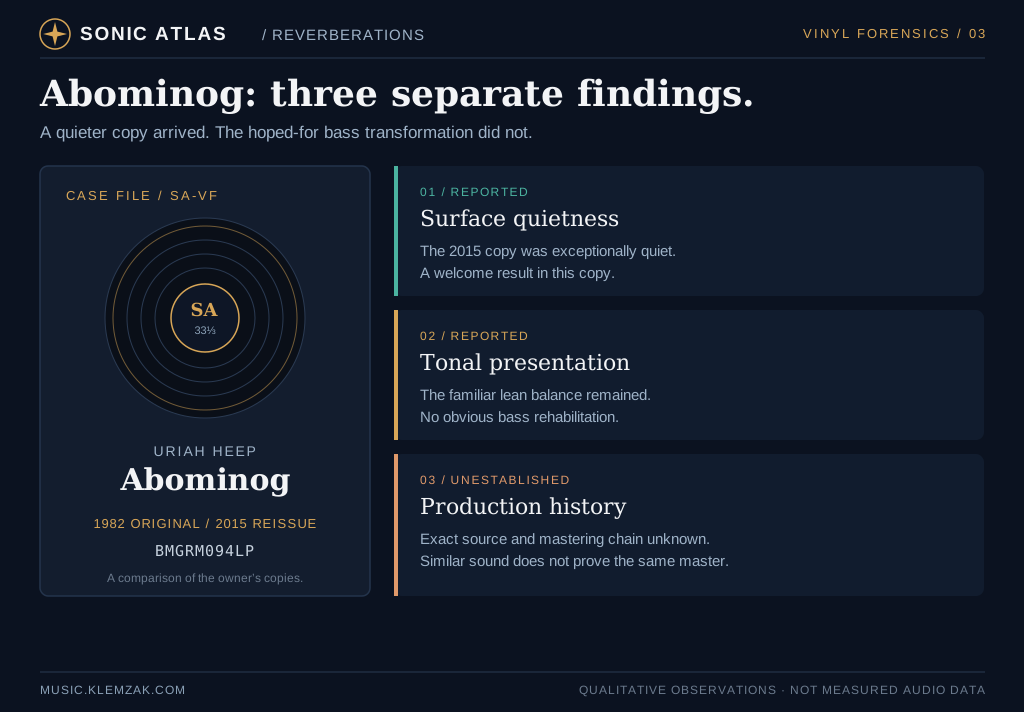
Figure 3. Three separate findings from the published Abominog comparison. These are qualitative listening observations and an evidence limit, not frequency-response or dynamic-range measurements.
VI. The mastering engineer is not a necromancer
Suppose a record sounds congested, aggressive and dynamically exhausted. The temptation is to locate the final engineering credit and prosecute its owner. The inference is satisfying, economical and frequently premature.
Compression and clipping can enter before mastering, including during recording and mixing. Processing may affect individual instruments, grouped tracks or the complete mix. Further mastering can intensify those choices, but a finished release does not disclose their chronology merely by sounding unpleasant.[7] Responsibility requires evidence about the material delivered, the work performed and the version approved.
Mastering retains real agency: an engineer can improve balance, introduce damage, request another mix or make compromises. Limited control is not immunity. Equally, having the last professional name in the credits is not proof of sole authorship of every audible problem.
Once distortion or severe limiting is embedded in the available source, a different pressing cannot simply restore the missing history. Repair tools may improve particular artifacts; iZotope describes de-clipping as attempting to reconstruct the signal.[9] An estimate is useful work, but it is not recovered session evidence.
Ask which stage a proposed replacement actually revisits. Quieter vinyl may address a noisy copy. A different mastering may change tonal balance. Access to earlier elements may permit a different mix. No sticker promises that all three remedies have been administered.
VII. Evidence before adjectives
Begin with identity: catalog number, territory, edition-specific credits and complete runout inscriptions from both sides. Compare those against reliable release documentation. Original sleeve credits are historical information; a reissue may reproduce them without identifying the people responsible for its current cut. Names require context.
Then separate established facts, listening observations and hypotheses. An engineer’s account can document a source. Runouts can help establish cutting lineage. A controlled comparison can support a preference. None automatically performs the others’ job. In particular, initials in the dead wax cannot certify the absence of a digital step.
Uncertainty belongs in the description itself. If the source is undocumented, say so. If only one side carries an identifiable signature, report that limitation. The reader learns more from a carefully bounded statement than from an authoritative paragraph assembled out of mutually reinforcing guesses.
For listening, use comparable passages, keep the playback chain stable and match playback levels as closely as practical. If making digitized comparisons, document the capture chain and level adjustment. Repeated judgments carry more weight than an ecstatic first chorus. These are proposed controls, not procedures retroactively claimed for our Abominog comparison.
Write specific observations: less intrusive surface noise; clearer bass pitch; a vocal less abrasive at comparable loudness. Keep the causal conclusion proportionate. “I prefer this copy” can be entirely defensible while “the original tape was finally used” remains unsupported.
Buying another edition becomes rational when the documented intervention plausibly addresses the dissatisfaction. Otherwise, we are purchasing an experiment. That is permissible; collecting need not become accountancy. It should, however, retain enough intellectual self-respect to distinguish a hypothesis from a receipt.
A new purchase date is not evidence of a new sonic intervention. The record deserves an examination before the adjective receives tenure.

Figure 4. Match each claim to evidence capable of supporting it. A listening preference and a documented production history are complementary findings.
Sources and editorial notes
- Sonic Atlas, “Uriah Heep’s Abominog on Vinyl: A Quieter Background, the Same Lean Argument”, October 8, 2026. The owner’s published comparison supplies the listening observations. The exact source and mastering chain remain unestablished; no new listening session, blind test, level matching or measurement is claimed here. ↩
- Discogs, Database Guidelines 6: Format, §6.17, “Reissue And Repress”. Discogs’ precise cataloging definition is distinguished from looser retail usage. ↩
- Precision Record Pressing, “Guide: Direct Metal Mastering (DMM)”, April 15, 2020. Used for the distinction between lacquer and copper cutting surfaces, not to endorse a universal sonic ranking of the methods. ↩
- Precision Record Pressing, “Guide: How To Prepare Your Audio For Vinyl”, August 31, 2022. Covers cutting constraints and the ambiguity of the phrase “vinyl mastering.” ↩
- Abbey Road, “What’s the Difference Between Mastering and Remastering?”, August 14, 2022. Used for the purpose of remastering and the point that a remaster does not imply an inferior original. ↩
- Abbey Road, “Stem Mastering”. Explicitly distinguishes traditional stereo-mix processing from the additional access supplied by stems. ↩
- iZotope, “What is the difference between mixing and mastering?” and “Clipping in mixing explained, and how to use it.” These explain separate-track versus finished-mix processing and establish that clipping is not confined to mastering. The article makes no attribution of fault to a named engineer or release. ↩
- Steven Wilson, “Three Piece Suite”, official project account; remix released September 29, 2017. Documents the incomplete survival of Gentle Giant multitracks. ↩
- iZotope, “What are audio artifacts? Types, causes, and removal techniques”, particularly “RX De-clip” and the discussion of stereo-mastering repair limits. ↩
All external references checked October 14, 2026. The illustrations are original explanatory diagrams, not measurements, reproductions of session documentation, or claims about unidentified cuts.
Related reading
Keep Reading
Why Do Different Vinyl Pressings Sound Different? Mastering, Matrix Numbers & Pressing Plants Explained
Two records can contain the same album and still sound conspicuously different. Learn why mastering, lacquer cutting, metalwork, and pressing plants all leave an audible fingerprint on vinyl.
How to Read the Dead Wax: The Secret History Written in Your Record's Runout
Every vinyl record carries a forensic document in its runout groove. Learn to decode mastering engineer initials, pressing plant codes, stamper generations, and matrix numbers.
Uriah Heep's Abominog on Vinyl: A Quieter Background, the Same Lean Argument
The 2015 180-gram Abominog reissue (BMGRM094LP) was bought to rescue a lean 1982 original's bottom end. It delivered exceptionally quiet surfaces and a nearly identical tonal balance instead — a case study in why pressing excellence and musical rehabilitation are separate findings.
Aja Breathes; Gaucho Merely Has Excellent Manners
Why Steely Dan's 1977 masterpiece Aja remains sonically preferable to its immaculately upholstered successor Gaucho. Gaucho is perfection completed; Aja is perfection kept alive.